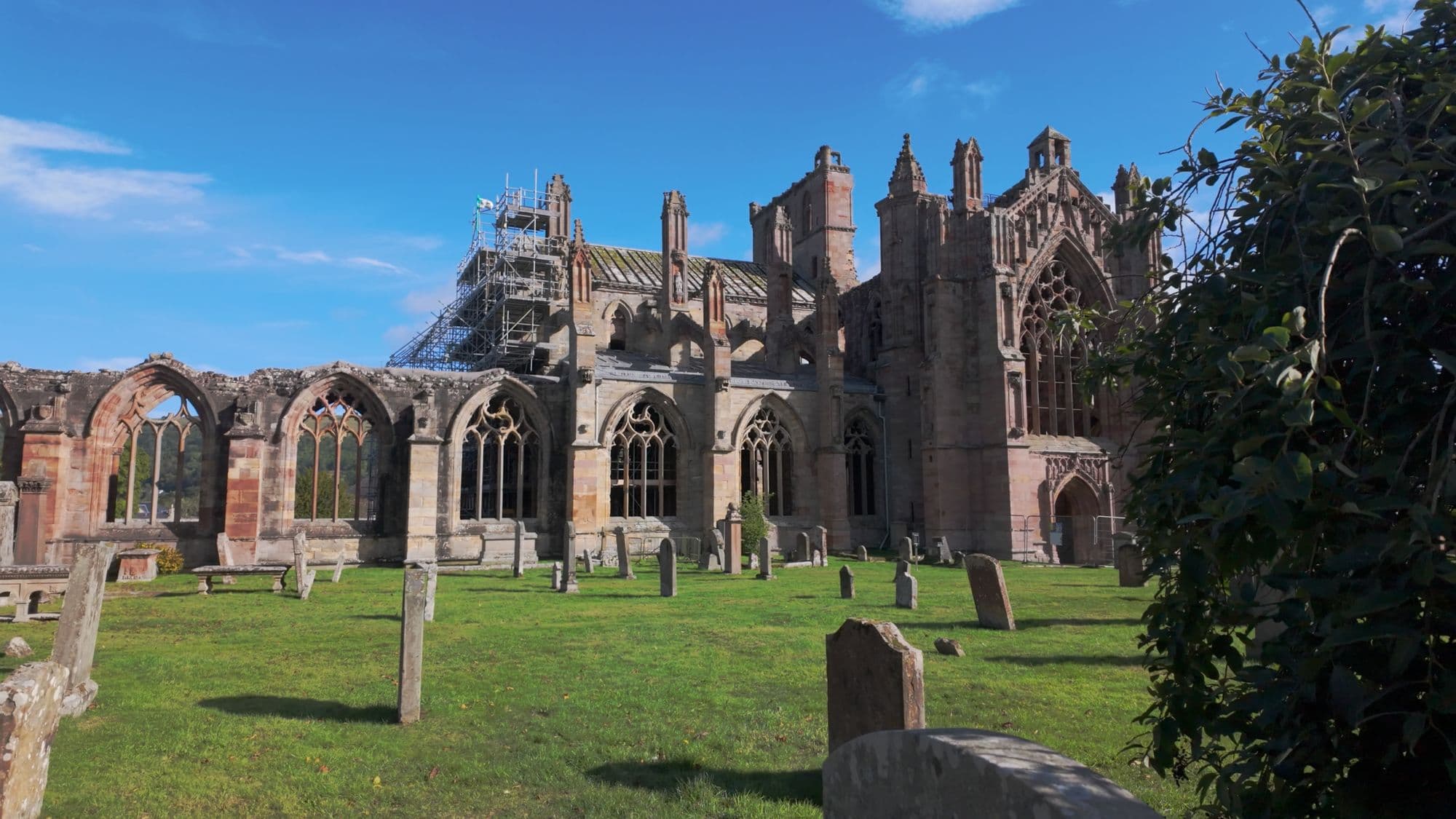
Melrose Abbey: The Long, Strange Trip of Robert the Bruce's Heart (and Dryburgh Next Door)
Melrose Before Melrose
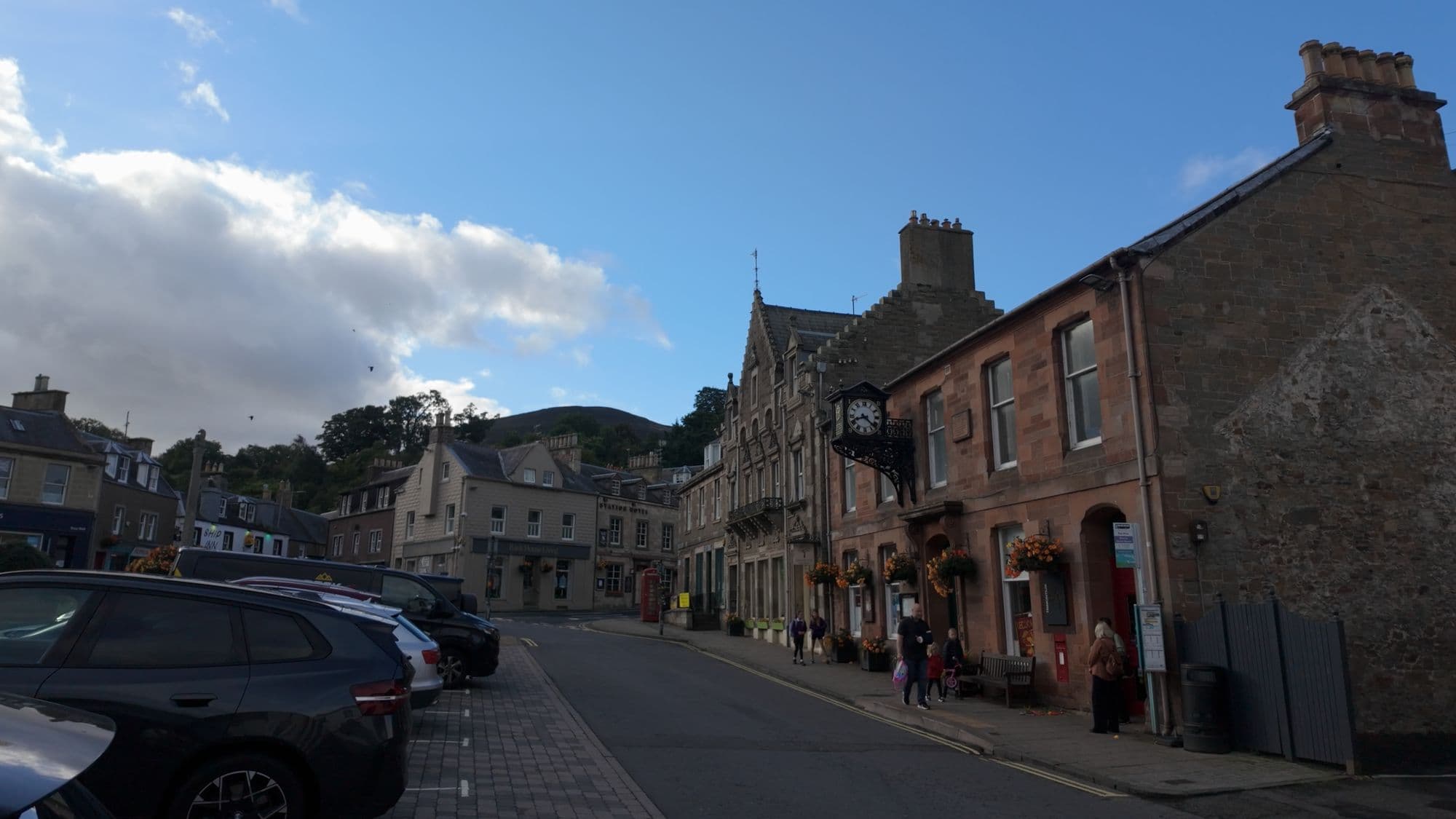
The abbey isn't the first holy site at Melrose. About two and a half miles east, on a loop of the Tweed, is Old Melrose, where monks from Lindisfarne founded a monastery in the 600s. Its most famous recruit was a shepherd boy named Cuthbert, who entered the community around 651 and became the most venerated saint in the north of England. Old Melrose was later destroyed, but the place kept its reputation, and that holy association is part of why the Cistercians were brought here centuries later.
Tap any photo to enlarge
Austere in Theory
The Cistercians began in 1098 at Cîteaux in Burgundy as a protest movement. Their founders thought the great Benedictine houses had gone soft, and they wanted to get back to hard manual work, plain food, silence and plain churches. Early Cistercian buildings were famously bare: no towers to speak of, no stained-glass pictures, no sculpture.Then they got rich, almost by accident. Cistercians chose remote land, worked it themselves with lay brothers, and turned out to be extremely good at sheep. Melrose built up a network of outlying farms called granges across the Borders and beyond, with huge flocks grazing the hills. Its wool went to the cloth towns of Flanders, where weavers in places like Bruges and Ghent bought every good fleece they could get. Melrose became one of the wealthiest religious houses in Scotland.The monks were also writing. The Chronicle of Melrose, kept by the community over generations, is one of the most important surviving sources for Scottish history in the 1100s and 1200s. A lot of what we know about that period, we know because somebody at Melrose wrote it down.The king Alexander II, who died in 1249, chose to be buried here, which says a lot about the abbey's standing by then.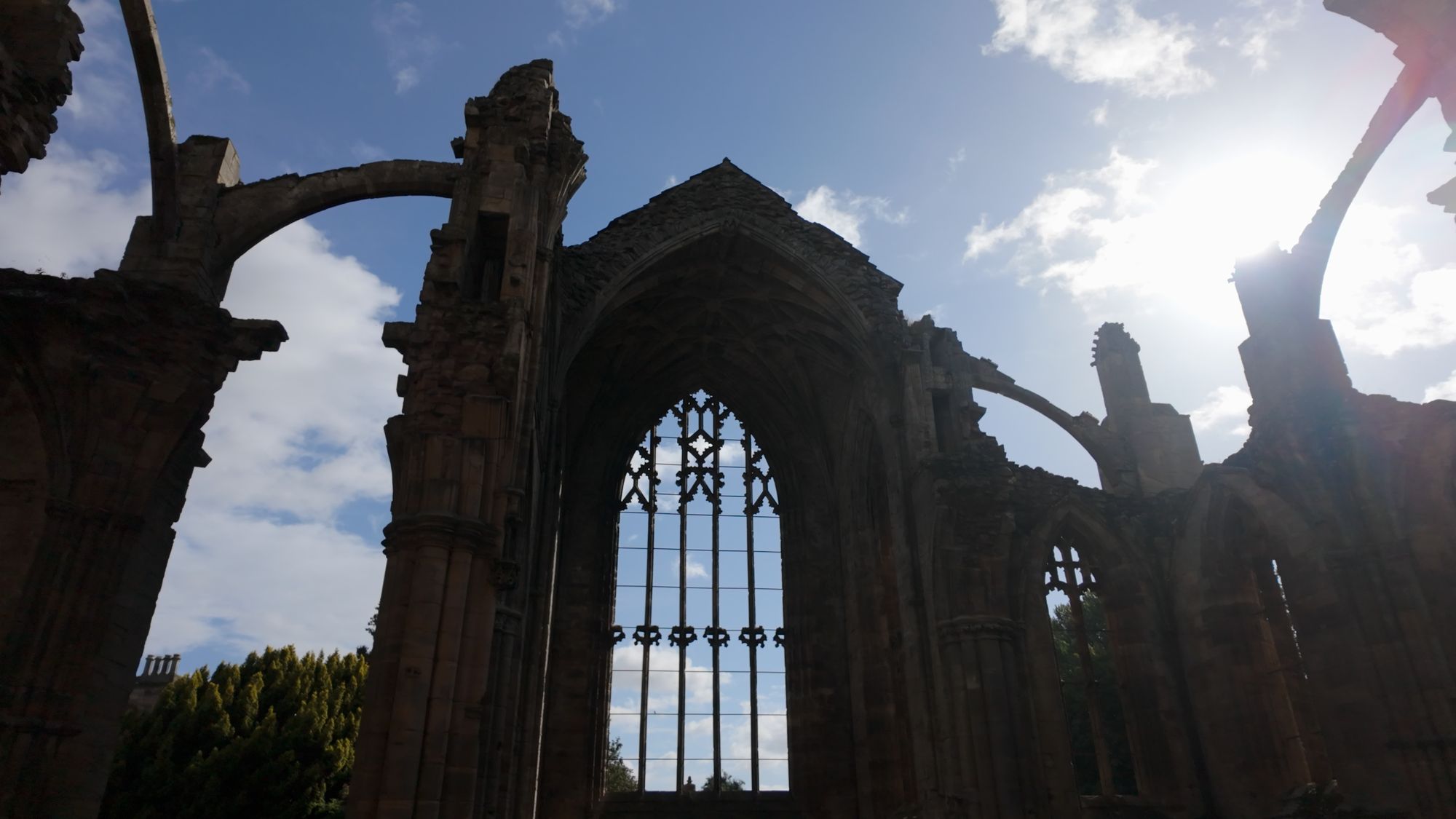
Burned and Rebuilt
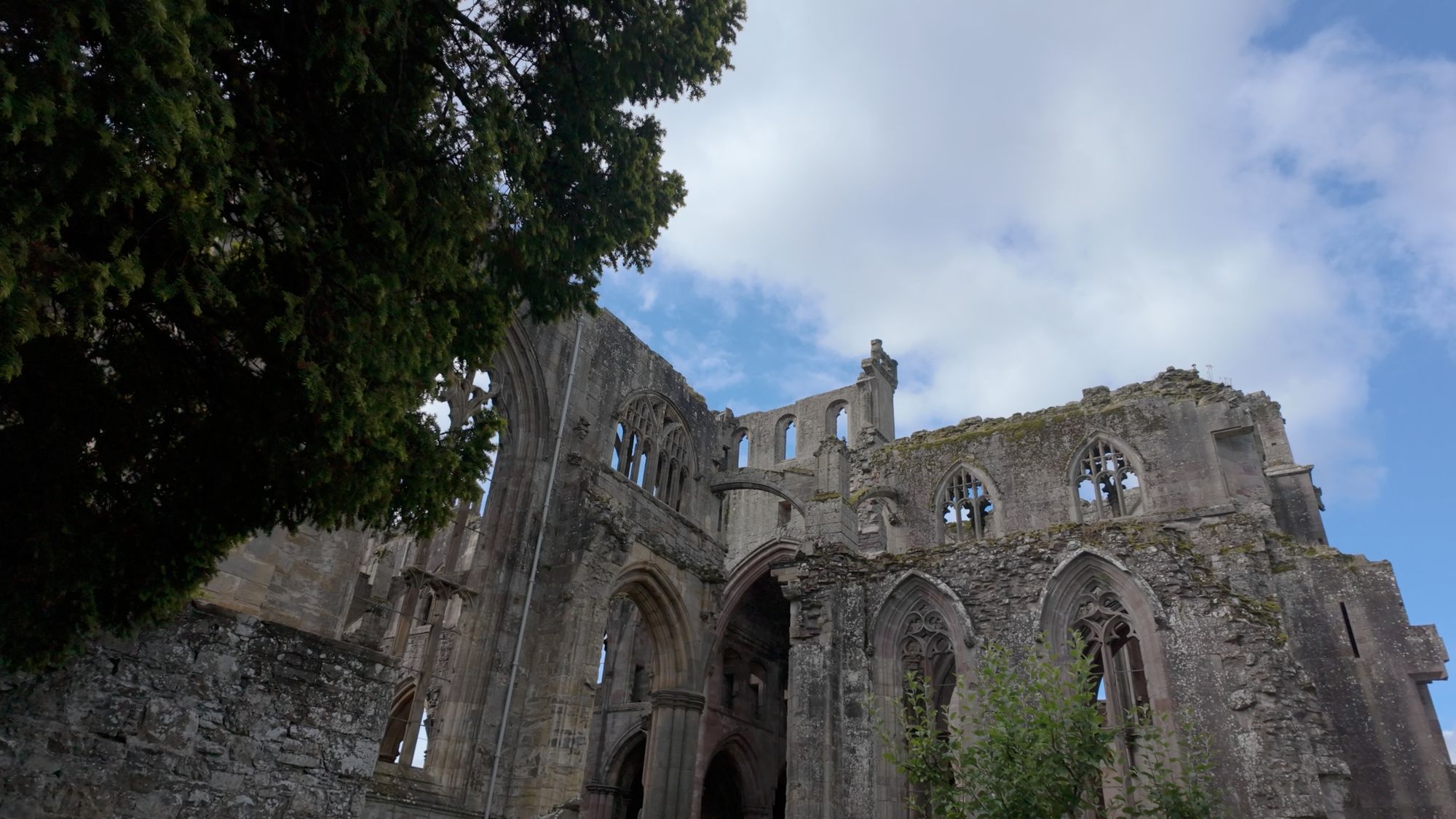
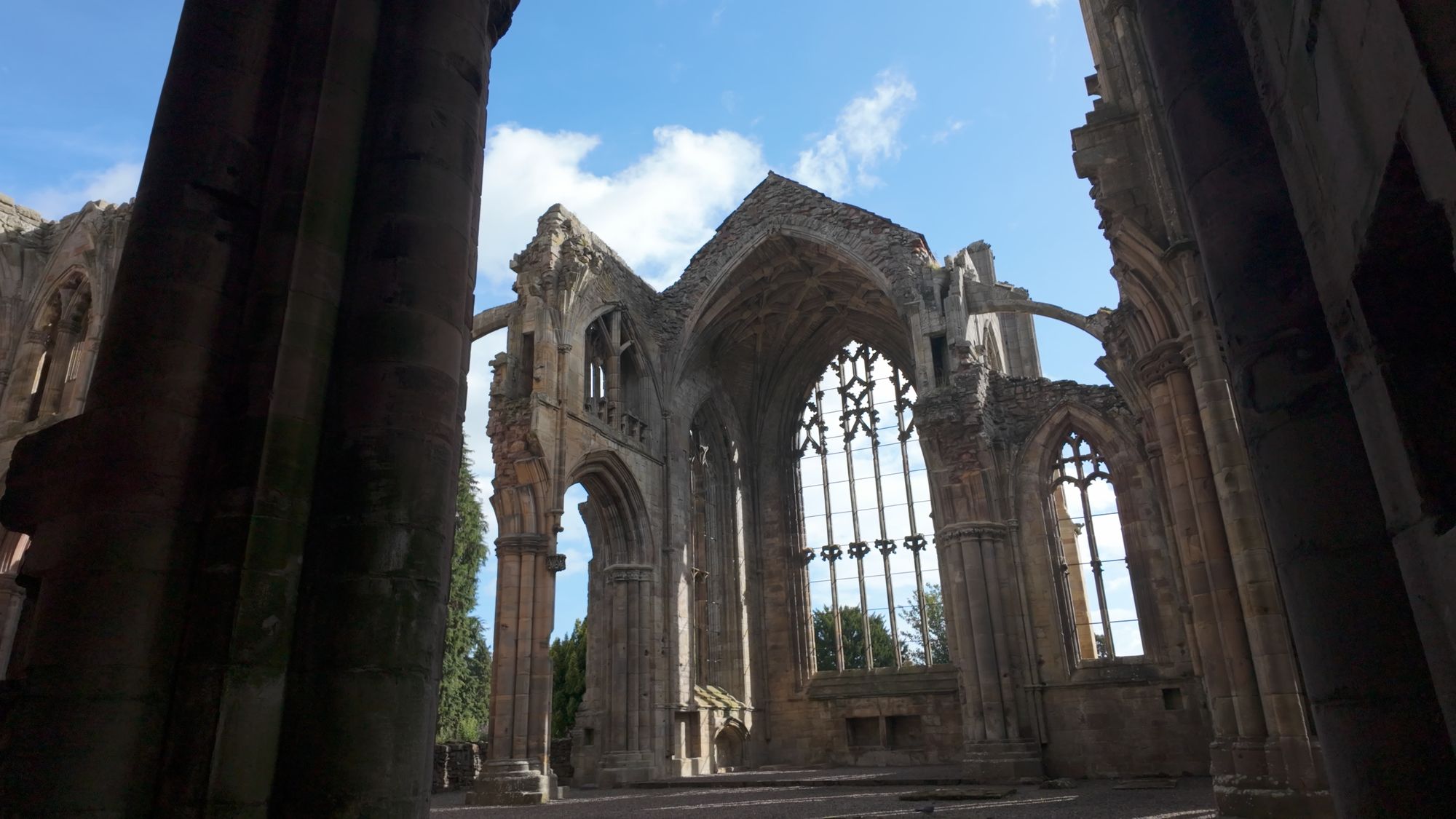
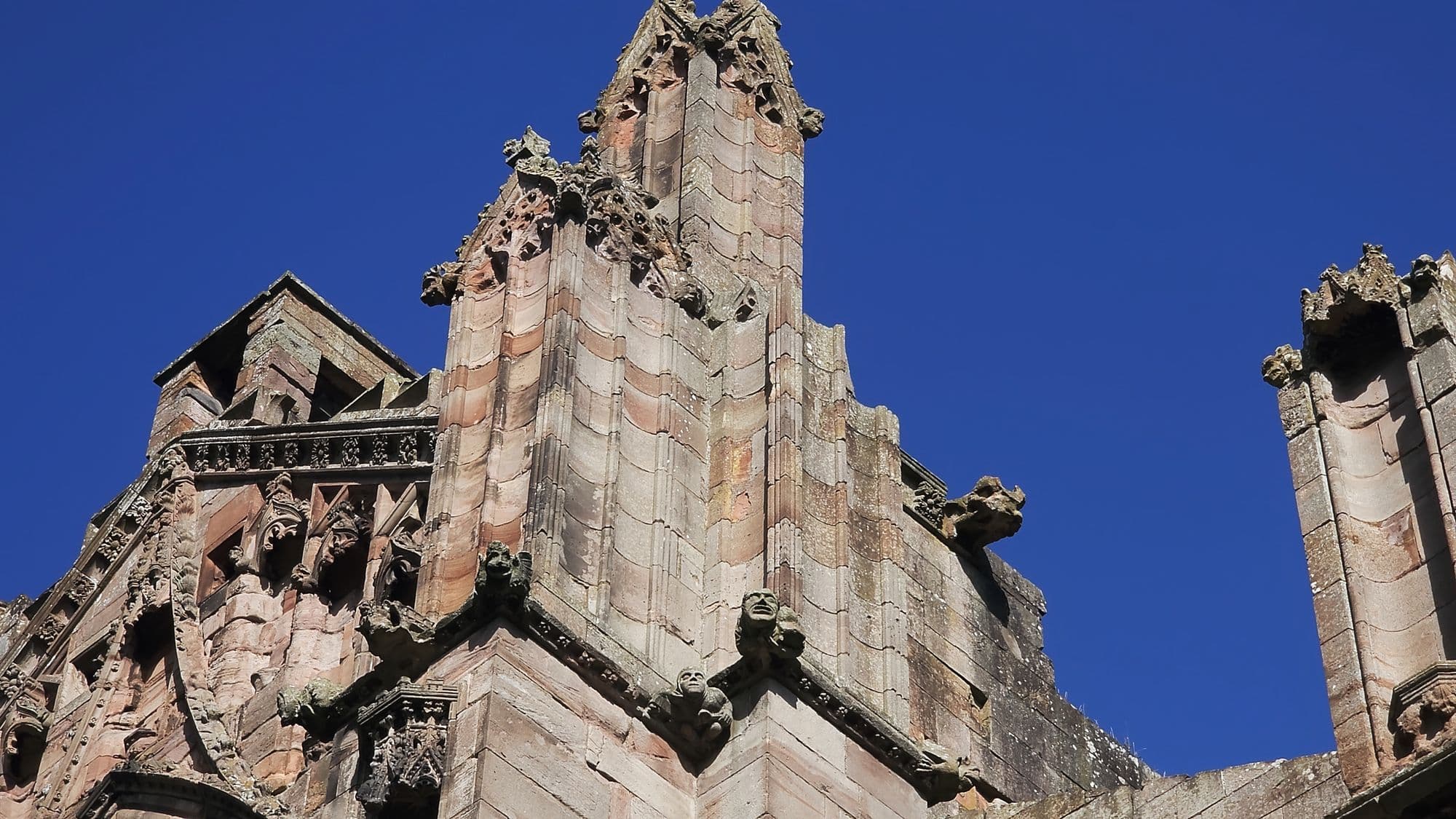
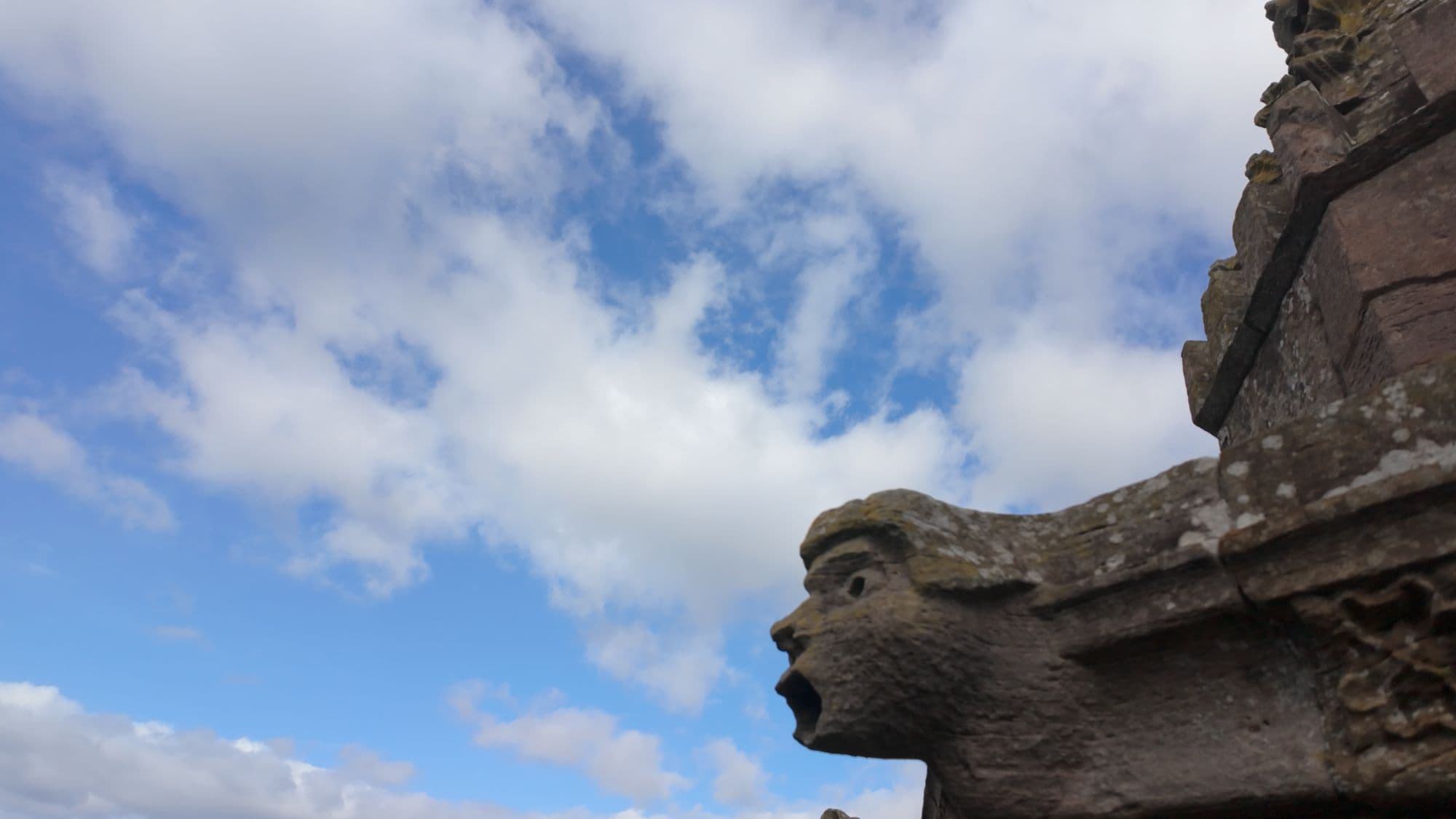
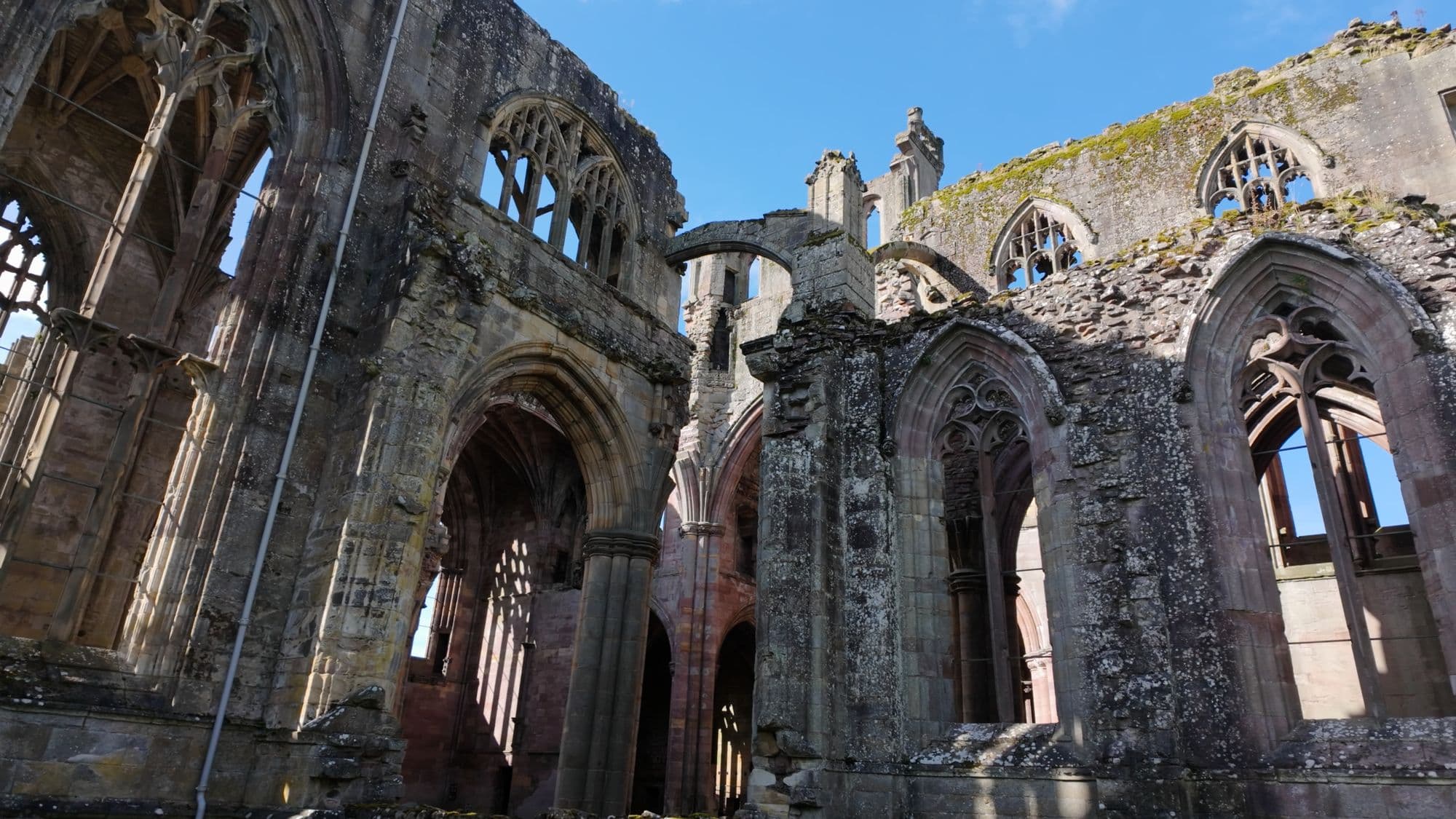
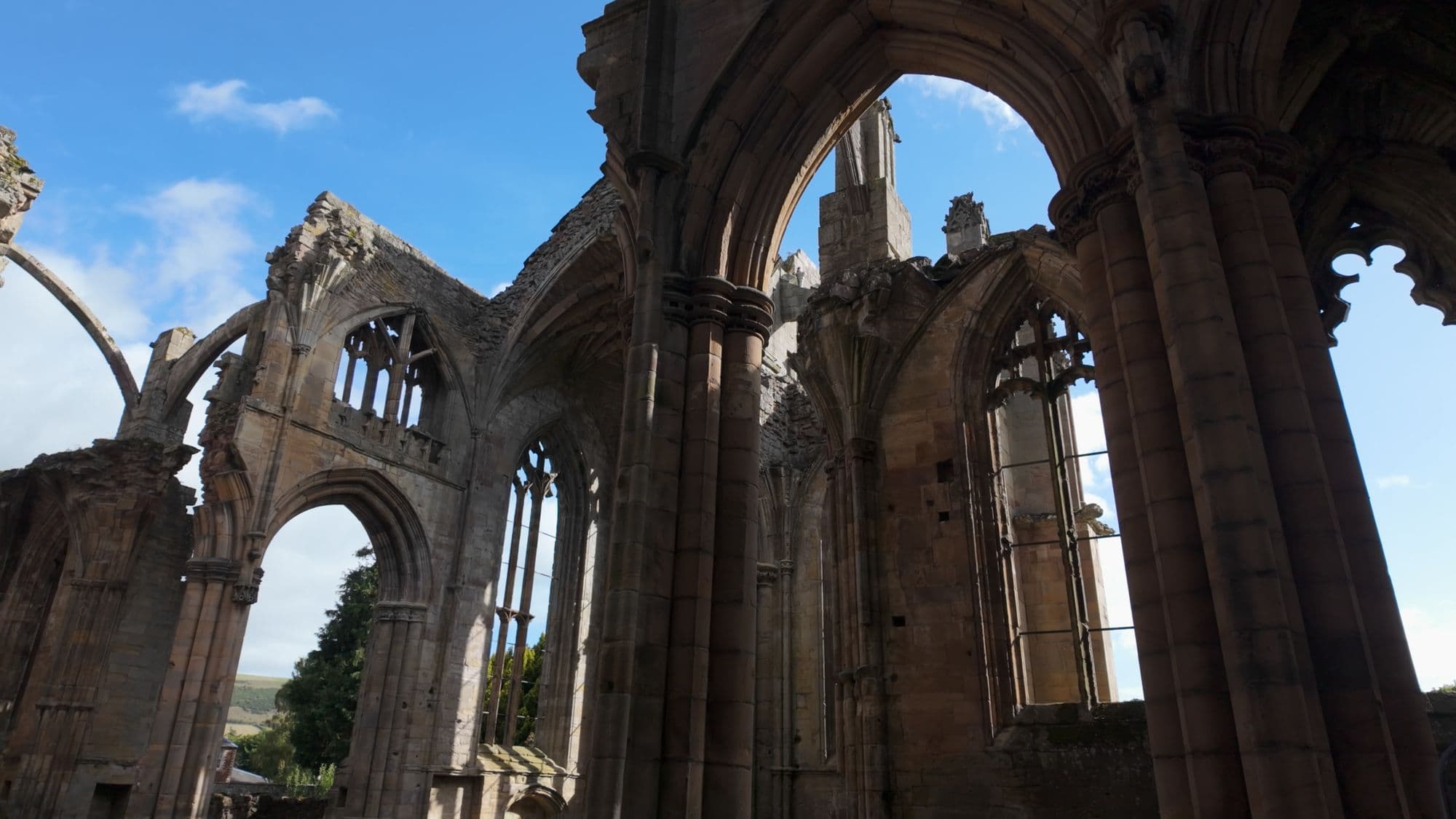
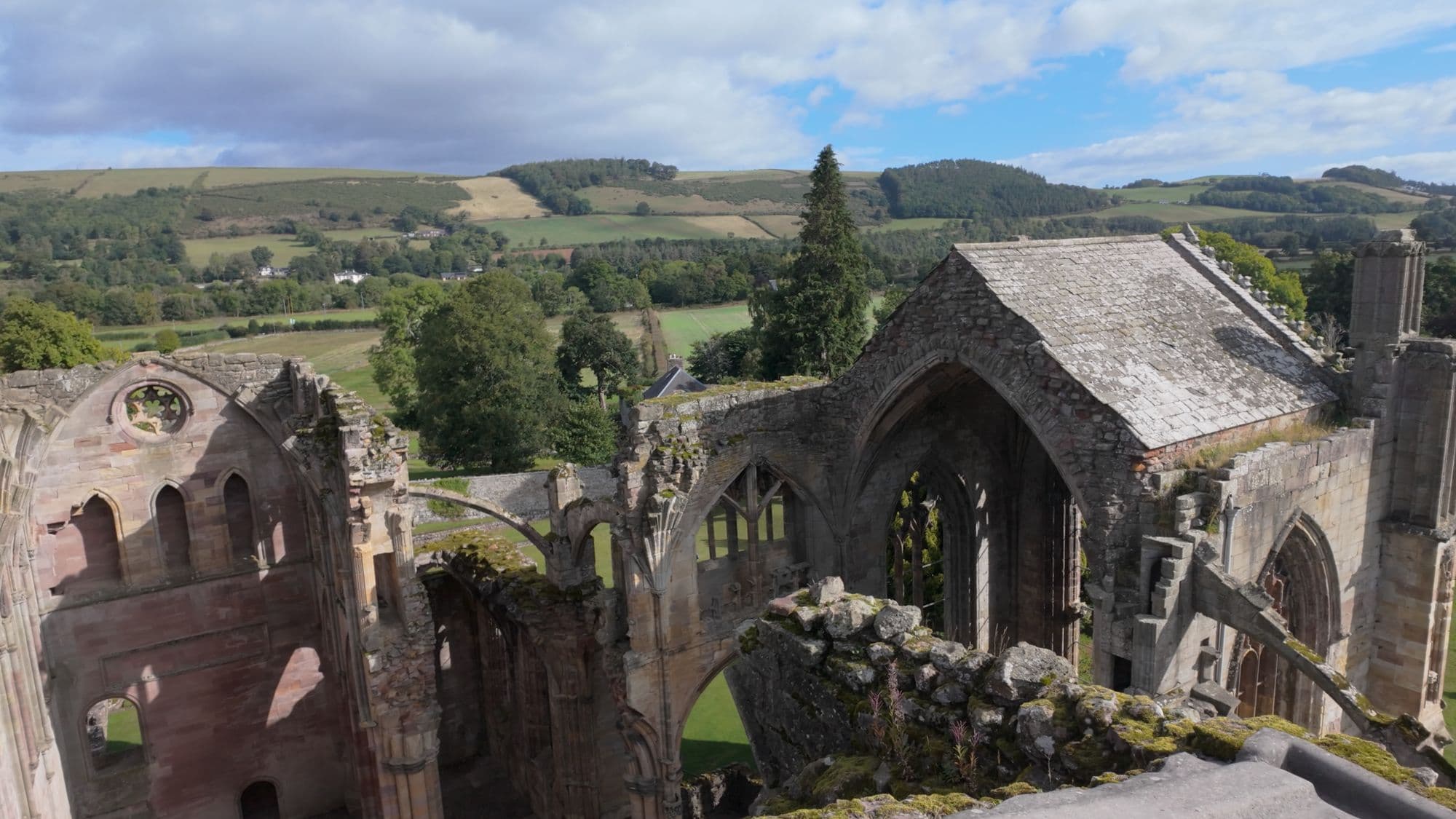
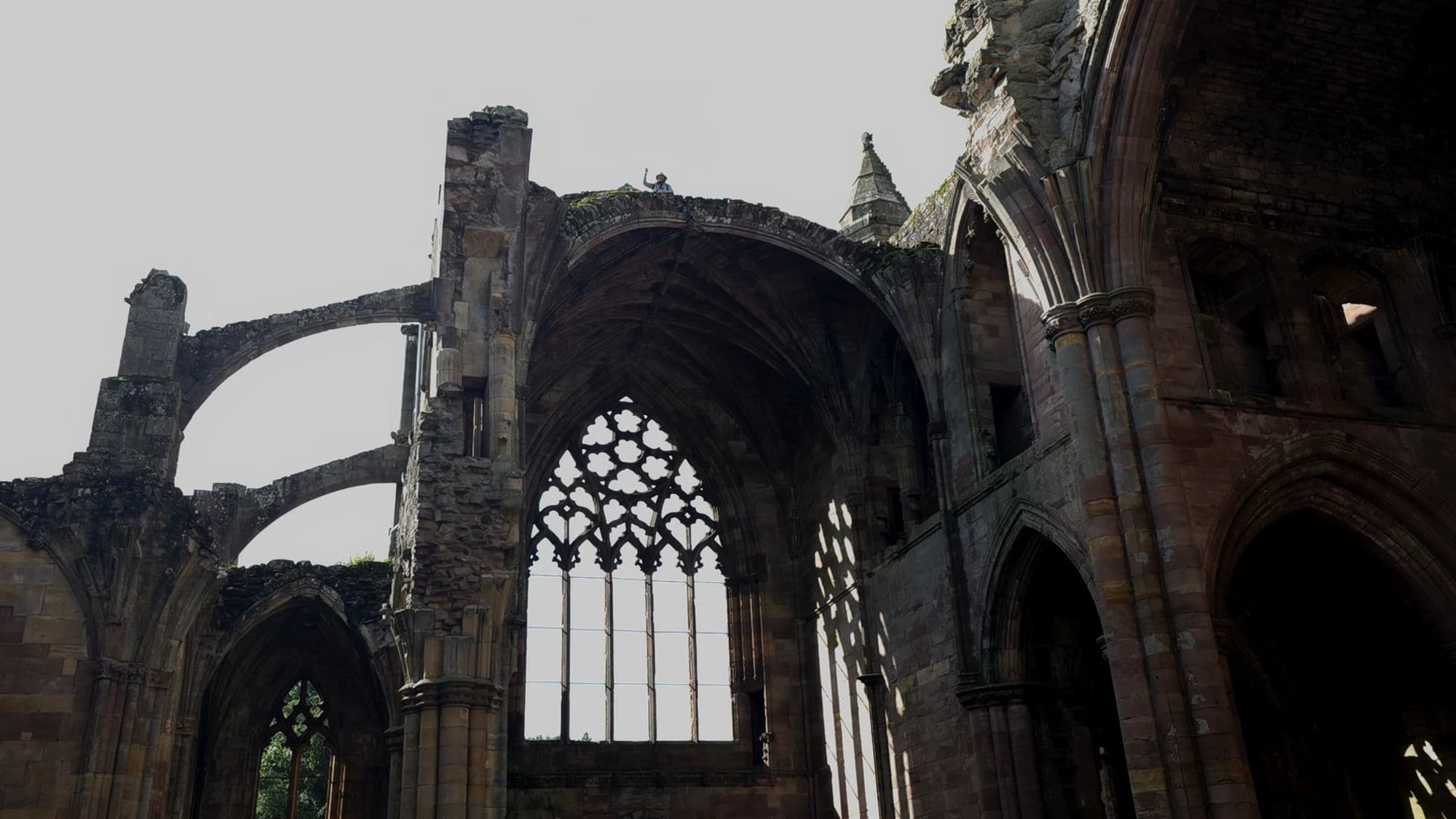
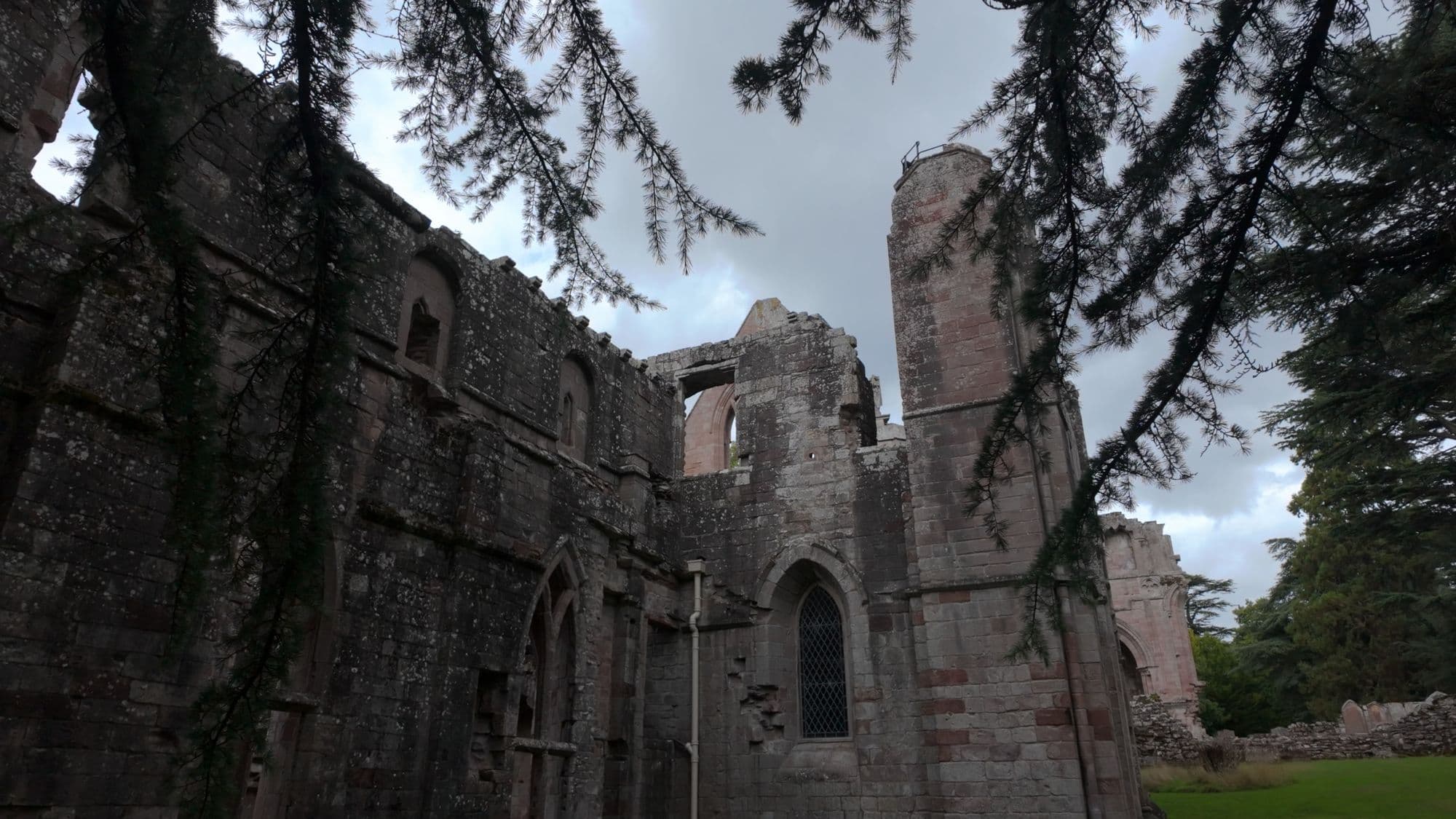
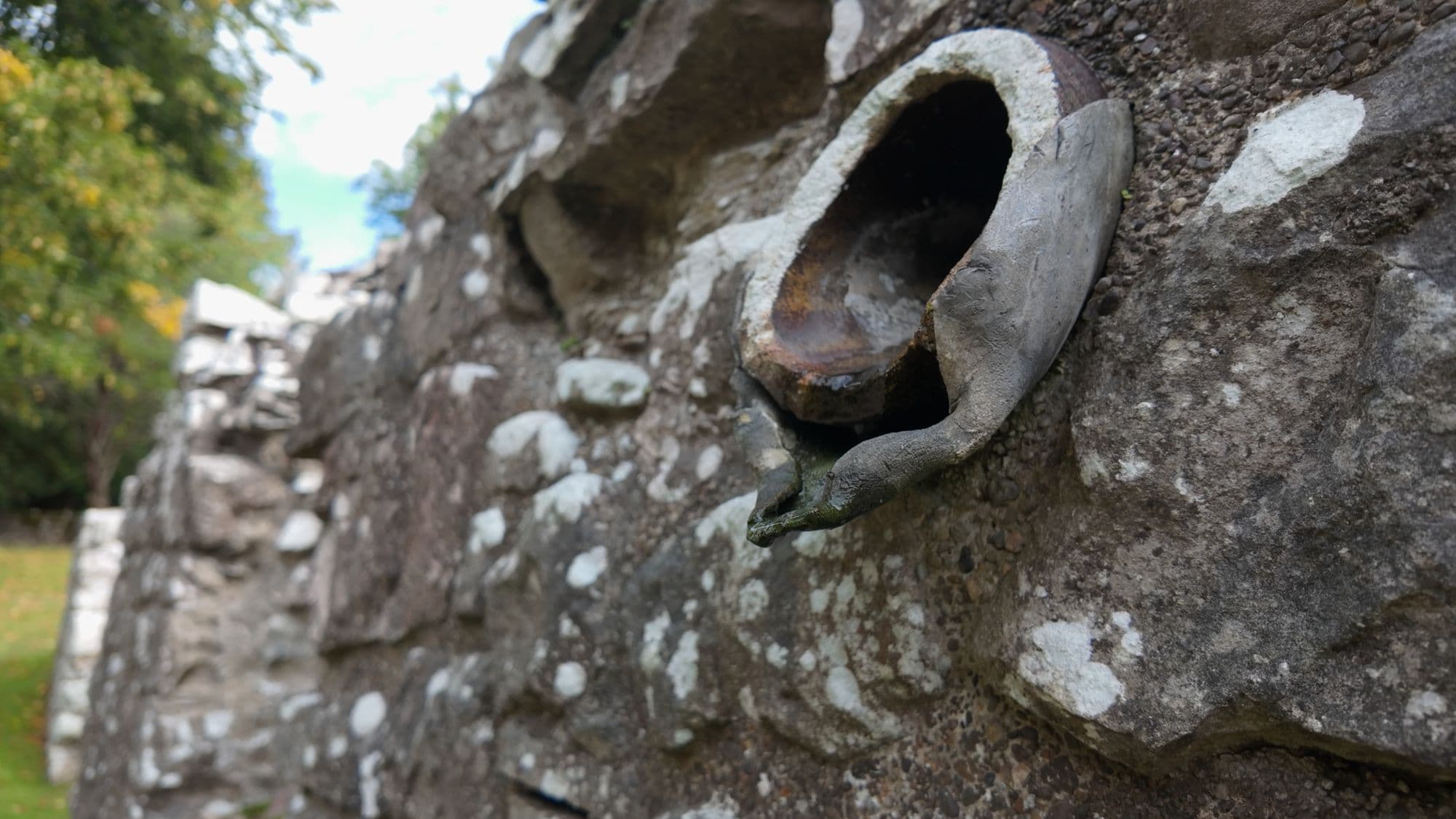
Being rich, holy and twenty miles from England is a bad combination.Edward I's armies attacked Melrose in 1300 and 1307. Edward II's attacked it in 1322. Then in 1385, Richard II of England invaded Scotland with a huge army and burned the abbey so thoroughly that the church had to be rebuilt from the ground up.That rebuild is what you see today. Almost everything standing at Melrose dates from after 1385. The work dragged on for more than a century, and the church still wasn't finished when James IV visited in 1504. Over that time different master masons came and went, some trained in England and some in France, and you can see their styles change across the building. The tracery in the big windows has the lacy, flowing look of French work in some places and the straighter lines of English work in others.One of those masons signed his name. An inscription inside the church credits John Morow, who says he was born in Paris and lists the other Scottish churches he worked on, including St Andrews, Glasgow and Paisley. It ends with a line of advice, Be halde to ye hende, roughly "keep the end in mind." Melrose took it as the town motto.The new church was anything but austere. The outside is covered in sculpture: saints in niches, dragons, demons and hobgoblins, angels playing lutes, cooks holding ladles, and, on the roofline, a pig playing the bagpipes. Whatever the founders at Cîteaux would have made of that, the masons of 15th-century Melrose clearly enjoyed themselves.Then the Rough Wooing arrived. In 1544 and 1545, Henry VIII's armies came north to force the Scots to marry the infant Mary, Queen of Scots to his son, and the English commander, the Earl of Hertford, burned his way through the Border abbeys. It was the same war, and the same commander, that burned Craigmillar Castle and Rosslyn outside Edinburgh. Melrose was badly damaged and never properly repaired. After the Reformation in 1560, the community simply died out, and the last monk, John Watson, died around 1590. Part of the ruined nave was patched up and used as the parish church until 1810.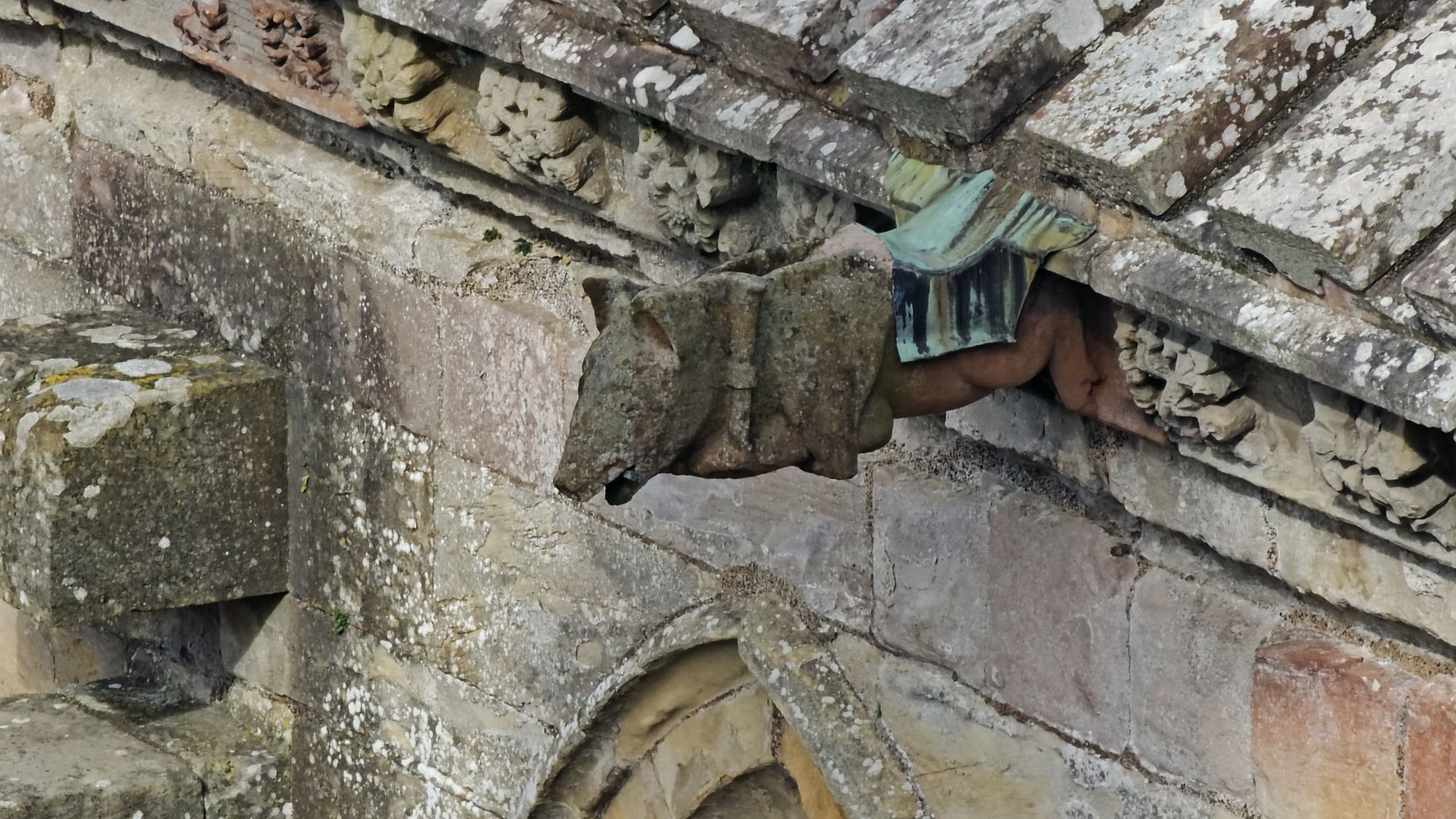
Tap any photo to enlarge
The Wizard of the Borders
The strangest person associated with Melrose may never have set foot in it.Michael Scot was born around 1175, somewhere in the Borders. He became one of the great scholars of medieval Europe. He went to Toledo in Spain, which was then the center of a huge translation movement, learned Arabic, and translated Aristotle into Latin along with the commentaries of Islamic philosophers like Averroes and Avicenna. A good deal of the Aristotle that medieval European universities read reached them through translators like Scot. Later he became scientific adviser and court astrologer to the Holy Roman Emperor Frederick II in Sicily, a ruler so unconventional that his contemporaries called him stupor mundi, the wonder of the world.A man who read Arabic, cast horoscopes for an emperor the Pope excommunicated, and wrote about the stars was always going to get a reputation. Within a few decades of his death, Dante put him in the Inferno, in the eighth circle of Hell among the sorcerers, astrologers and false prophets. Their punishment is to walk forever with their heads twisted around backward, weeping down their own spines, because in life they tried to see too far ahead.In Scotland the folklore went further. Michael Scot the wizard was supposed to have split the Eildon Hills above Melrose into their three peaks by setting a demon to the job, and then kept the demon busy by ordering it to weave ropes out of sea sand. He was also said to be buried in Melrose Abbey with his books of magic. When a stone coffin turned up during work at the abbey in 1812, people promptly decided it was his, on no evidence whatsoever.Sir Walter Scott made the legend famous. In The Lay of the Last Minstrel (1805), a knight comes to Melrose in the dead of night to open the wizard's grave and take the book of spells buried with him. The poem also gave the abbey its most-quoted lines:> If thou would'st view fair Melrose aright,> Go visit it by the pale moonlight.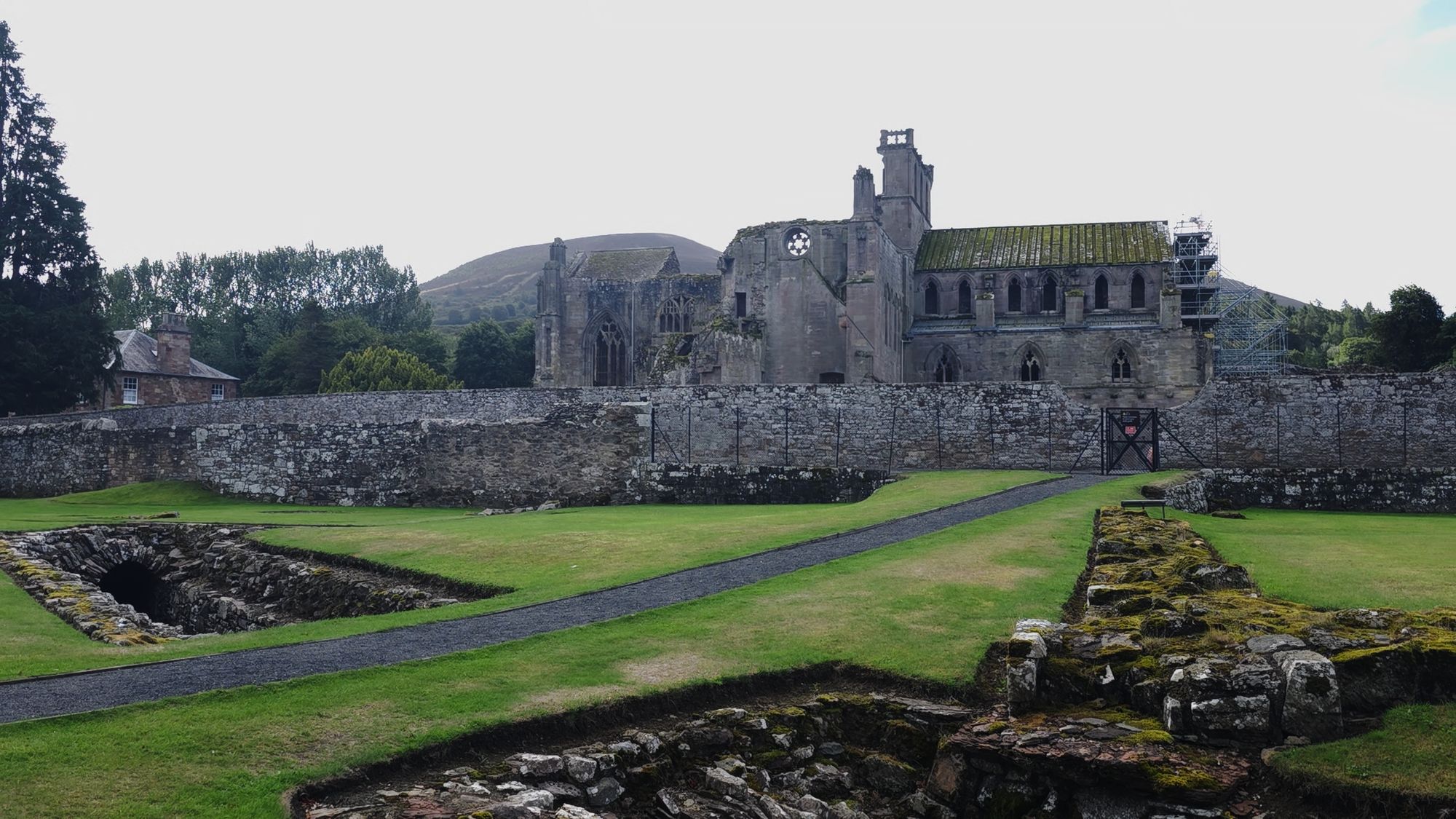
The Heart of Robert the Bruce
Robert the Bruce spent most of his reign at war. He seized the throne in 1306 by murdering a rival in front of a church altar, spent years as a hunted outlaw, won Scottish independence on the field at Bannockburn in 1314, and spent another fourteen years forcing England to admit it. The Treaty of Edinburgh–Northampton finally did, in 1328.He died a year later, in June 1329, probably in his mid-fifties and after a long, wasting illness that chroniclers called leprosy (modern historians aren't so sure). He'd been excommunicated for the altar killing, and he'd once vowed to go on crusade, a vow he never got to keep. On his deathbed he worked out a way to keep it anyway. His body would go to Dunfermline Abbey, the royal burial church, where it still lies. His heart would be cut out, embalmed, and carried to the Holy Land against the enemies of Christ. Once that was done, the heart was to be buried at Melrose.He picked the man for the job carefully.The Black Douglas
Sir James Douglas had been with Bruce since the desperate early years. The Scots called him the Good Sir James. The English called him the Black Douglas, and it was said that English mothers in the north quieted their children by telling them the Black Douglas would get them.He'd earned it. In 1307, Douglas took back his family's castle from its English garrison by attacking on Palm Sunday while they were at church. Then, so the castle couldn't be used against him again, he piled the dead soldiers into the cellar with the castle's stores of food and wine, poured the wine over the lot, and burned it. The Scots called it the Douglas Larder.Douglas had Bruce's heart sealed in a small silver casket, traditionally said to have hung around his neck, and in 1330 he set out with a company of knights. They never reached the Holy Land. In Spain, King Alfonso XI of Castile was fighting the Moorish kingdom of Granada, and for crusaders on their way east, a war against Muslims in Spain counted. Douglas joined it.In August 1330, at the Battle of Teba, near Málaga, Douglas was cut off from the main army and killed, along with the few knights still with him.The famous version has him tearing the casket from his neck, hurling it into the enemy ranks and charging after it, shouting at the heart to lead the way and he would follow. It's told and retold, and it may even be true, but it comes from accounts written well after the fact. What's solid is that the survivors recovered both Douglas's body and the casket. His flesh was boiled off so his bones could make the long journey home, and they were buried at St Bride's Kirk in Douglas, Lanarkshire. The heart went to Melrose, as Bruce had asked.It was a fitting place for it. When Edward II's army wrecked Melrose in 1322, Bruce had paid for the repairs, including a grant of £2,000 in 1326, which was an enormous sum. The Douglas family put a red heart on their coat of arms after Teba, and it's still there.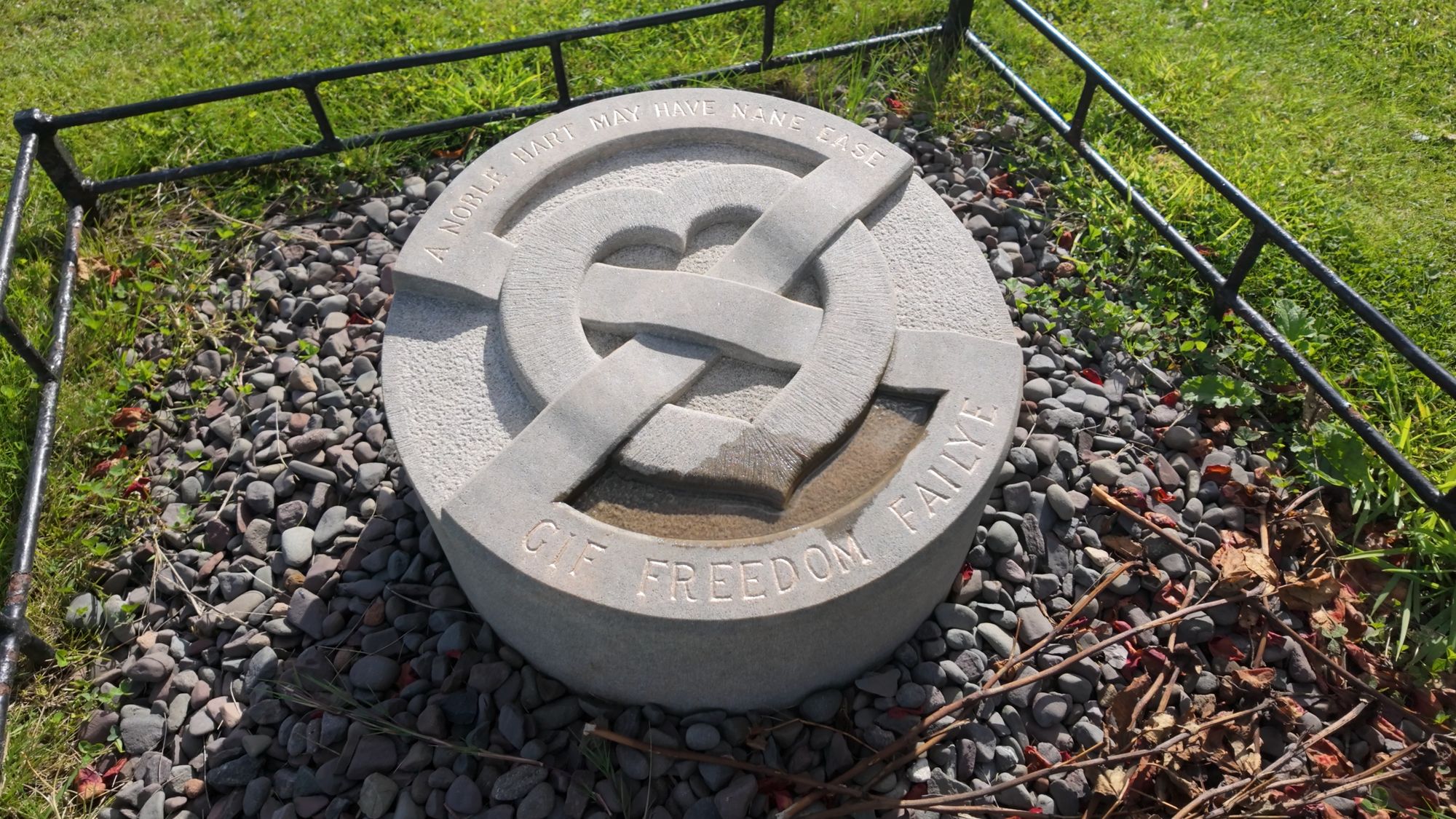
Lost, Found, Lost and Found Again
Over the following centuries, through the burnings and the Reformation and the slow collapse of the abbey, everyone lost track of exactly where the heart was.In March 1921, workmen from the government's Office of Works were digging below the floor of the chapter house when they found a conical lead casket. They didn't open it. They made a small copper plaque recording that it had been found beneath the chapter house floor in March 1921, put it in with the casket, and buried it again.In 1996, Historic Scotland's archaeologists excavated the chapter house floor and found the casket a second time, with the 1921 plaque still in place: a note from one generation of excavators to the next. This time it went to a lab in Edinburgh. A fibre-optic camera showed a second, smaller lead container inside the first, about ten inches tall and tapering toward the top, and that's where the heart is. The inner casket was never opened, and no DNA test was done.On 22 June 1998, the casket was reburied privately at Melrose. Two days later, on the anniversary of Bannockburn, Scotland's Secretary of State, Donald Dewar, unveiled the round memorial stone that marks the spot. Its inscription is adapted from The Brus, the long poem about the king written in the 1370s by John Barbour, Archdeacon of Aberdeen:> A noble hart may haiff nane ese,> gif fredome failyhe.A noble heart can have no ease if freedom fails.Can it be proven that it's Bruce's heart? No. The archaeologist who led the investigation said the honest answer is that it's reasonable to assume it is. A king's heart was brought home from Spain to Melrose, and a medieval heart in a lead casket turned up exactly where you'd expect it. That's about as close as history usually gets.The Most Dangerous Family in Scotland
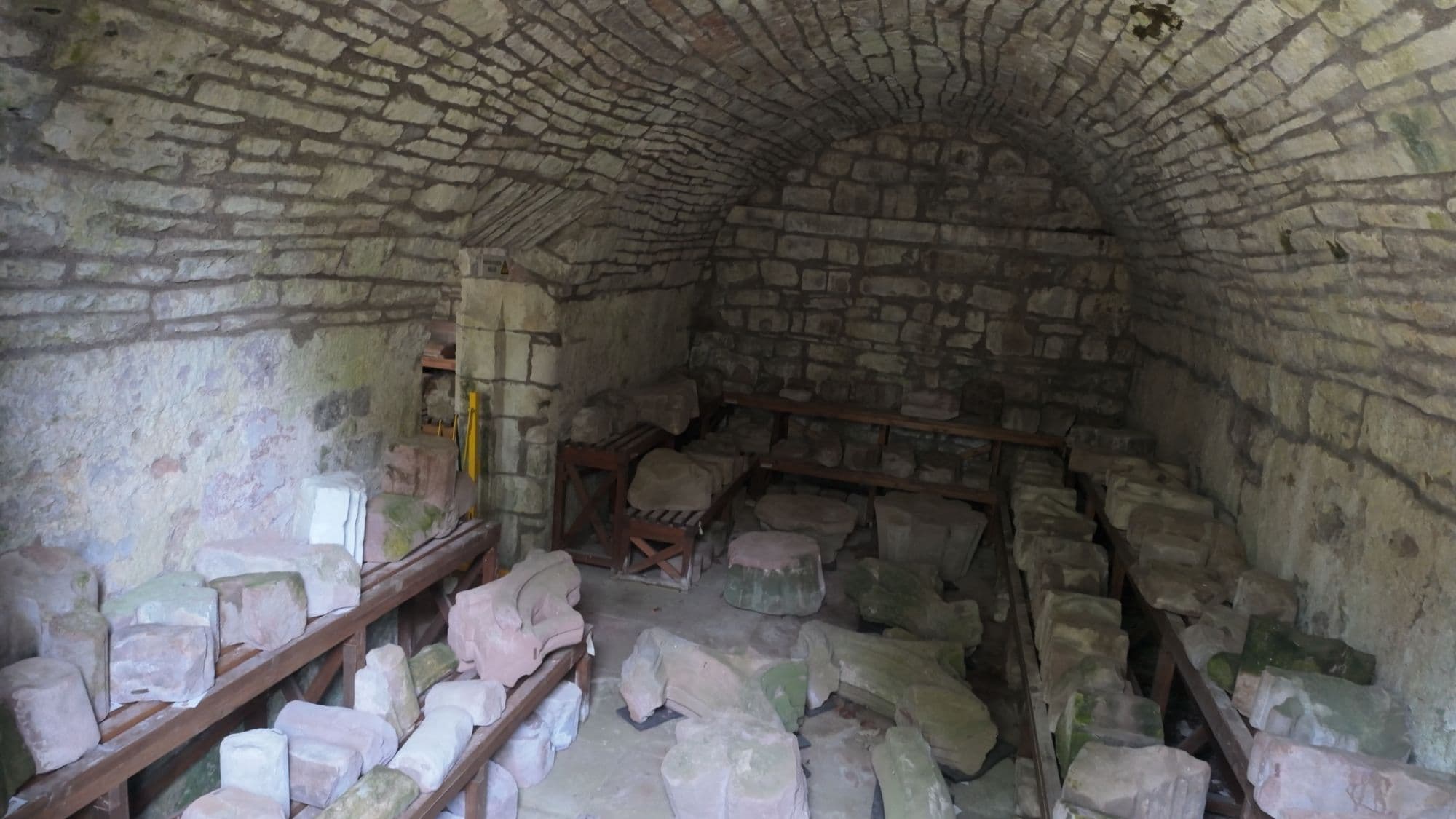
The Black Douglas's family went on to become something bigger than he was.Through the 1300s and 1400s, the Douglases were the most dangerous family in Scotland. They held huge territories across the south, they could raise private armies, and they were the crown's main defense against England. That made them indispensable to the kings of Scots, and a threat to them. Kings married into the family, rewarded it, and periodically tried to destroy it.The senior line, the Black Douglases, descended from Sir James's nephew, the first Earl of Douglas. Their power ended in murder twice over.In 1440, the sixteen-year-old 6th Earl of Douglas and his younger brother were invited to Edinburgh Castle to dine with the ten-year-old king, James II. At the end of the meal, according to later tradition, a black bull's head was set on the table, a sign of death. The two boys were dragged outside, given a mock trial, and beheaded. It's remembered as the Black Dinner.Twelve years later, in 1452, James II, now grown, invited the 8th Earl of Douglas to Stirling Castle under a promise of safe conduct, argued with him over dinner, and stabbed him to death with his own hands. His courtiers finished the job, and the body was thrown out of a window. Over the next three years the crown hunted the rest of the family down, and by 1455 the Black Douglases were finished. James II didn't long outlive them. His own death, a few miles down the Tweed in 1460, belongs to part two of this day.The junior line, the Red Douglases, Earls of Angus, came out on top mostly by siding with the king and outlasting their cousins. They went on to be just as troublesome for the next century of Scottish kings.Even Melrose ended up in Douglas hands in the end. After the Reformation, the abbey's income went to a commendator, a layman given the right to collect a religious house's revenues without any part in its religious life. Commendators were usually royal favorites or younger sons of powerful families. The last commendator of Melrose was a James Douglas, and in 1590 a building next to the cloister was converted into a fine house for him. It's now the Commendator's House Museum. It's full of carved stone that's come down off the church over the centuries, along with medieval floor tiles, cooking pots and portable urinals pulled out of the abbey's great drain, which is probably the most honest picture of monastic daily life in the whole place.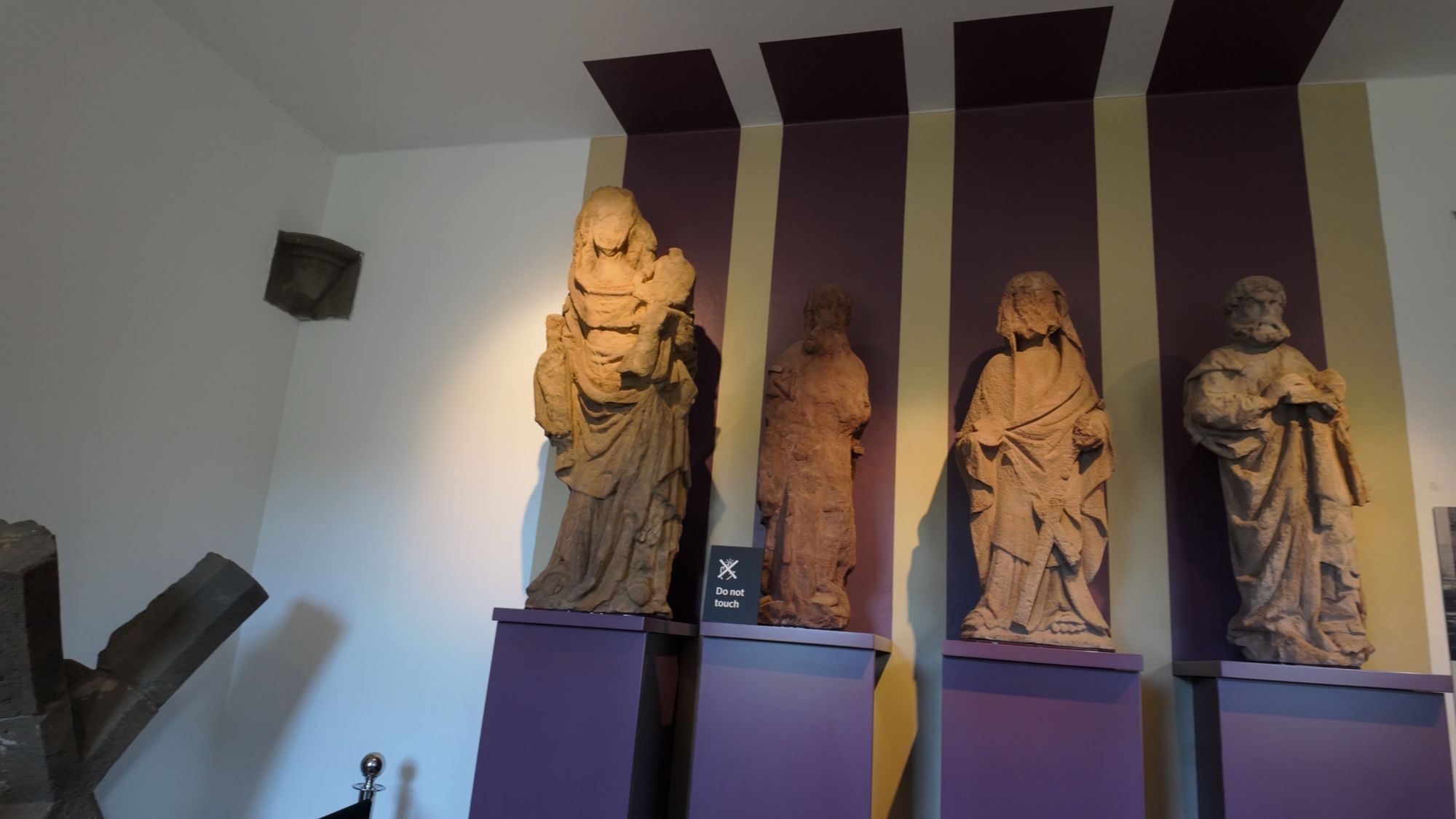
Tap any photo to enlarge
Unforgettable Experiences
Scottish Borders has incredible experiences worth booking in advance
Affiliate links • Helps fund my adventures at no extra cost to you
Dryburgh: The White Canons
A few miles downriver, in a bend of the Tweed, Dryburgh Abbey belongs to a different kind of religious life entirely.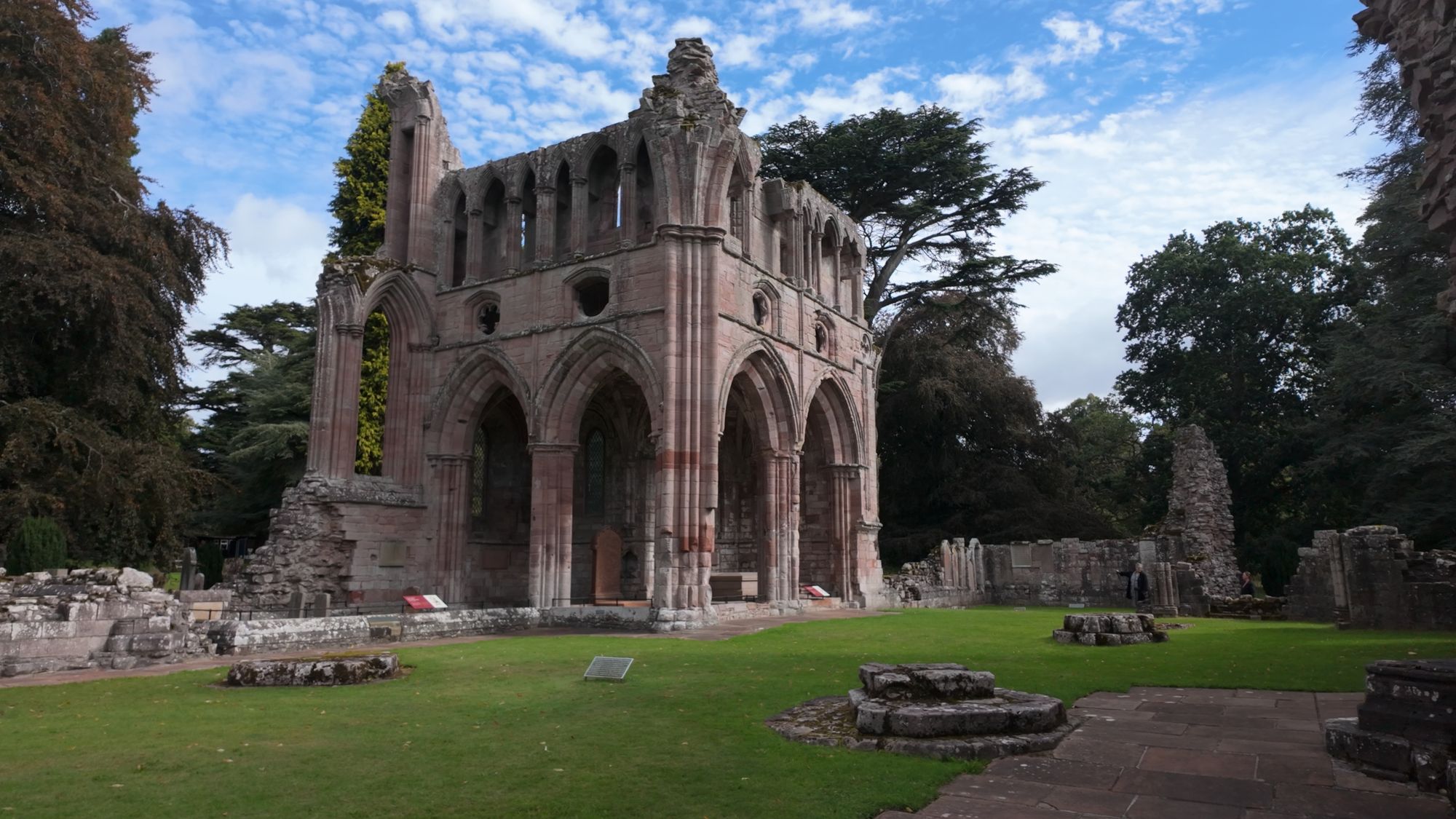
The Son
Hugh's eldest son, also named Hugh, went south and made his career in England, at the court of Henry II.On 29 December 1170, after Henry, in a rage at Archbishop Thomas Becket, reportedly asked whether no one would rid him of this turbulent priest, four of his knights rode to Canterbury. Hugh de Morville was one of them. They cornered Becket in his own cathedral at the hour of vespers and cut him down at the altar steps. Most accounts say Morville didn't strike a blow himself. His job was to hold back the crowd while the other three did it. It didn't matter. Becket was made a saint within three years, his shrine became the greatest pilgrimage site in England, and the four knights became some of the most infamous men in Christendom.The father died a canon at Dryburgh, praying in the abbey he built. Eight years later the son helped kill an archbishop in his own church.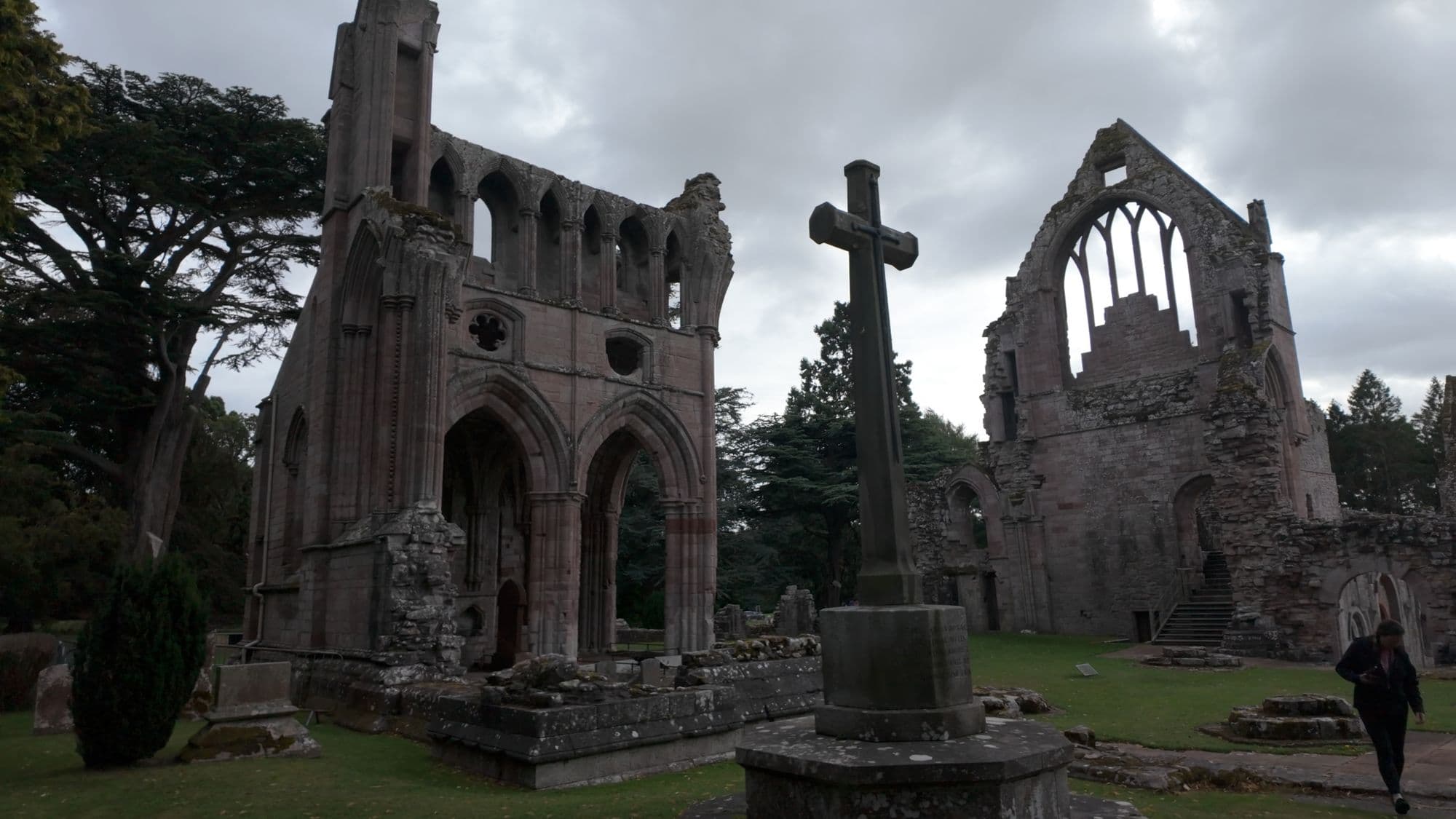
Tap any photo to enlarge
Burned for Ringing the Bells
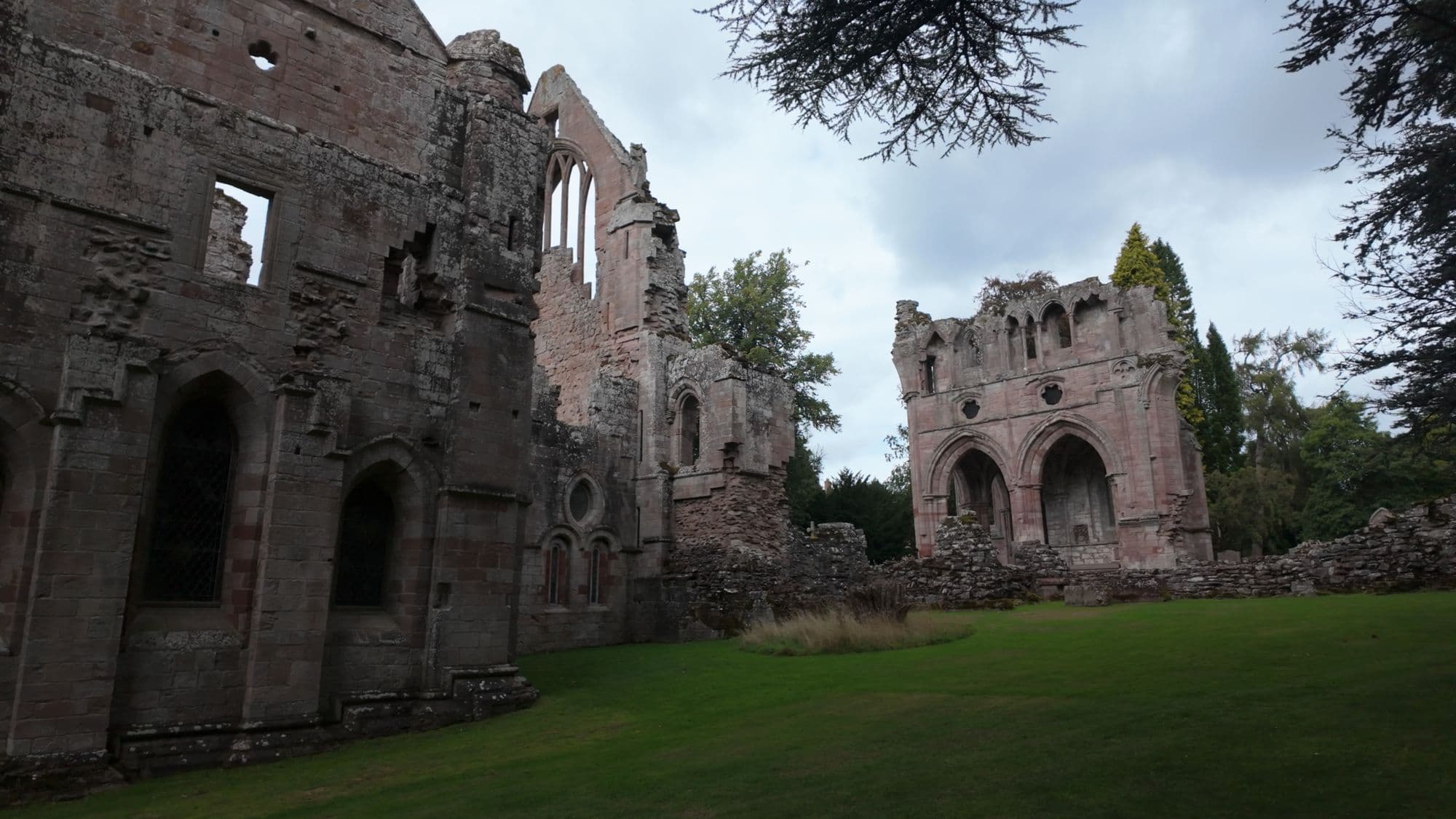
Dryburgh was never as rich as Melrose, Kelso or Jedburgh, but it was just as exposed. English armies burned it in 1322, sacked it in 1385, and burned it in 1544 and again in 1545.The 1322 attack is the one with the story. Edward II had invaded Scotland that summer, but Bruce simply pulled everyone back and stripped the country of food in front of him. The English army got as far as Edinburgh, found nothing to eat, and starved its way back south. As it retreated past Dryburgh, the canons, thinking the danger had passed, rang the abbey bells to celebrate. The soldiers heard them, turned around, and set the place on fire.Bruce poured money into Melrose afterward. Dryburgh got very little from him beyond confirmation of a small existing rent, and historians still aren't sure why.The burnings of the 1540s, in the Rough Wooing, were the end. When the Reformation came in 1560, life at Dryburgh effectively stopped. The remaining canons lived on in a dwindling community until, by 1584, only two of them were left alive.The Cloister
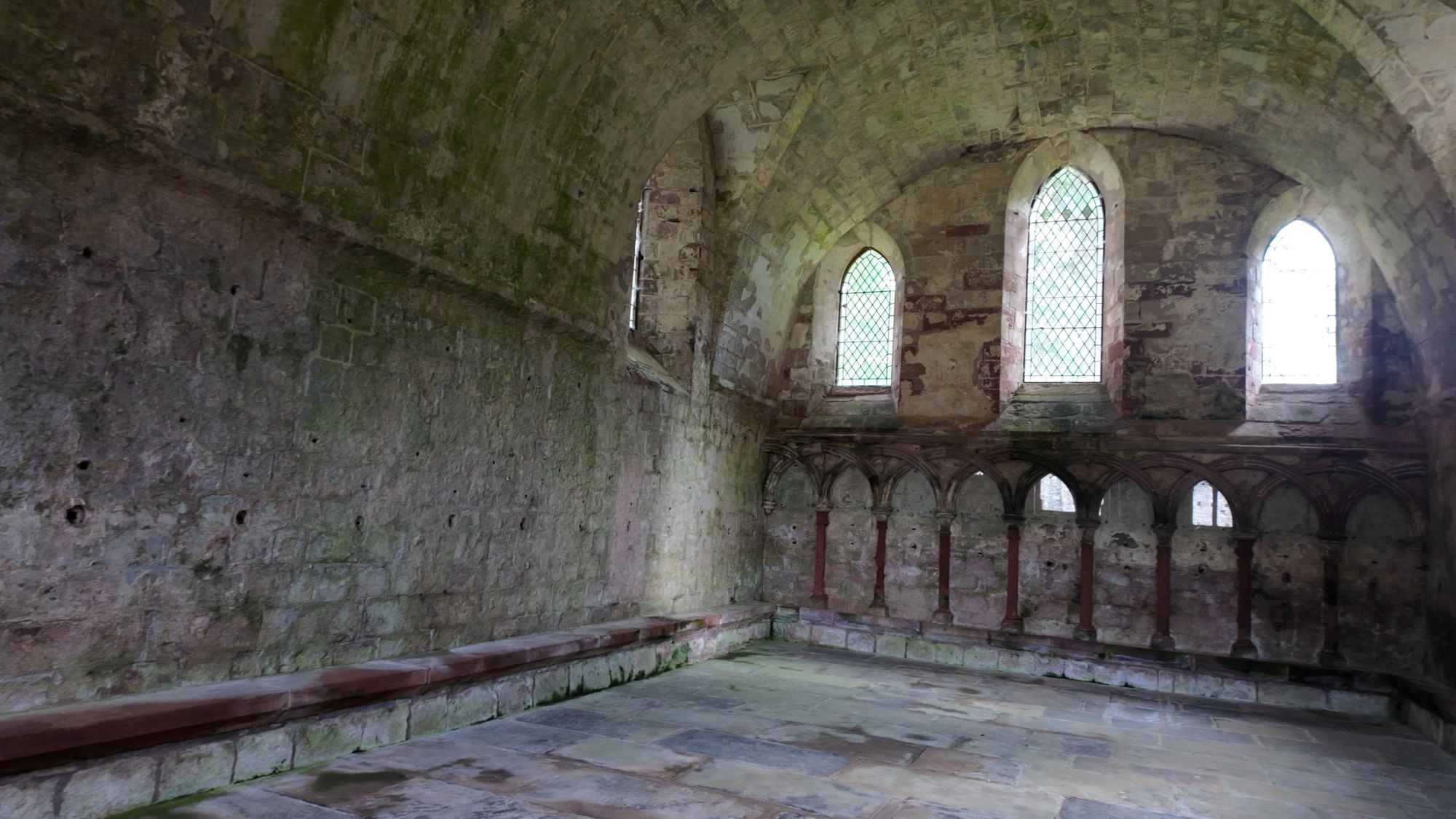
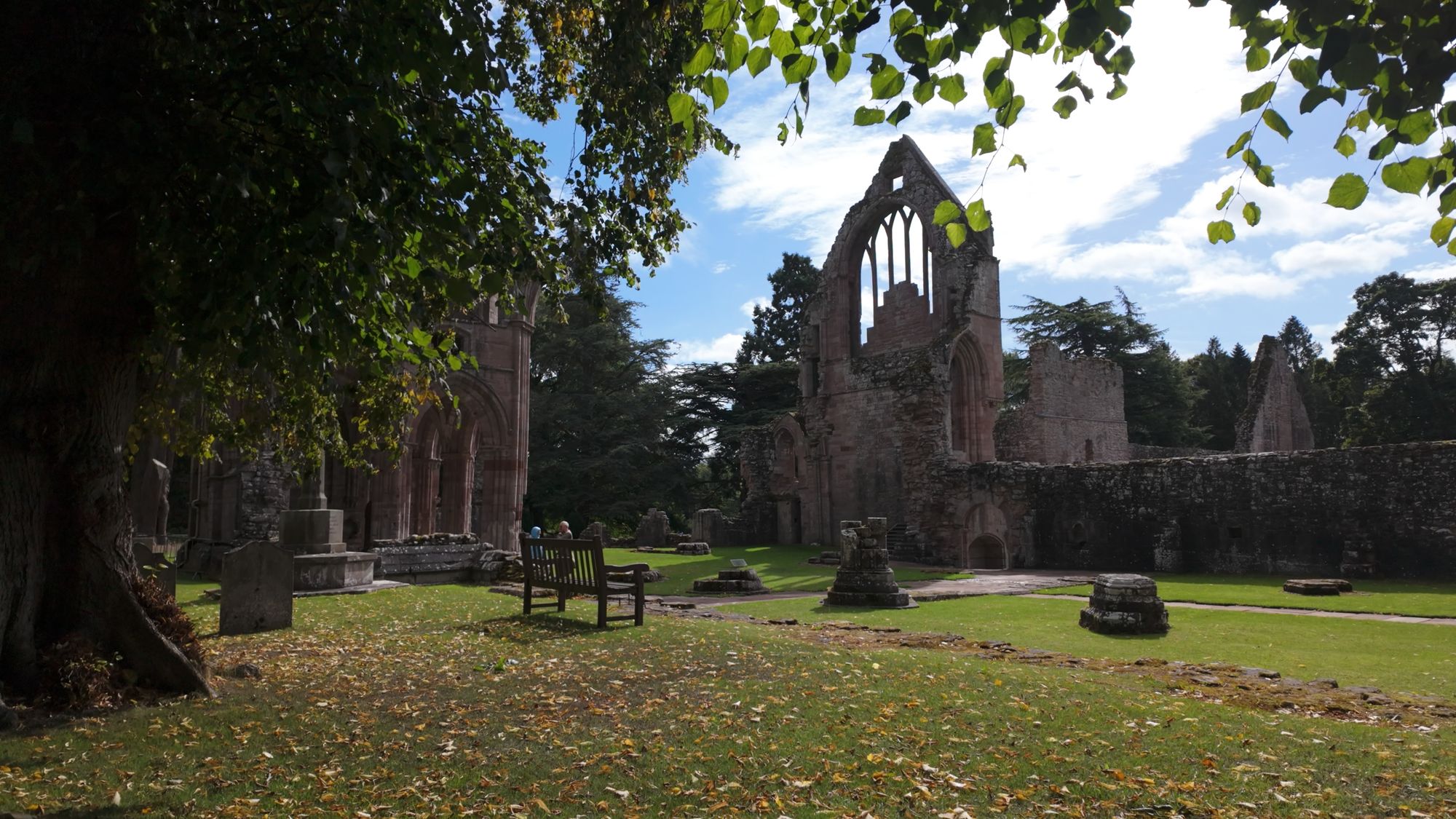
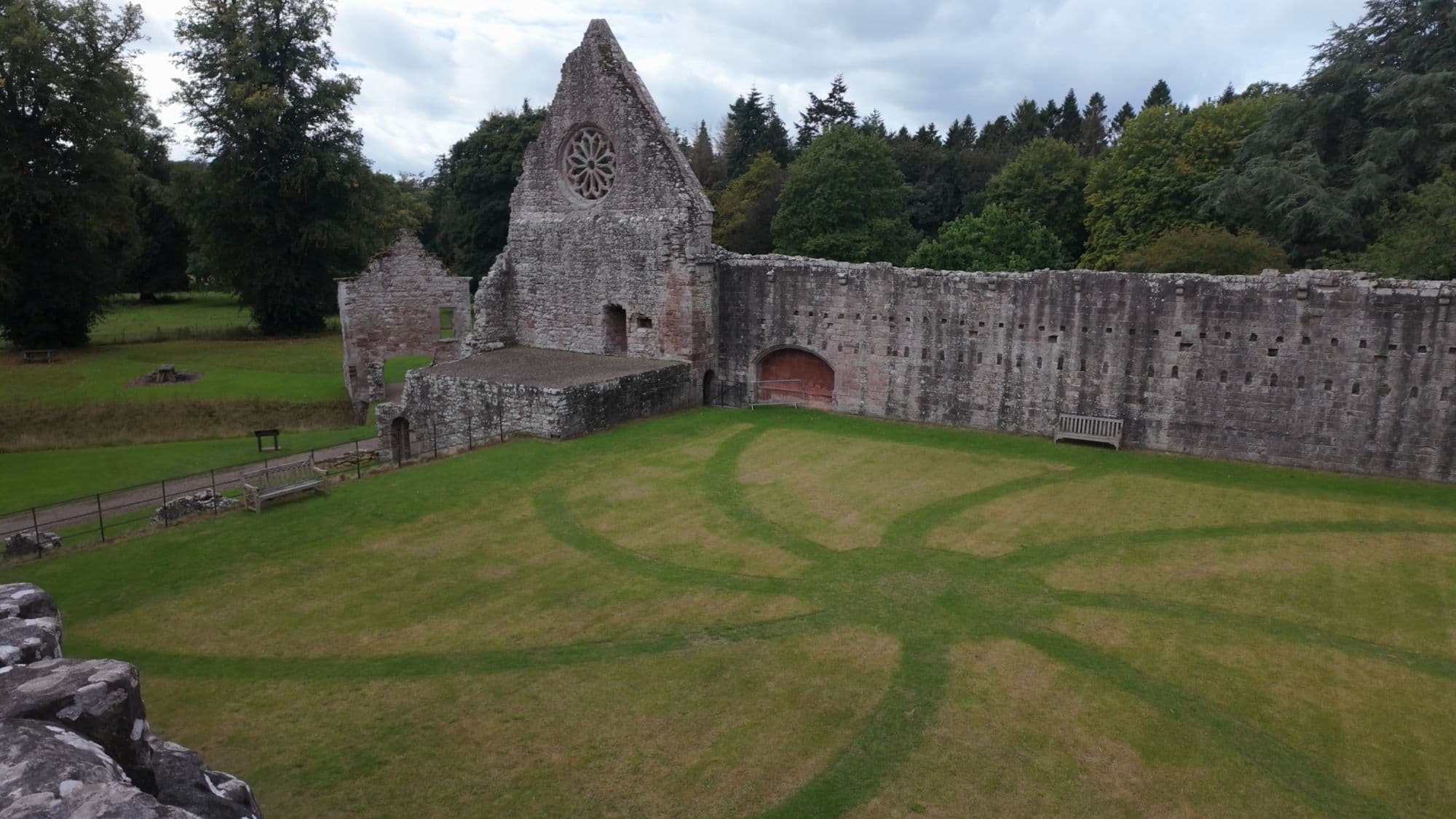
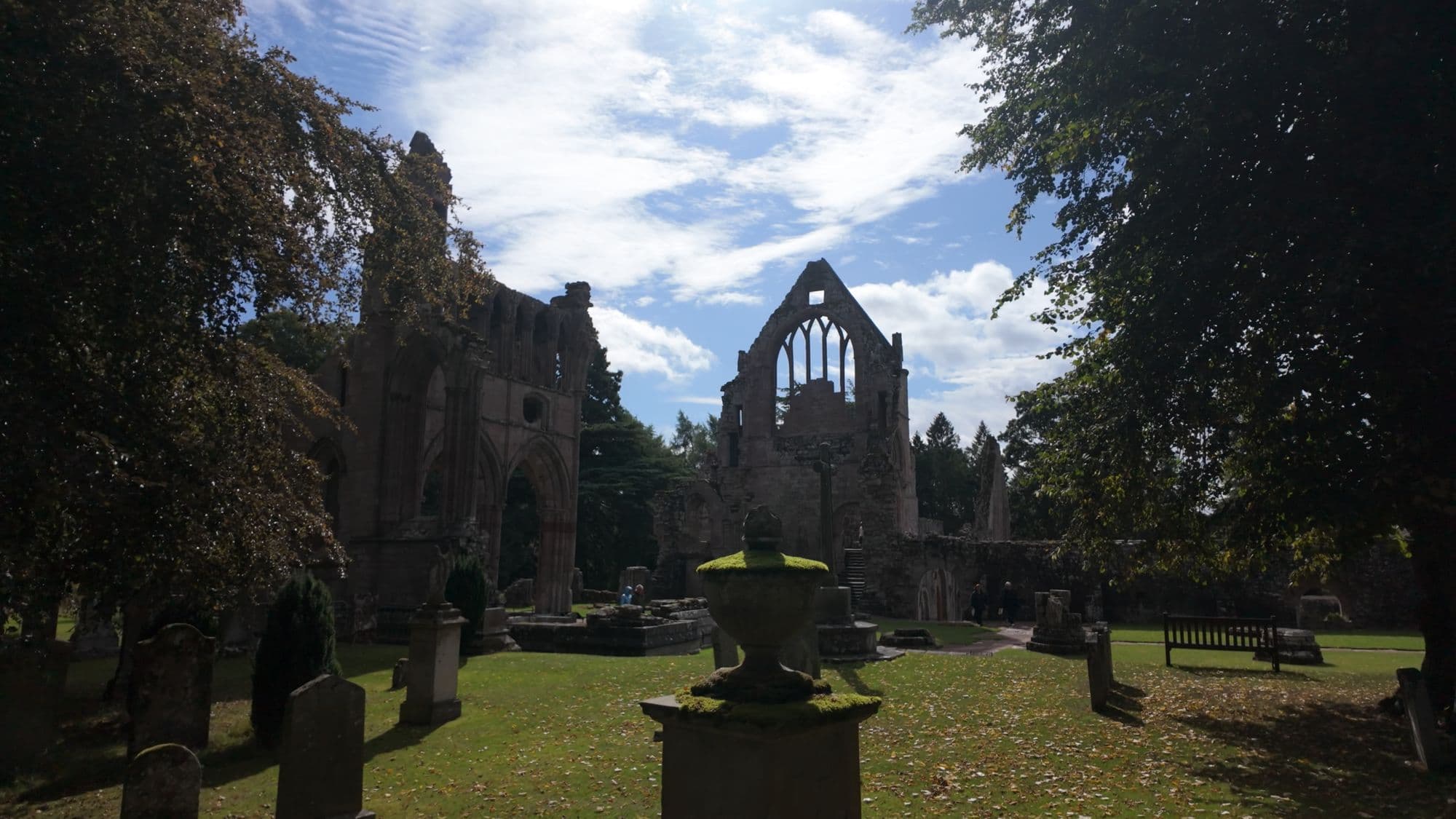
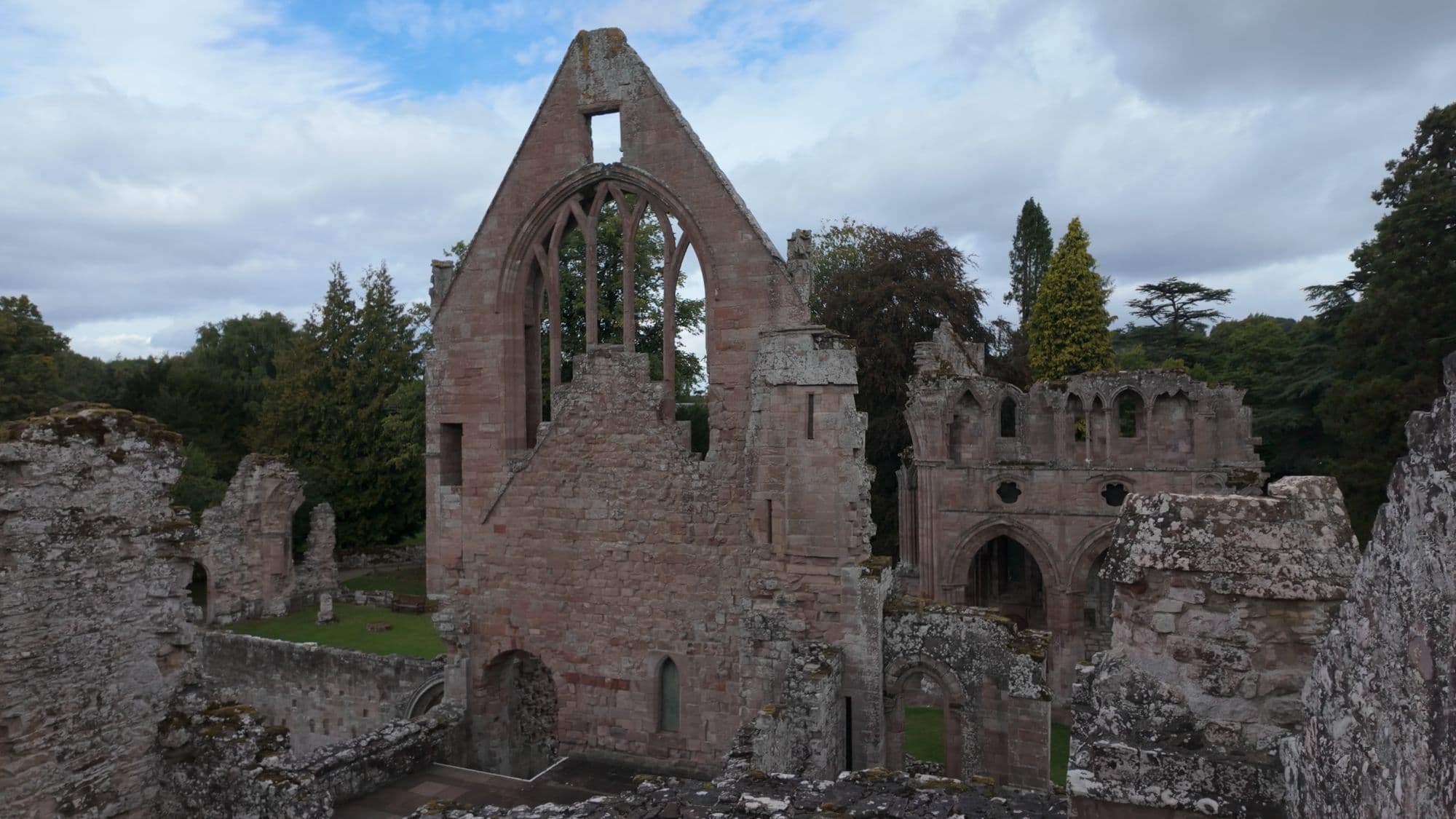
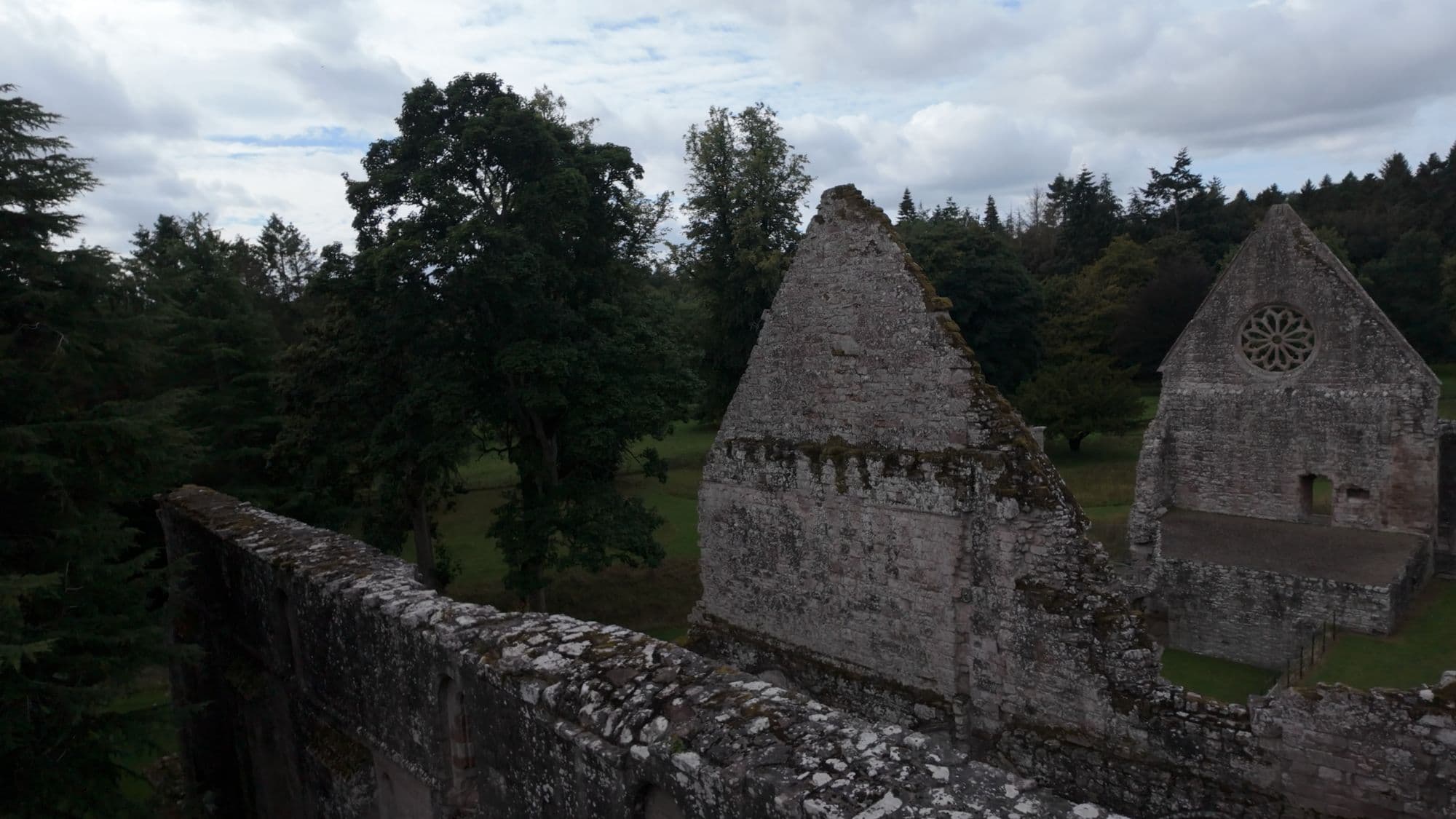
The church at Dryburgh is mostly gone: the transepts survive, along with a scattering of arches framing open lawn. But the buildings along the east side of the cloister are some of the best-preserved monastic rooms in Scotland, and they show how the canons actually lived.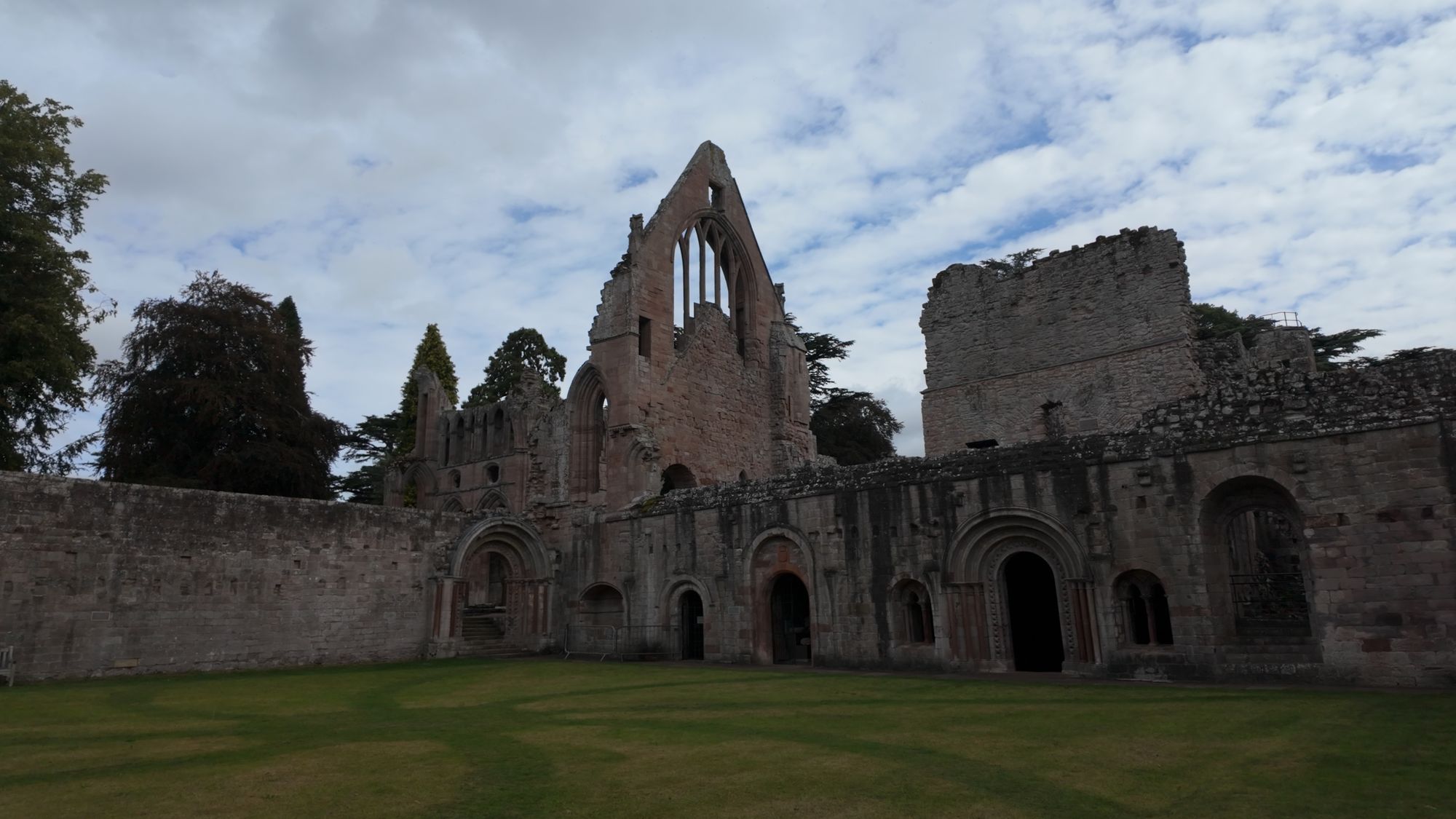
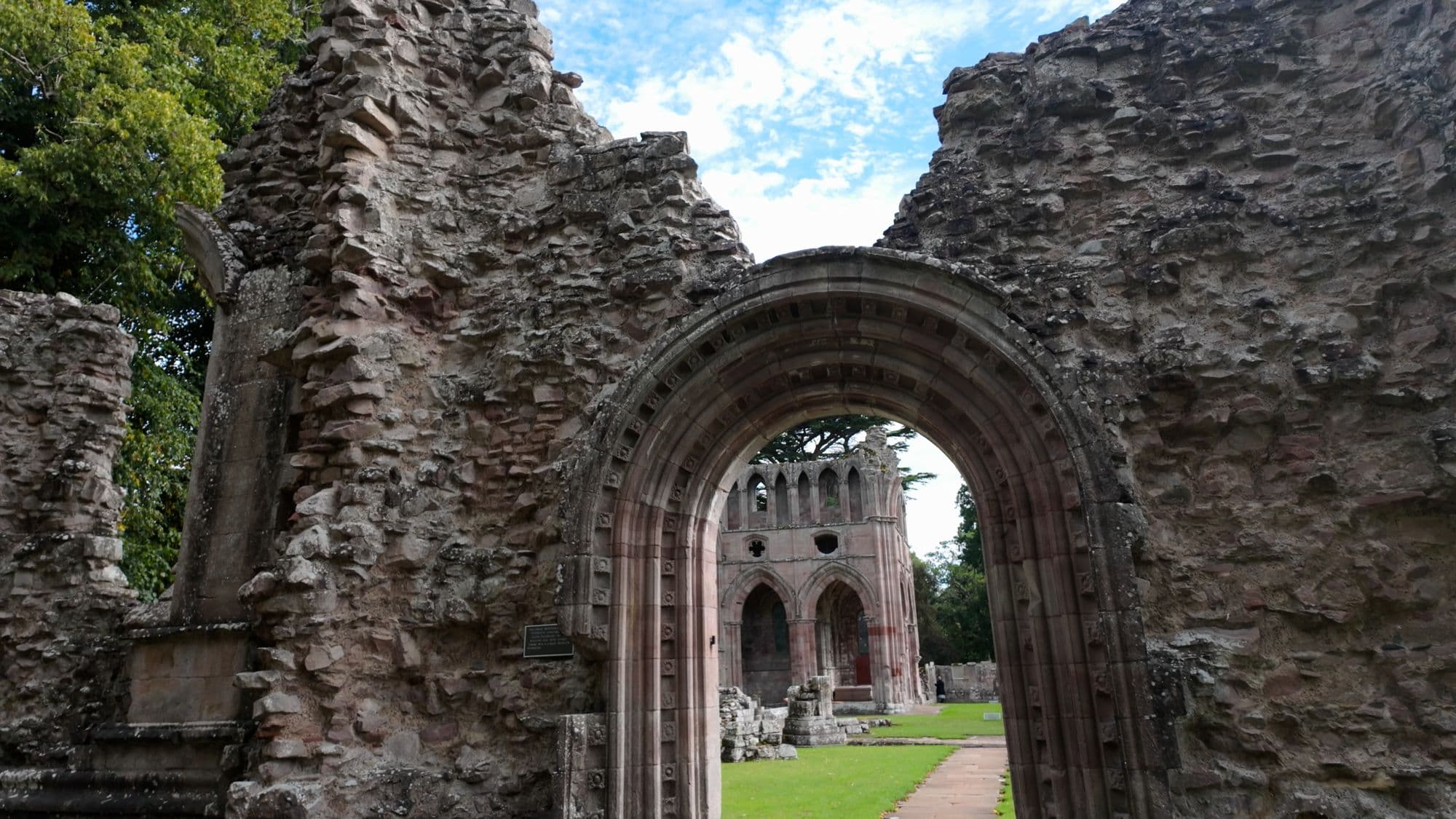
Tap any photo to enlarge
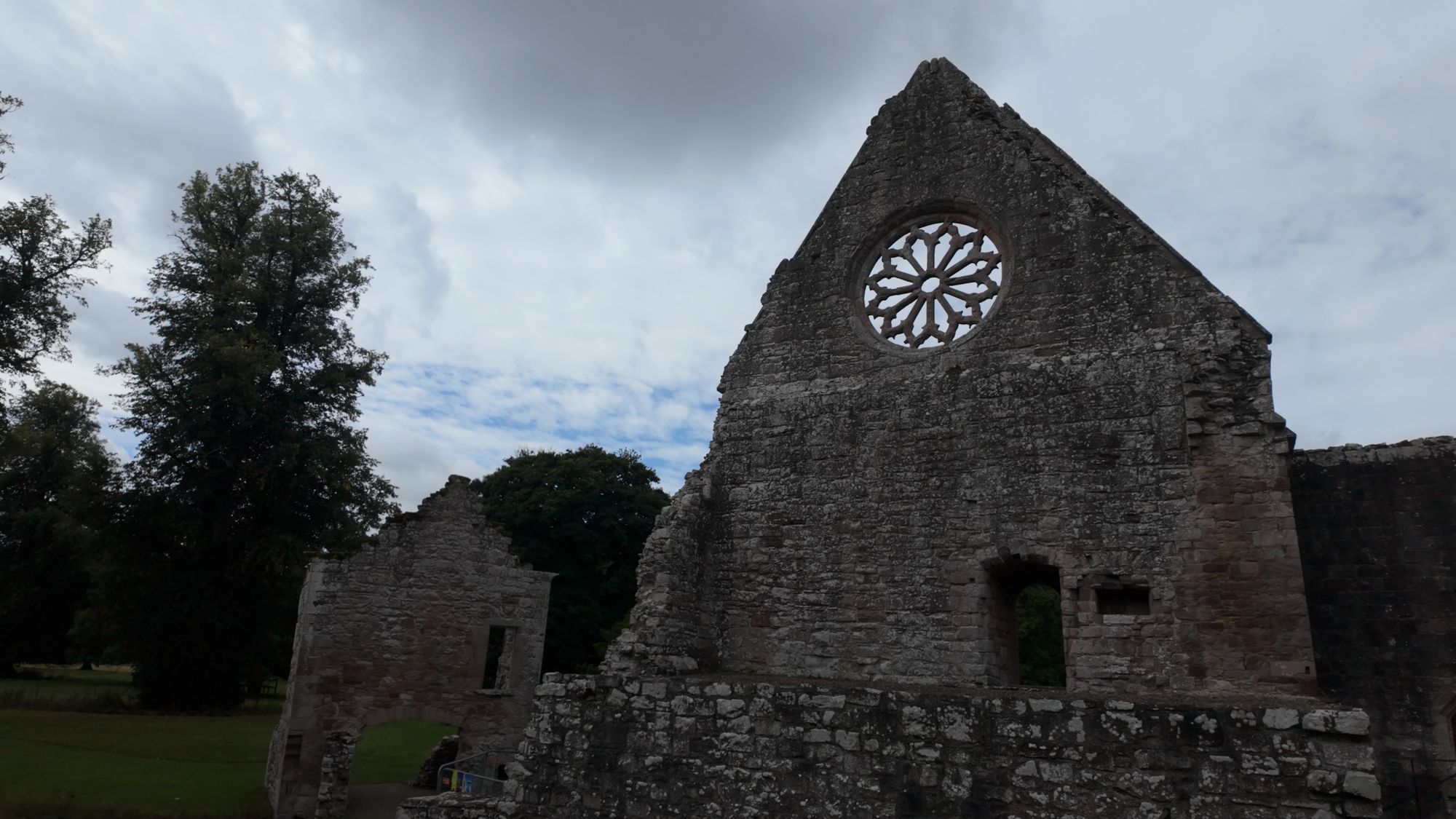
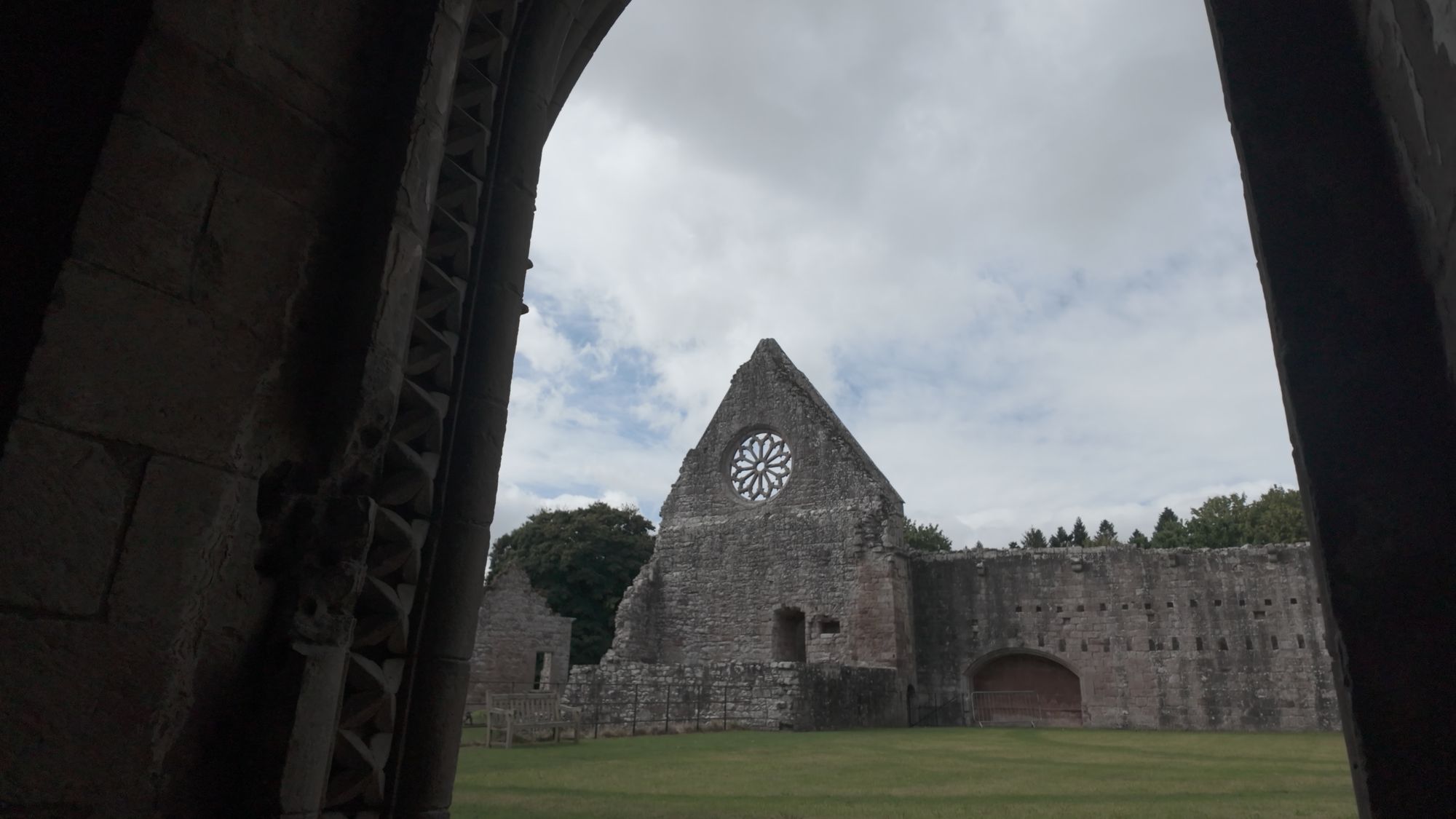
The Earl Who Turned a Ruin Into a Garden
After the Reformation, Dryburgh's lands passed through a run of commendators from the Erskine family and were eventually absorbed into the earldom of Mar. Then the estate changed hands, belonging for a time to the Haliburtons, until in 1786 it was bought back by an Erskine descendant: David Steuart Erskine, 11th Earl of Buchan.Buchan was a genuine eccentric and a genuine scholar. In 1780 he founded the Society of Antiquaries of Scotland, which still exists and is still the country's leading body for the study of its past. At Dryburgh, he turned the ruins into a romantic landscape garden. He planted trees among the walls and put up monuments around the estate, including a temple to the Muses and, in 1814, a colossal red sandstone statue of William Wallace looking out over the Tweed. It still stands on the hillside above the river.His romanticism had a practical side. At a time when old ruins all over Scotland were being quarried for building stone, owning Dryburgh as a showpiece protected it. Buchan died in 1829 and is buried at the abbey, in what was the canons' sacristy.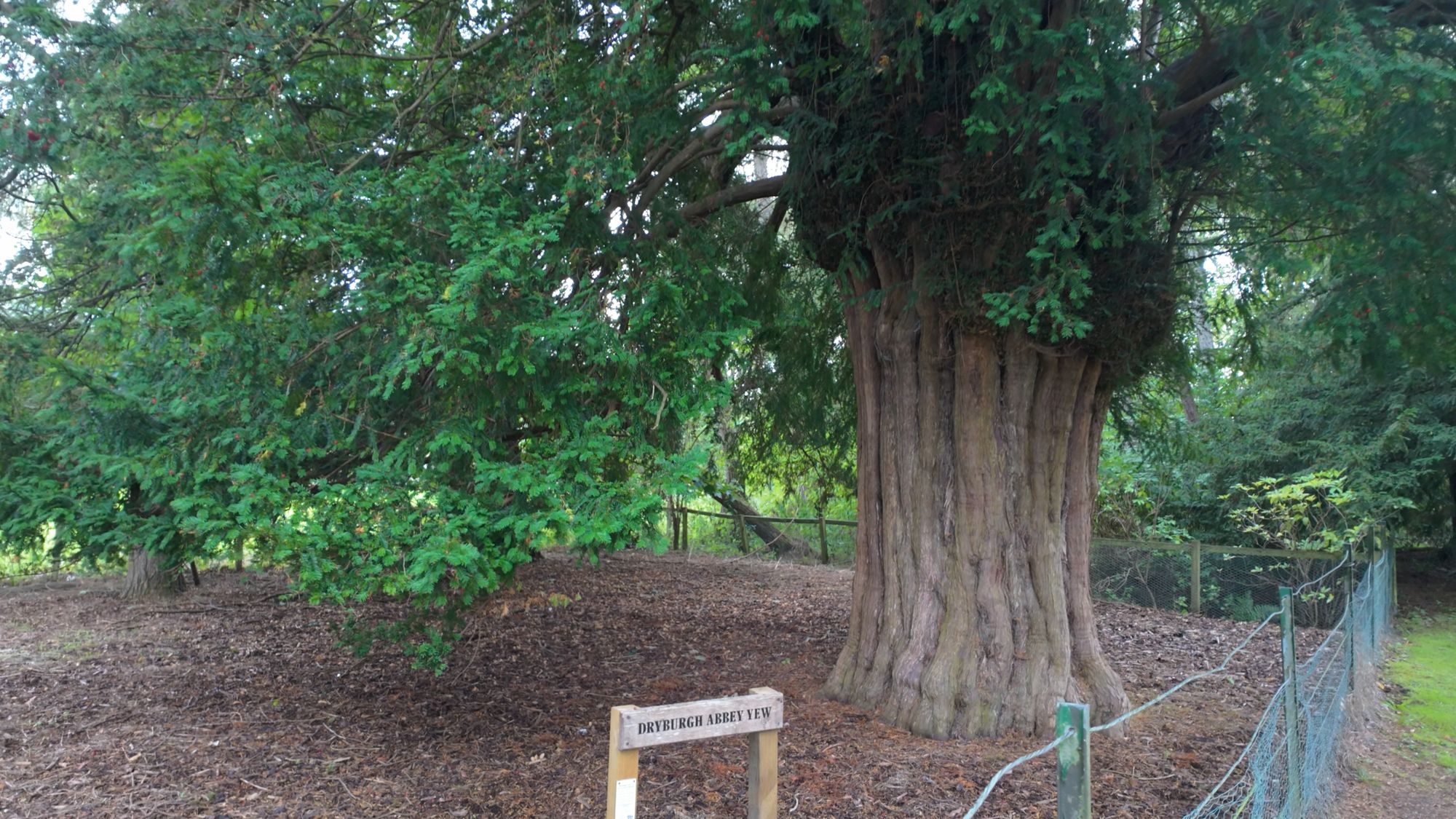
Two Graves
Two burials made Dryburgh what it is today.On 26 September 1832, Sir Walter Scott was buried in the abbey's north transept, a part of the ruin he called St Mary's Aisle. He'd died five days earlier at Abbotsford, the house he built on the Tweed a few miles west of Melrose. He had the right to be buried at Dryburgh through his Haliburton ancestors, who had once owned the abbey lands. His wife lies with him in a plain red granite tomb, and his son-in-law and biographer, John Gibson Lockhart, is buried close by.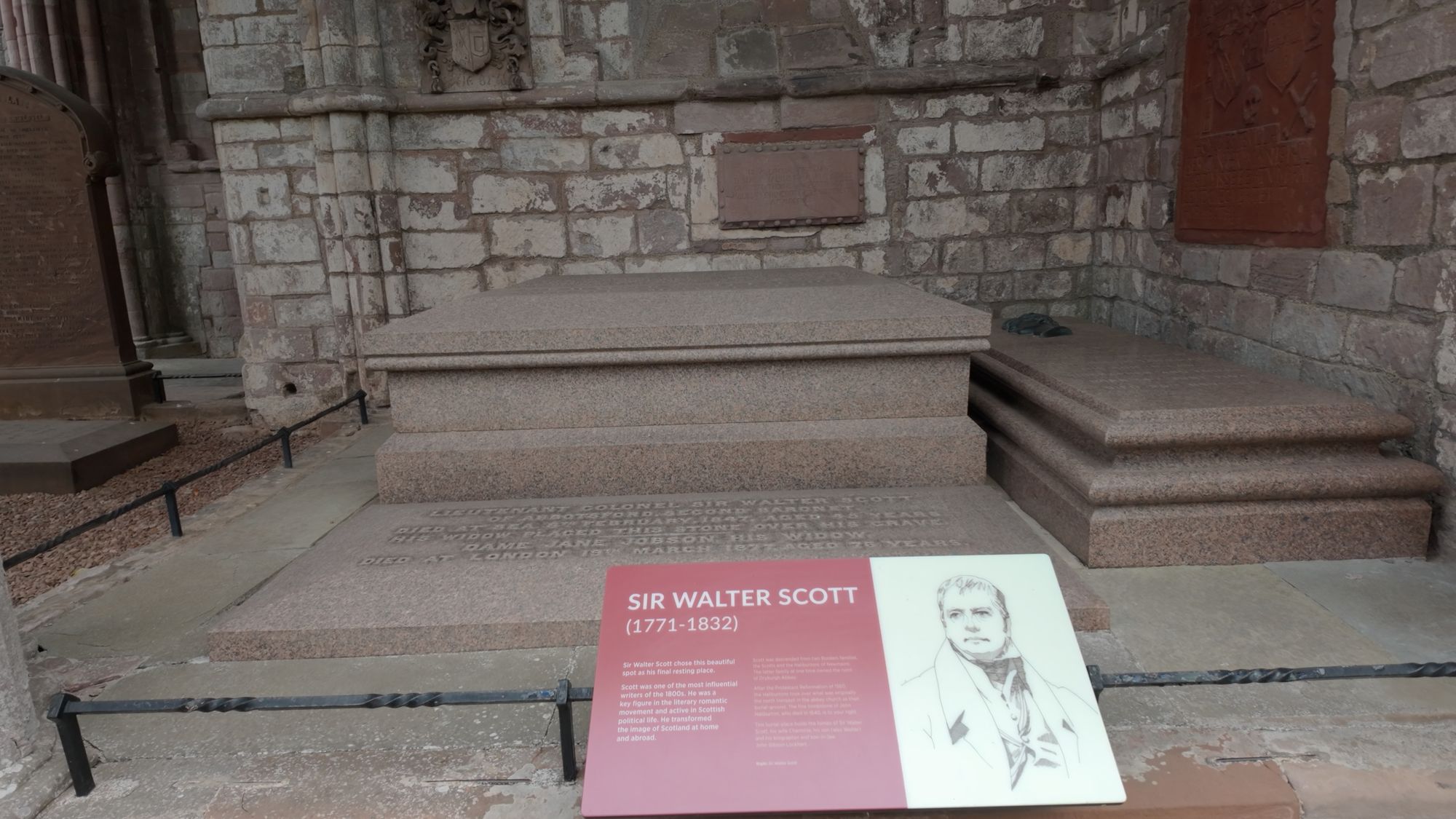
Visiting Melrose and Dryburgh
Both abbeys are cared for by Historic Environment Scotland and both are ticketed. If you're planning to see several HES sites on one trip, look at the Explorer Pass before you go.Melrose Abbey is right in town. The ticket includes the Commendator's House Museum, which is worth the time. Walk the outside of the church slowly and look up; most of the best carvings are high on the walls and roofline. Inside, a very narrow spiral stair climbs high into the ruin. It's tight going, but the view over the town and the Tweed valley is worth it.Dryburgh Abbey is a short drive away, near St Boswells, at the end of a wooded lane. It's much quieter than Melrose, and the cloister buildings are the part not to miss. Scott's house at Abbotsford and Buchan's Wallace statue are both close enough to add to the same day.The Borders really need a car. The Borders Railway gets you as far as Tweedbank, next to Melrose, but the abbeys, towers and castles are spread out across the farmland.Freedom on Wheels
Rent a car in Edinburgh for total flexibility — it's how I prefer to travel
Affiliate links • Helps fund my adventures at no extra cost to you
Tap any photo to enlarge

Want to see it yourself? Plan a trip to Scottish Borders
VagaPlan builds a day-by-day itinerary around how you travel, with real sites, opening hours, costs and booking links. Start with Scottish Borders already filled in and get 3 trip ideas free.
Perfect Places to Stay
Find the best hotels in Melrose — I always recommend booking early
Affiliate links • Helps fund my adventures at no extra cost to you
Further Reading
Books about Robert the Bruce Scottish Borders history — history, culture, and the context that makes travel richer
Affiliate links • Helps fund my adventures at no extra cost to you
Support My Travels
Affiliate links
Affiliate link — helps fund the adventures at no cost to you
More in the Series
Next Article