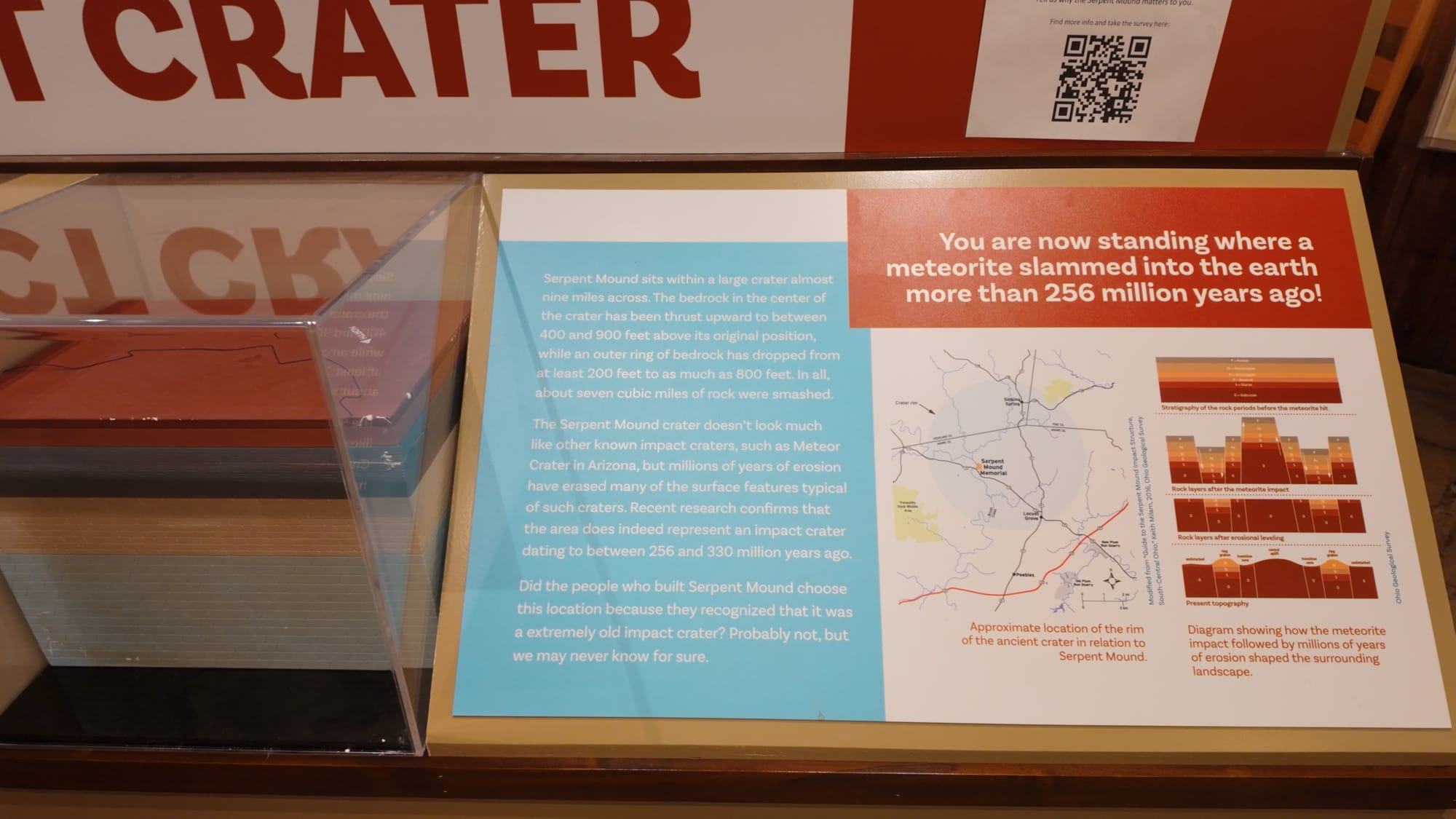
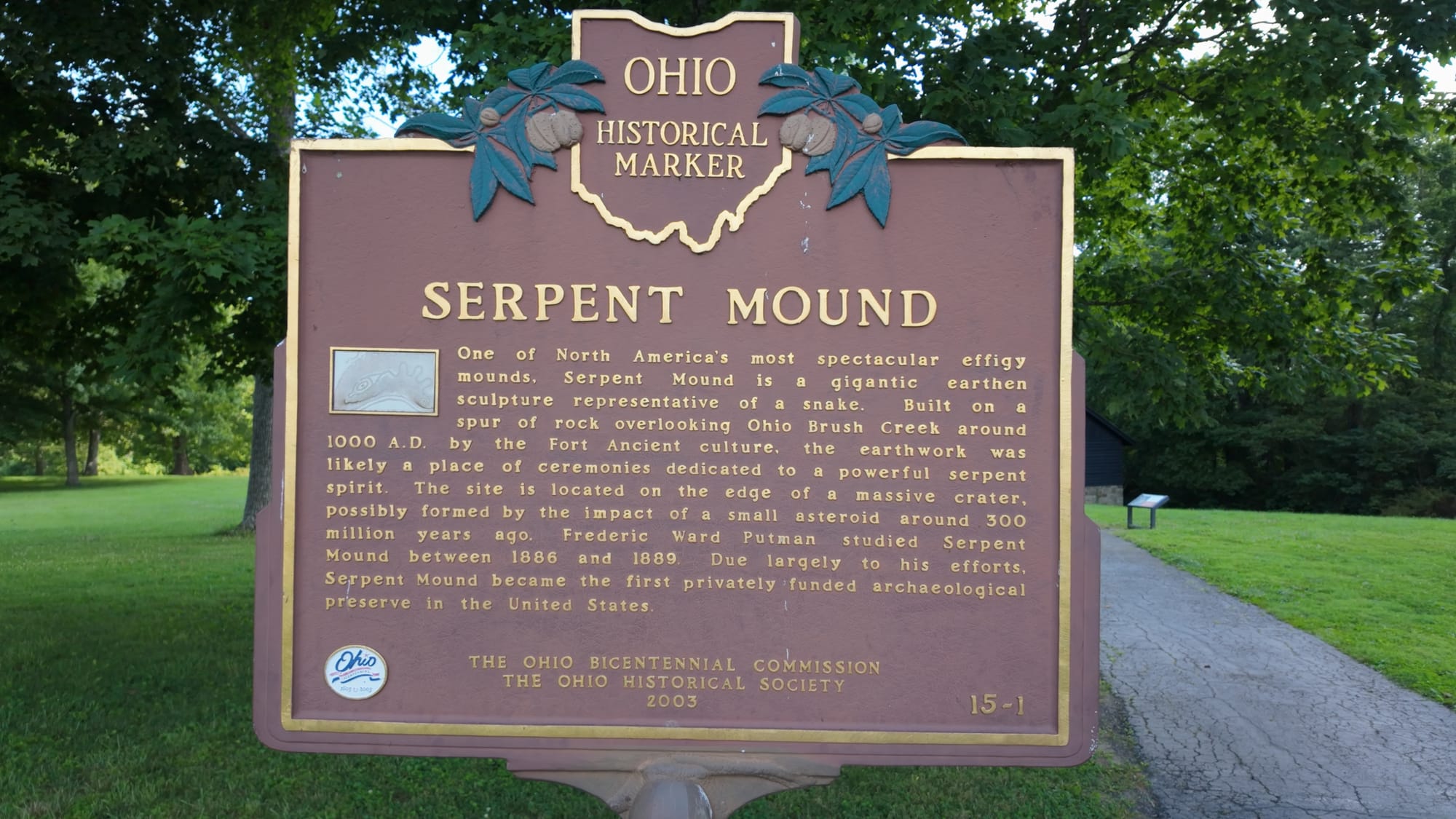
Something hit southern Ohio a few hundred million years ago. An asteroid, or a comet — nobody's fully sure which. It punched a crater roughly five miles across, and then time got to work on it: buried it, eroded it, flattened it so completely that the geologists who eventually noticed something was wrong spent decades calling it a sunken mountain, or an old volcano, or anything but what it actually was.Thousands of years later, people walked out onto the rim of that buried crater and built a quarter-mile-long serpent out of piled earth.Nobody can agree on when they did it. That's not a marketing line — it's a live argument in the archaeological literature, and it is nowhere near settled.This is Serpent Mound, outside Peebles in Adams County, about seventy miles east of Cincinnati, on a plateau above Ohio Brush Creek. It's the best-known ancient site in Ohio. It's also, by a wide margin, the one we understand the least.
The Serpent Itself
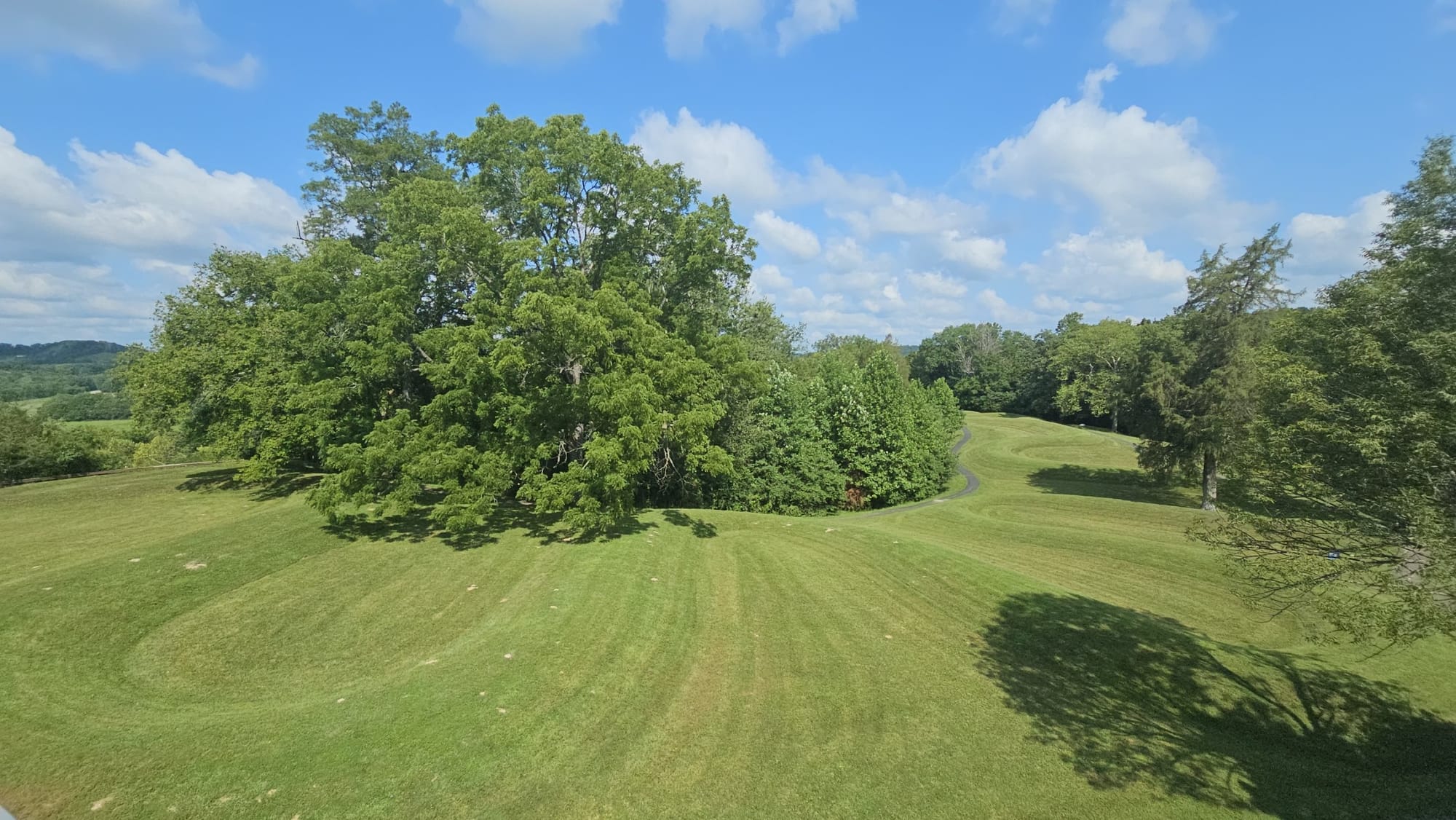
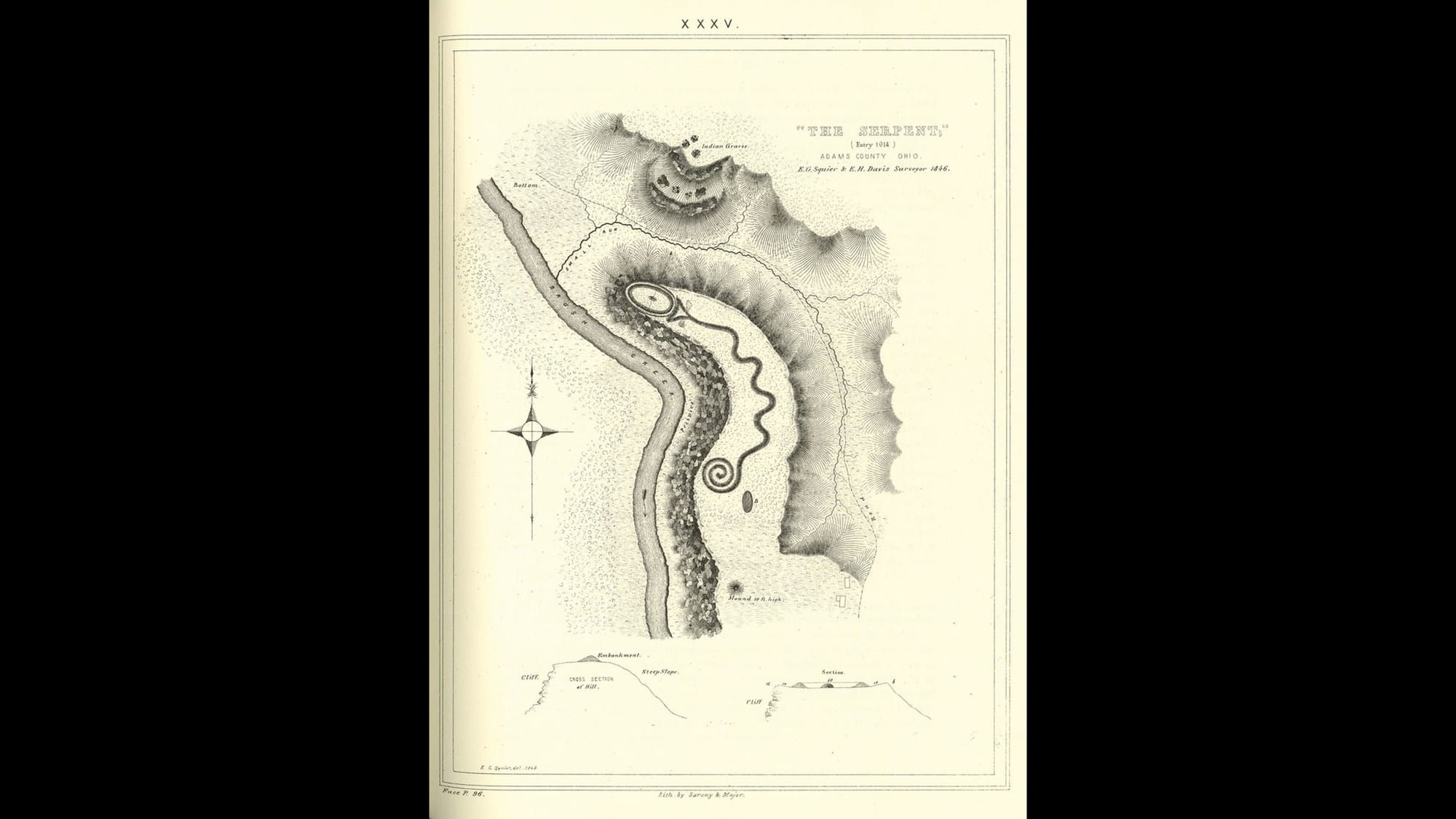
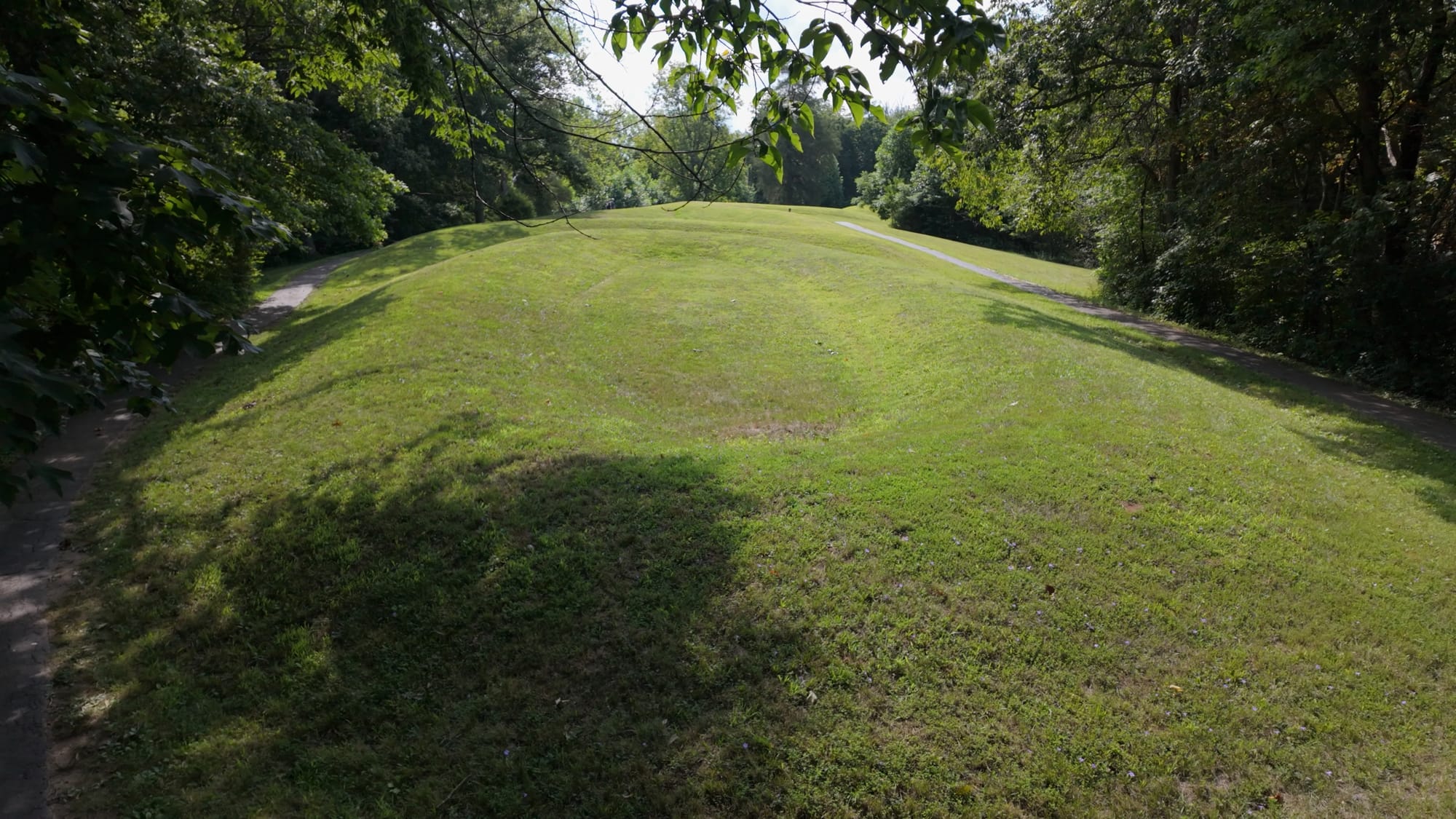
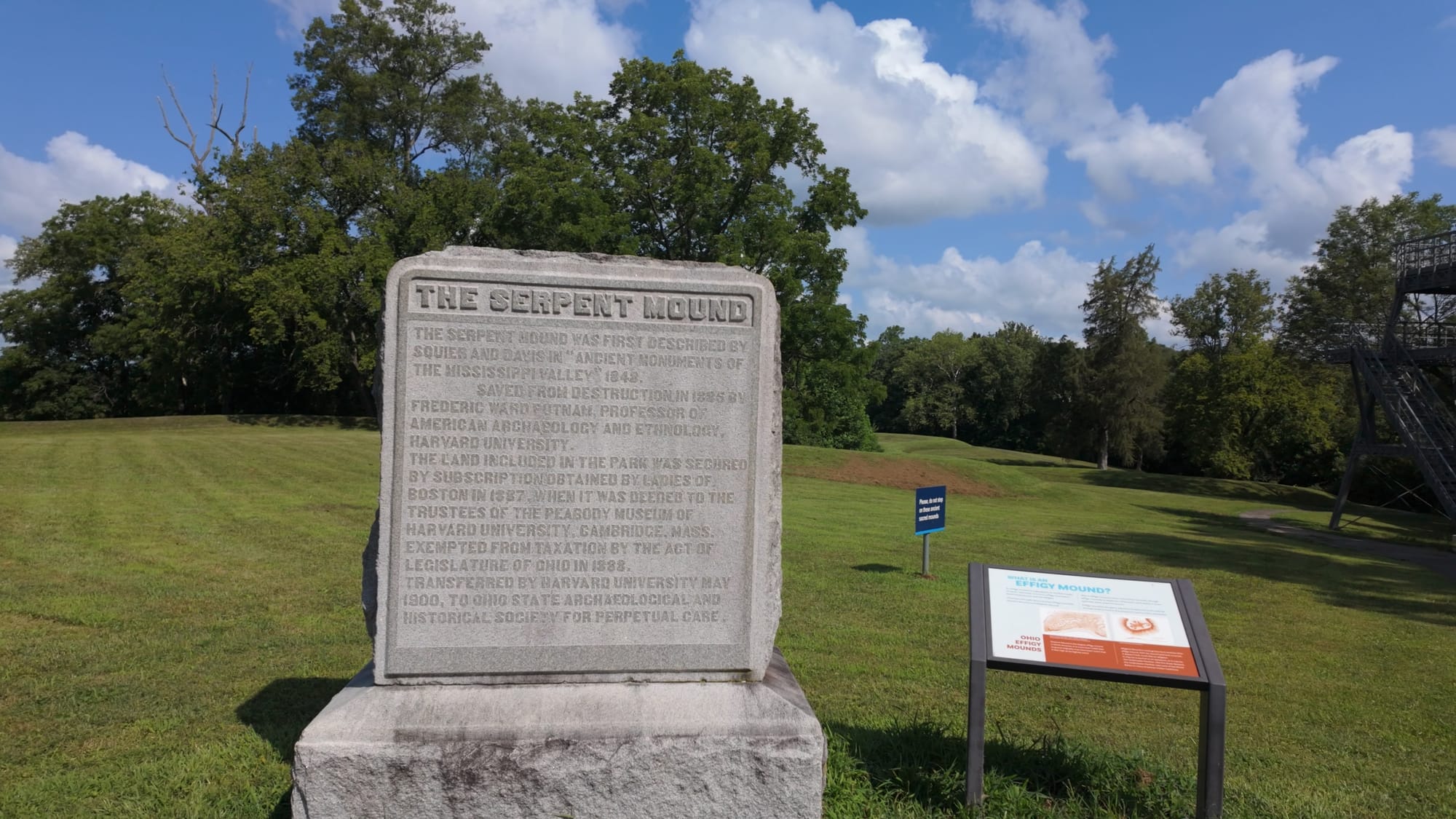
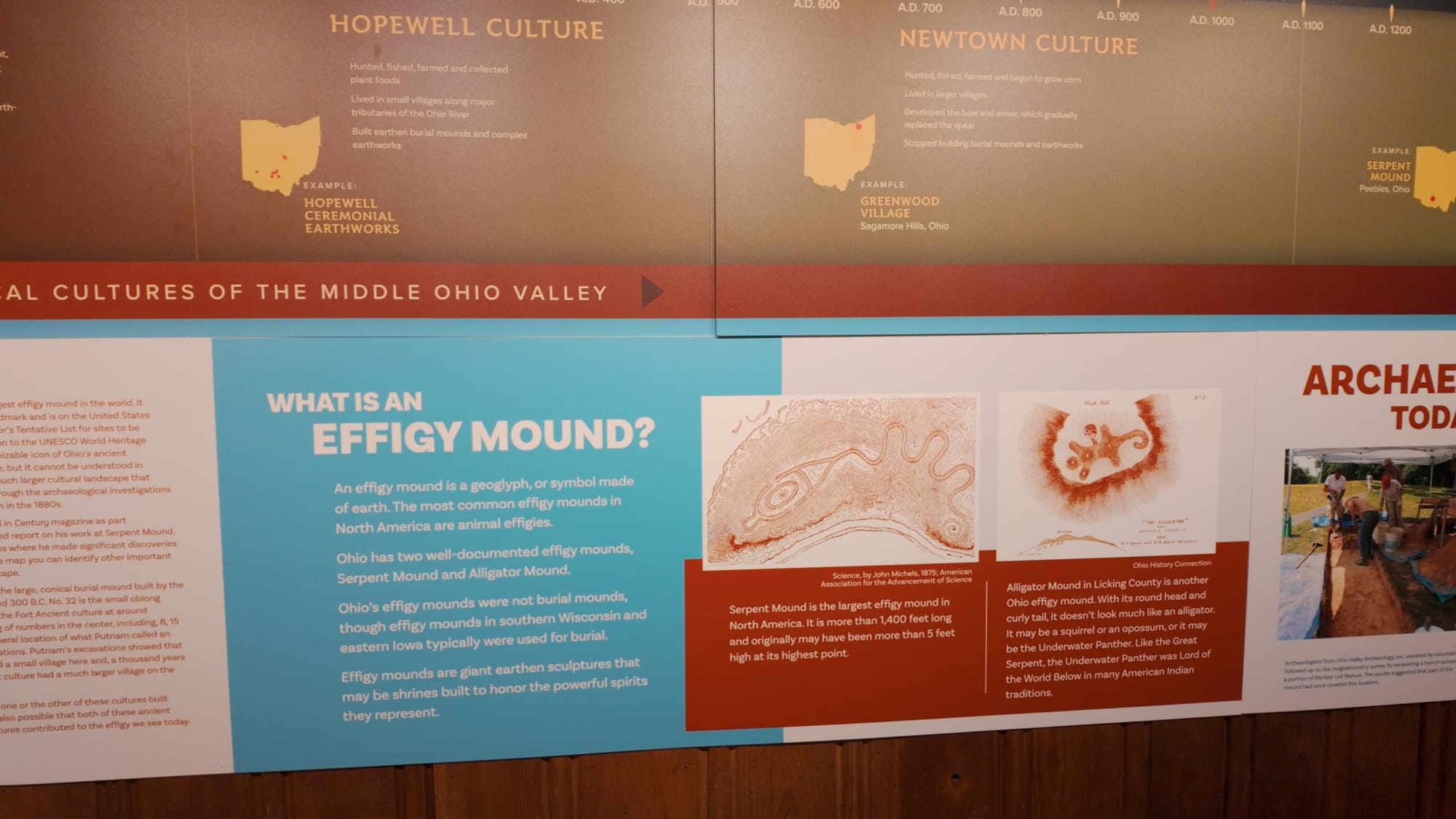
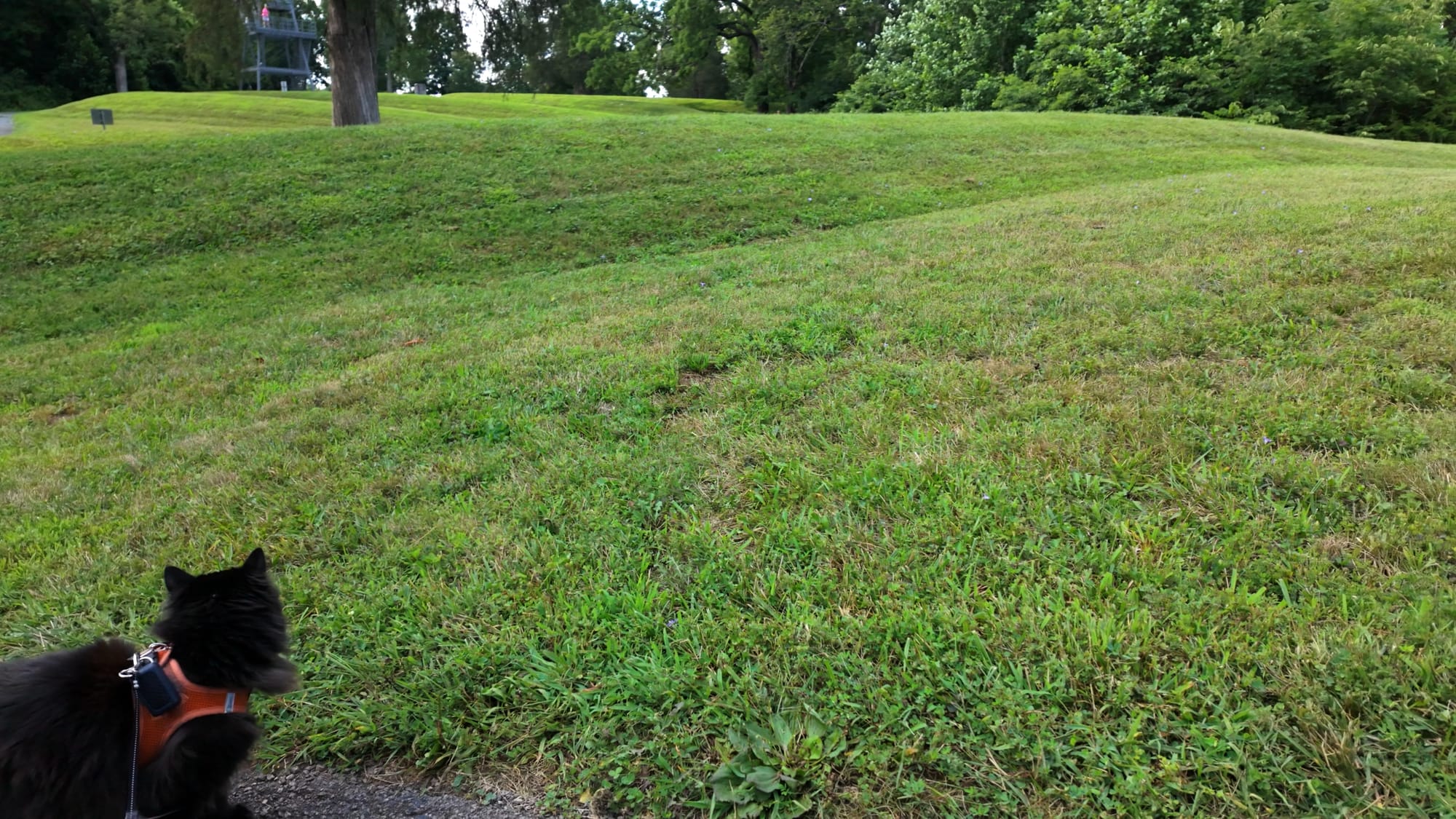
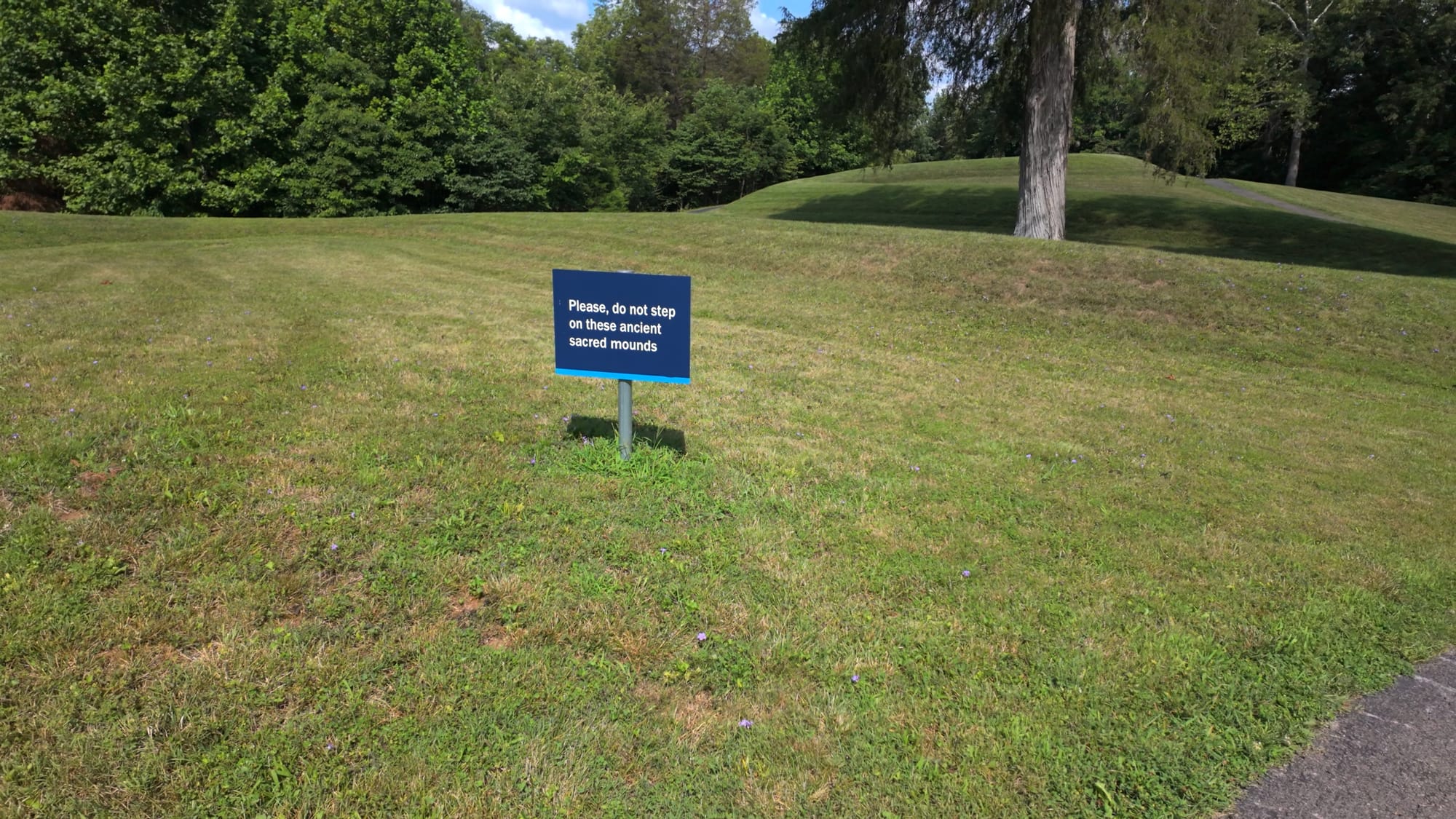
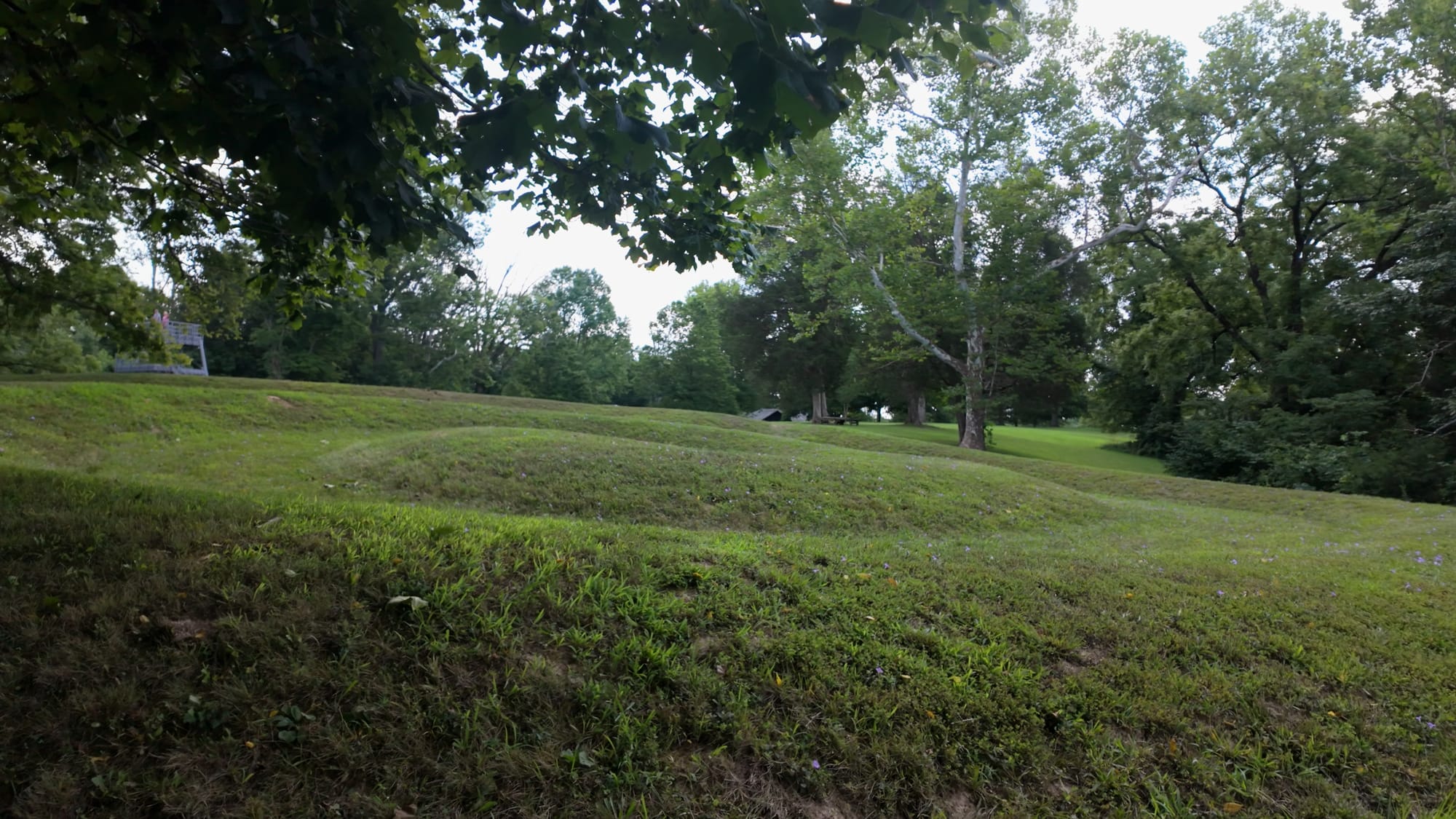
It runs 1,348 feet, head to tail — roughly a quarter mile. Seven coils through the body, a triple-coiled tail at one end, and at the other an open mouth wrapped around a hollow oval about 120 feet long.It's not tall. Three feet, give or take. Stand next to it at ground level and you're looking at a long, low ridge of grass — it's genuinely hard to tell you're looking at anything at all. That's the whole problem with this place. The shape only reads from above, which is why there's a steel observation tower on site, put up in 1908. (Check before you go — it's been closed for structural repairs for a few years now, and there's no telling what state it'll be in by the time you get there.)Ephraim Squier and Edwin Davis surveyed the serpent in 1846, and their map ran two years later in Ancient Monuments of the Mississippi Valley — the first book the Smithsonian Institution ever published. They looked at the oval in the serpent's mouth and decided it was an egg, mid-swallow. Other researchers over the years have called it the sun. Or an eye. Or the body of a frog.Egg, sun, eye, or frog. Four readings, one oval, no consensus — and there probably never will be one. If you've got a fifth after seeing the footage, the comments are open.
Ground That Isn't Normal
The plateau under Serpent Mound isn't ordinary bedrock. The rock layers there are scrambled — material that should sit deep underground turns up near the surface instead. Early geologists guessed volcano. Others guessed a collapse from below. A 1975 survey started building the case for something else entirely, and in 2003 a team of geologists working with the Ohio Department of Natural Resources confirmed it: impact. The crater itself has eroded so thoroughly that there's nothing left to see with the eye. It's the ground beneath it that gives the whole thing away — what geologists call cryptoexplosion structure, disturbed and folded rock with no volcanic material to explain it, the signature of a hit rather than an eruption.The people who built the serpent had no way of knowing any of that. They couldn't have known about the asteroid, and they had no instrument that would show them what the rock was doing beneath their feet. But out of all the ground in southern Ohio, this is where they raised the largest effigy mound in the world. Maybe there was something about this place that felt different. Maybe it's simply where they already were. Nobody knows, and it's worth being skeptical of anyone who claims otherwise.
The Actual Mystery
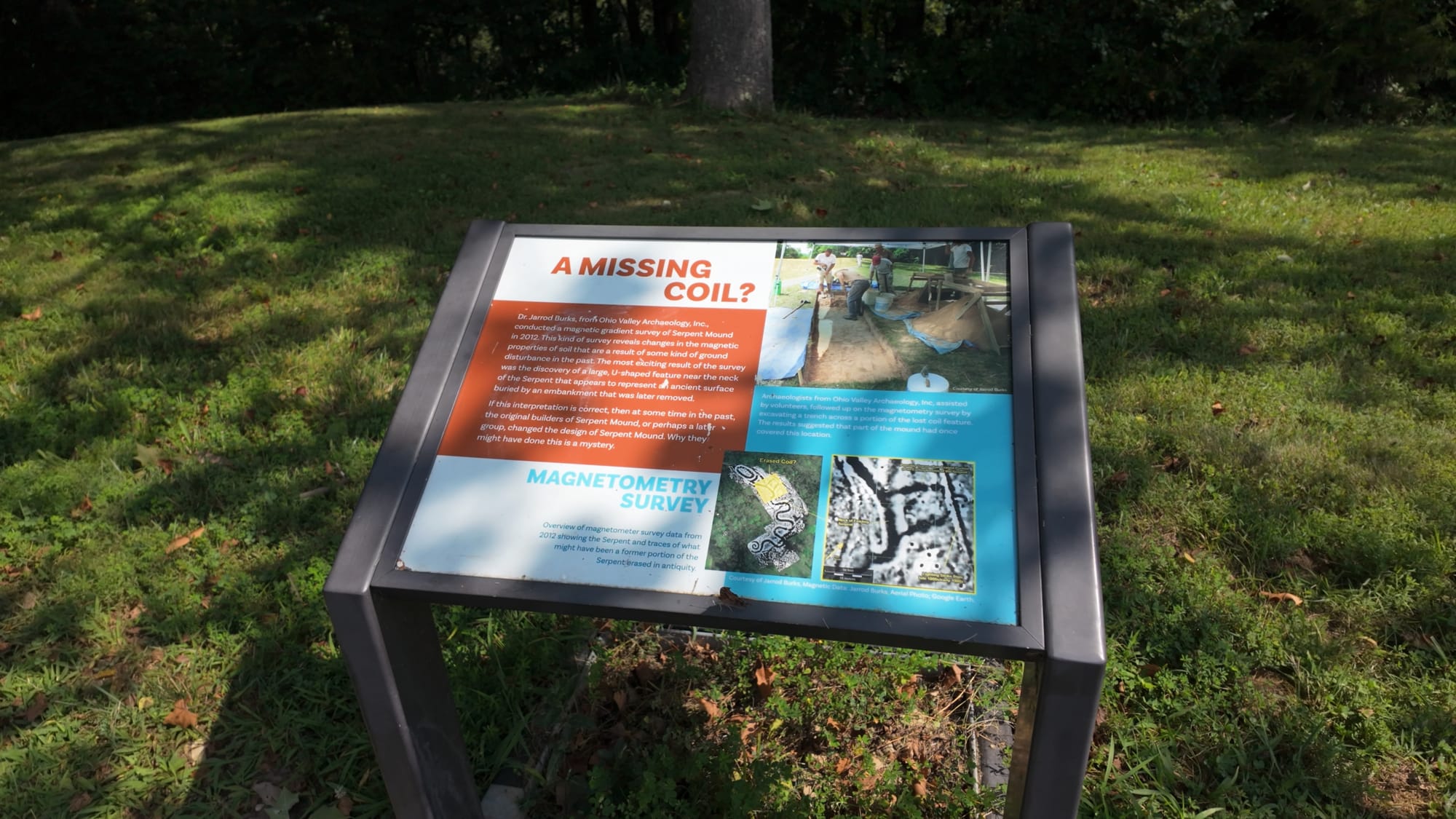
For more than a hundred years, the standard answer was the Adena culture, which occupied the region from roughly 800 BCE to about 100 CE and is well known for building burial mounds — including a couple that sit right next to the serpent. The logic seemed reasonable: Adena mounds nearby, so an Adena serpent.The problem is that the serpent itself is empty. When Frederic Putnam, a Harvard archaeologist, cut trenches into it in the late 1880s, he found nothing inside — no burials, no tools, none of the artifacts normally used to date a mound. This was never a burial site. The Adena attribution was never based on evidence inside the serpent. It was based on its neighbors.Then, in the 1990s, a team pulled charcoal from within the mound and ran radiocarbon dates. The results came back at roughly 1070 CE — not Adena at all, but Fort Ancient, a culture that didn't exist until nearly a thousand years after the Adena had faded out.Which happens to be the same culture that moved into the walls of Fort Ancient Earthworks a thousand years after the Hopewell built them, and got the name pinned on them by archaeologists who hadn't yet worked out who'd actually built what. So one of the two leading candidates for Serpent Mound's builders is a people named after a place they had nothing to do with. That's the actual state of the field.For a while, the 1990s date looked settled. Then in 2014 a different team took soil cores from beneath the mound, dated the organic material inside them, and got roughly 320 BCE — swinging the argument back toward the Adena. That team also argued the 1070 CE date was real, just not a construction date: that Fort Ancient people had repaired an already-ancient serpent centuries after the original builders finished it.Brad Lepper, one of the archaeologists behind the earlier charcoal study, pushed back hard, and the disagreement is technical in a way that matters. The 2014 samples weren't charcoal — they were organic material pulled from soil cores, and that kind of sample can read far older than whatever layer it's actually sitting in, thanks to older carbon getting redeposited by water and erosion. His own team's charcoal dates, re-run, came back around 700 CE. He also points out that the Adena aren't known for effigy mounds or serpent imagery at all, while the Fort Ancient culture built at least one other effigy mound in Ohio and used serpent motifs throughout its art.That went back and forth in the journals for years — rejoinders, replies to rejoinders, replies to those.Here's where it actually lands, and it's a more interesting answer than either side simply winning: both camps now accept that none of the dated samples can be reliably tied to the actual moment of construction. Every date anyone has produced is what archaeologists call a terminus post quem — it tells you the mound existed by some point, not when it was built. So the honest answer to who built Serpent Mound, and when, is that nobody currently knows — and the researchers arguing about it will tell you that themselves.Sit with that, because it matters for what comes next.There's also a stranger wrinkle nobody expected. In 2012, Dr. Jarrod Burks of Ohio Valley Archaeology ran a magnetic gradient survey across the site — a technique that reads disturbances in the soil's magnetism left behind by digging, filling, or building, long after the ground looks flat and undisturbed to the eye. The survey turned up a large U-shaped feature near the serpent's neck that appears to be a buried, older ground surface — one that used to be covered by an embankment that isn't there anymore. Volunteers followed up with an excavated trench and the data held up: part of the serpent's body, once present, seems to have been erased.If that reading holds, then at some point in the past — the original builders, or a later culture entirely — someone changed the design of an already-existing serpent. Why is anyone's guess. It's one more thing this site keeps refusing to resolve.
The Nonsense That Fills a Vacuum
An absence of certainty is an opening, and this place has been filled with nonsense for two hundred years.The oldest and ugliest version is the Moundbuilder Myth — the claim that Native Americans couldn't have built the earthworks, that it must have been a lost white race, or Israelites, or Atlanteans, or giants. This wasn't a harmless fringe theory. It was a story manufactured by 19th-century settlers who wanted the land, and deciding the people already living on it hadn't built anything worth respecting made taking it easier to live with. Archaeology has considered it dead for over a century. It is still circulating.In 2021, a group came to Serpent Mound to cast out demons. Their leader claimed Ohio's earthworks were built by Nephilim, a race of giants, and said — this is a direct quote — "This has nothing to do with the Indians." Members of the American Indian Movement of Ohio showed up to protest. That happened in 2021, not 1850.Then there's the softer version: energy vortexes, dowsing rods, ancient astronauts, Atlantean star maps. Every solstice draws a crowd, and some of it is harmless. Some of it is the same idea wearing better clothes.So, plainly: Serpent Mound was built by Native Americans. The dispute is over which culture, and which century. That's the entire real argument. Anyone selling giants, aliens, or a lost civilization isn't offering an alternate theory — they're recycling a story that was written to justify taking this land, and doing it on top of a place many people still consider sacred.
The Astronomy, Which Is Real and More Modest Than You've Heard
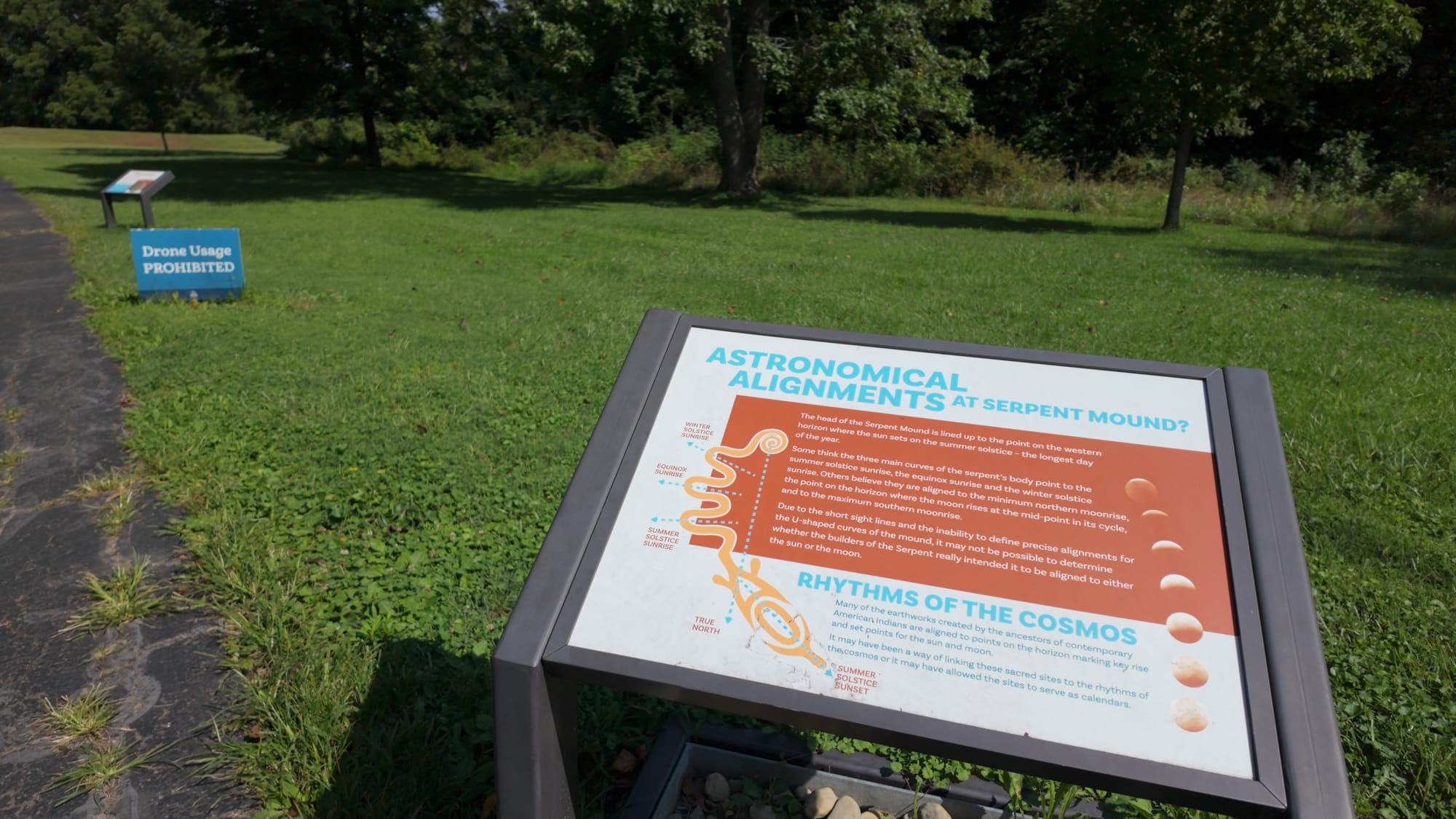
The serpent's head, and the oval in its mouth, line up reasonably well with the point on the horizon where the sun sets on the summer solstice. On the longest day of the year, people still gather here to watch it happen.But there's a wrinkle. The ridge the serpent is built along — the spur of high ground itself — already points in roughly that direction. So the alignment could be deliberate. Or the builders might have chosen this particular ground because it already had that alignment. Or the serpent simply follows the shape of the land it's on, and the sun does what the sun always does. All three remain live possibilities.Beyond the solstice alignment, be skeptical of anything more elaborate. Researchers have matched the serpent's three big body curves to solstice and equinox sunrises. Other researchers have matched those same three curves to lunar events instead. The sight lines involved are short and the curves are broad, which means there's enough slack in the geometry to make it point at nearly anything you're looking for. Ohio History Connection's own official position is that we may not be able to determine whether the builders intended any celestial alignment at all. When the organization that manages the site is that careful, it's worth being that careful too.
How It Almost Didn't Survive
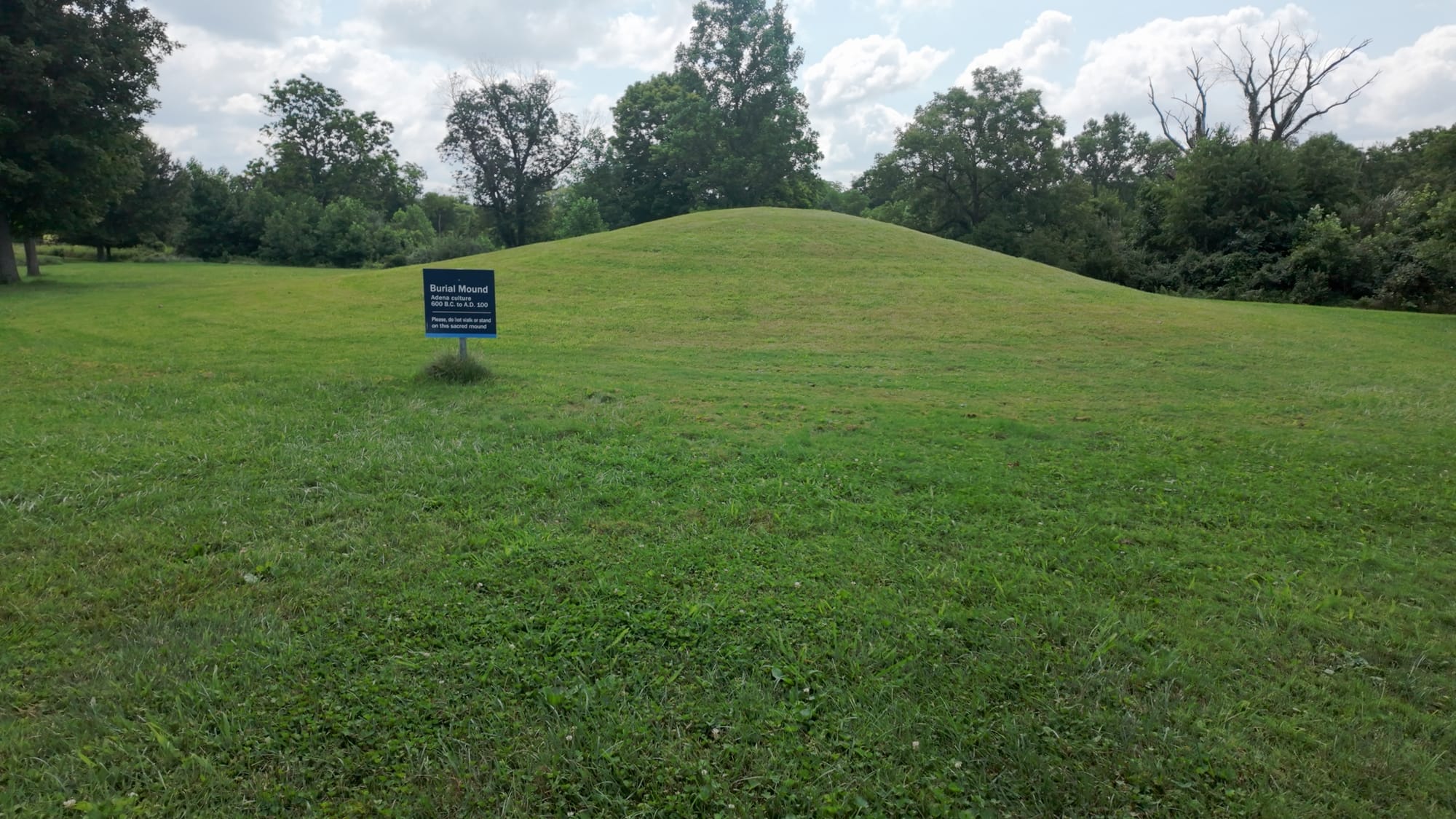
In 1859, a tornado tore across the promontory and stripped it bare. After that, the land was farmed. Cattle walked over the effigy. Plows ran across it. Souvenir hunters dug into it and left the holes open, and the rain did the rest.The person who intervened was Putnam. He came through in the 1880s, saw how quickly the mound was deflating, and decided it had to be purchased outright to save it. He didn't have the money himself. It was raised for him by a group of women in Boston, organized by Alice Fletcher, who funded the purchase by subscription. Sixty acres, bought in 1887 on behalf of Harvard's Peabody Museum.Sit with that one too — the reason you can stand at Serpent Mound today is that a circle of women several hundred miles away decided a giant prehistoric serpent in rural Ohio was worth saving, and paid for it themselves.Putnam excavated the site and restored the effigy to something close to its original dimensions. Harvard ran the property as a public park until 1900, when it was deeded to the Ohio Archaeological and Historical Society — which exists today as the Ohio History Connection, and still holds the site. There's a small on-site museum, a path built to keep visitors off the mound itself, and the tower.There are Adena burial mounds on the property too — the culture whose presence originally, and mistakenly, got credited with building the serpent itself.
Still Sacred Ground
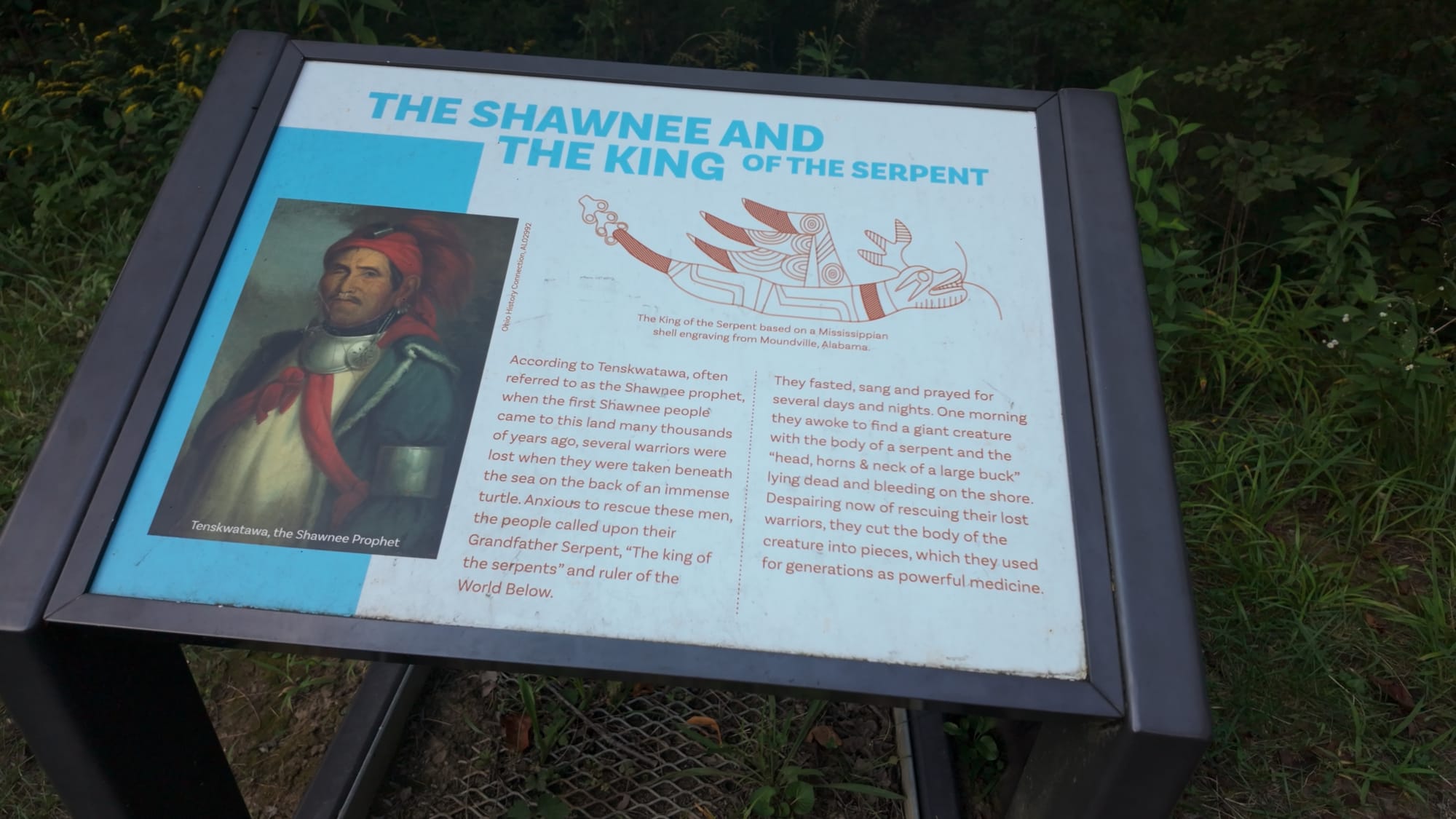
This is not an artifact. For the Shawnee, and for other Native nations with ties to this region, Serpent Mound is sacred ground — not formerly sacred, currently sacred. The chief of the Shawnee Tribe has written about the site alongside the Ohio History Connection's own archaeologist, the same researcher arguing the Fort Ancient case in the dating dispute above.There are burial mounds on the property, and a path built to route visitors around every one of them. Stay on it. Not for the grass — for the people this place still belongs to.Fort Ancient is a World Heritage-caliber site we can mostly explain: who built it, roughly when, roughly why. Serpent Mound is more famous, more visually striking, and by a wide margin the one we understand least. We don't know who made it. We don't agree on when. We can't fully explain why it's shaped the way it is, or why it sits where it sits.And it's still sacred to living people — two thousand years on. Or one thousand. Nobody's sure. That's rather the point.Ohio Hidden Corners is an ongoing series covering the overlooked, the odd, and the genuinely worth finding across Ohio. Episode 6 covers Serpent Mound in full — watch it below.
Want to see it yourself? Plan a trip to Southern Ohio
VagaPlan builds a day-by-day itinerary around how you travel, with real sites, opening hours, costs and booking links. Start with Southern Ohio already filled in and get 3 trip ideas free.