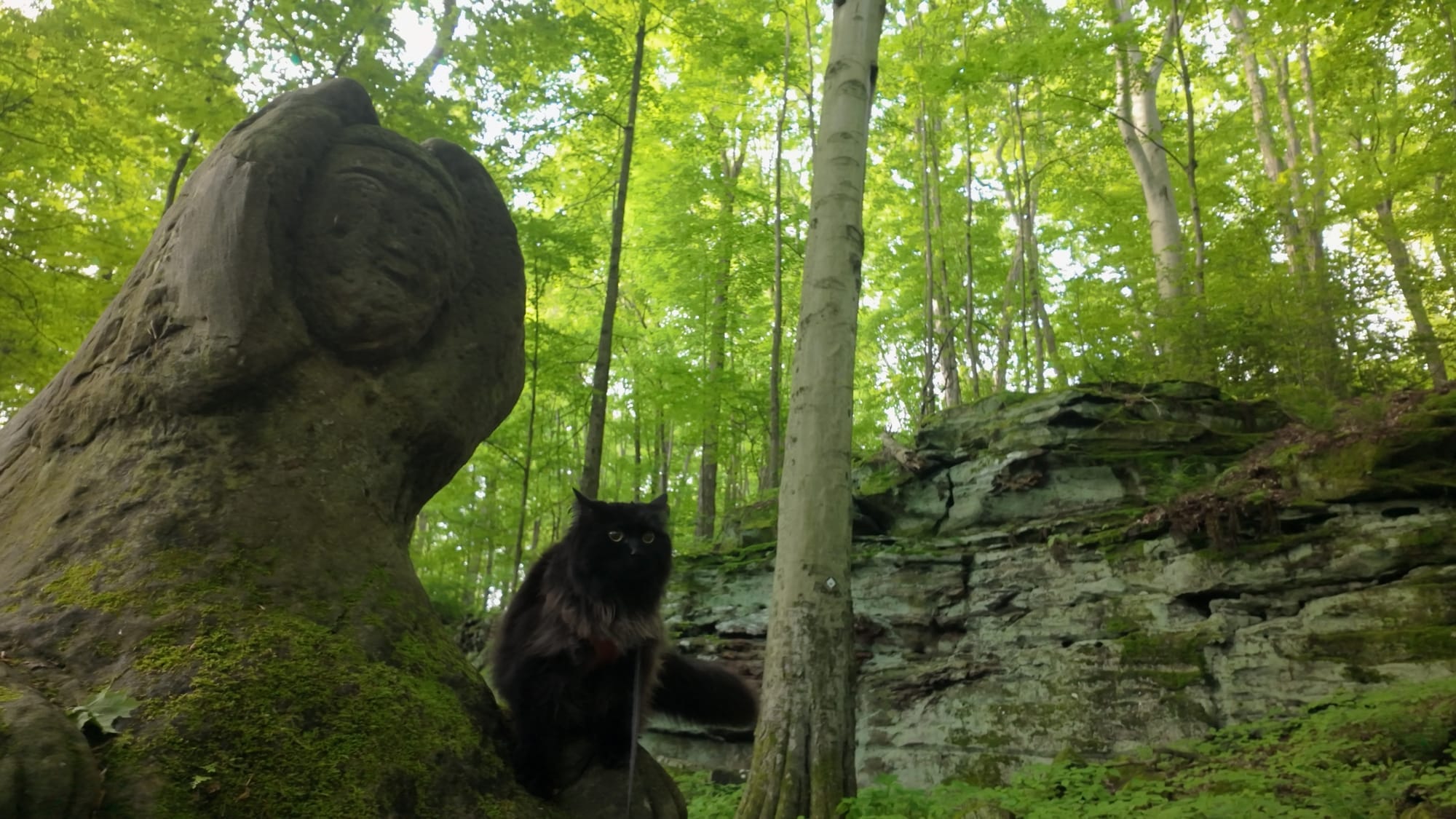
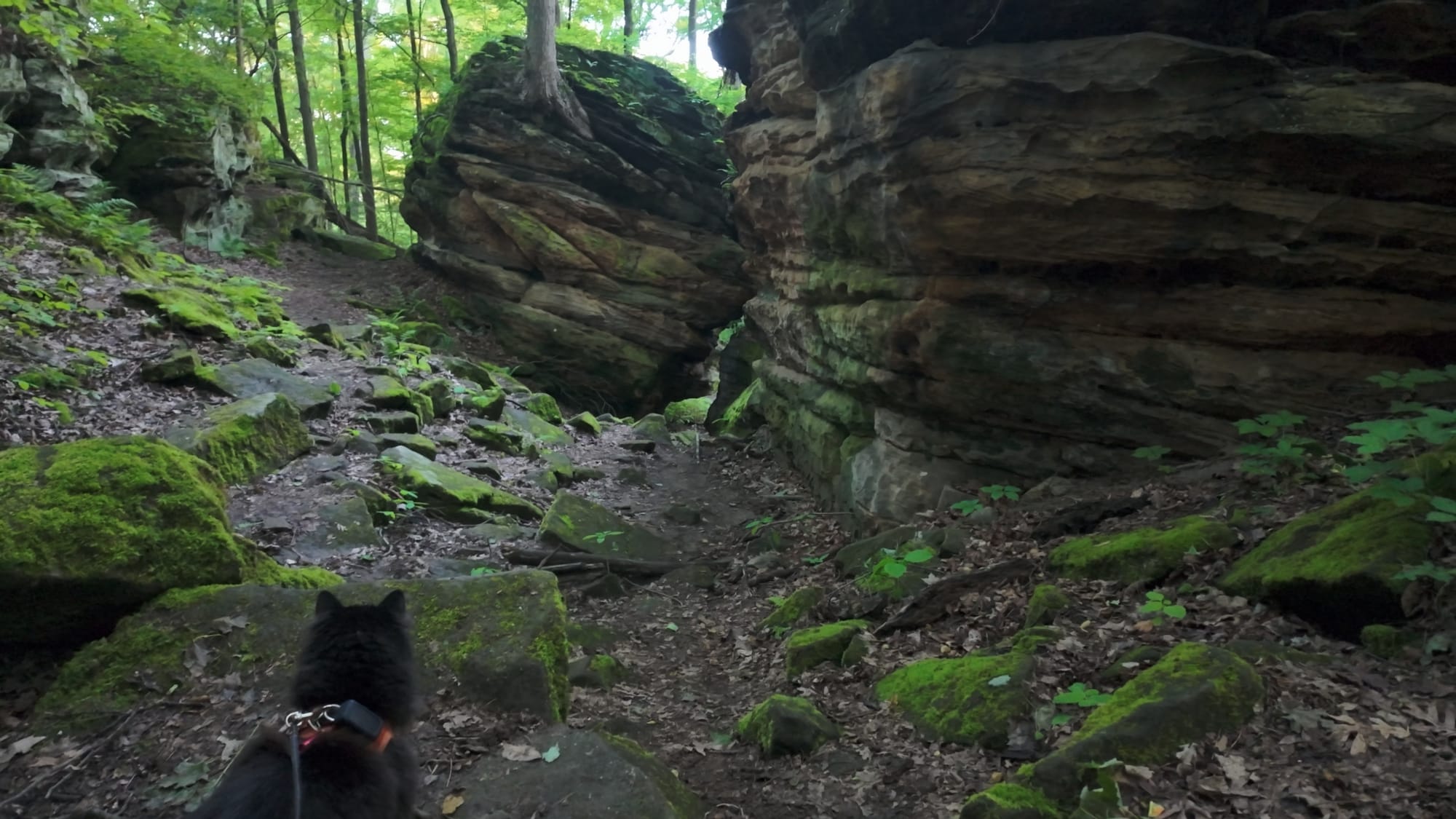
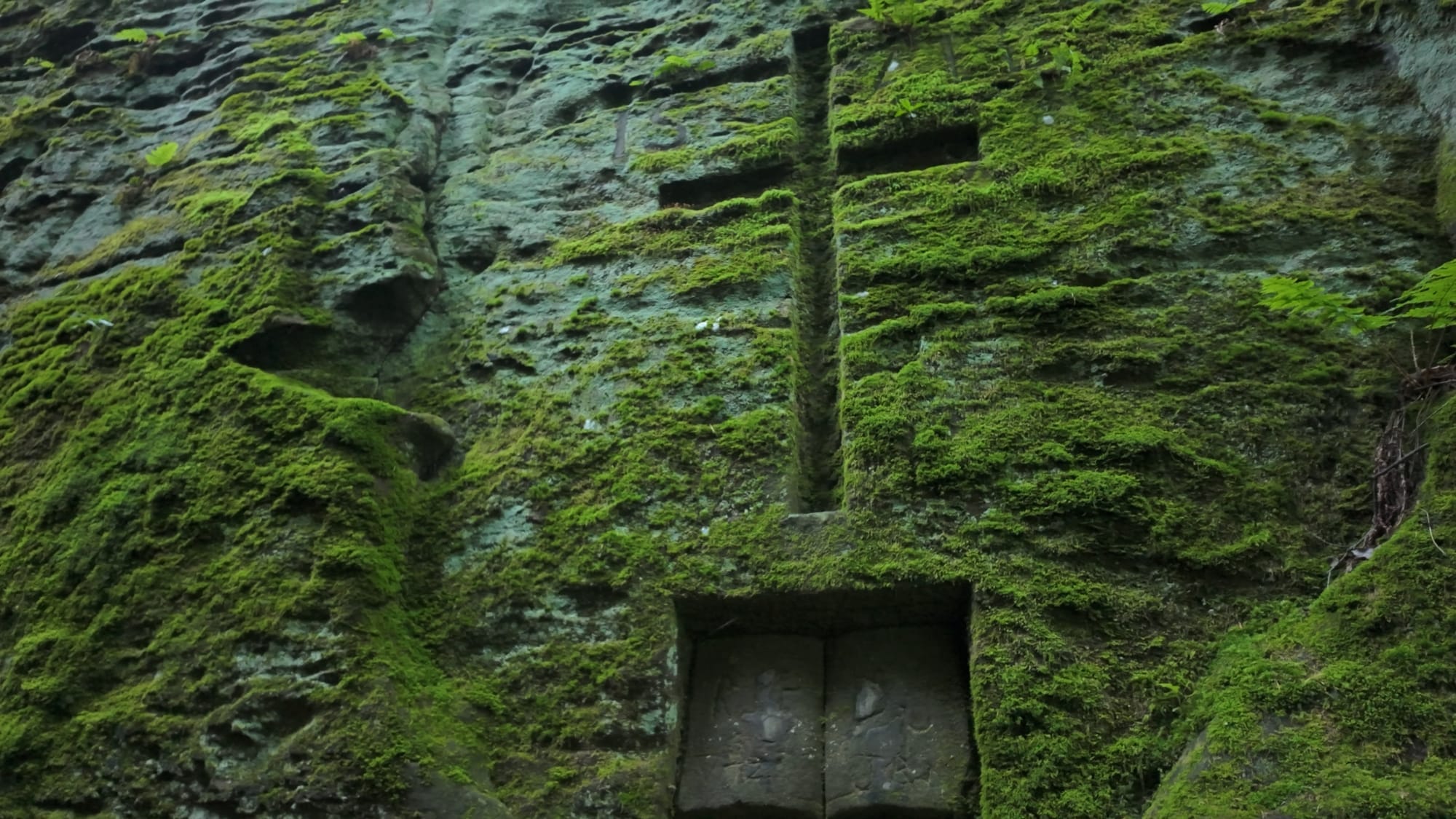
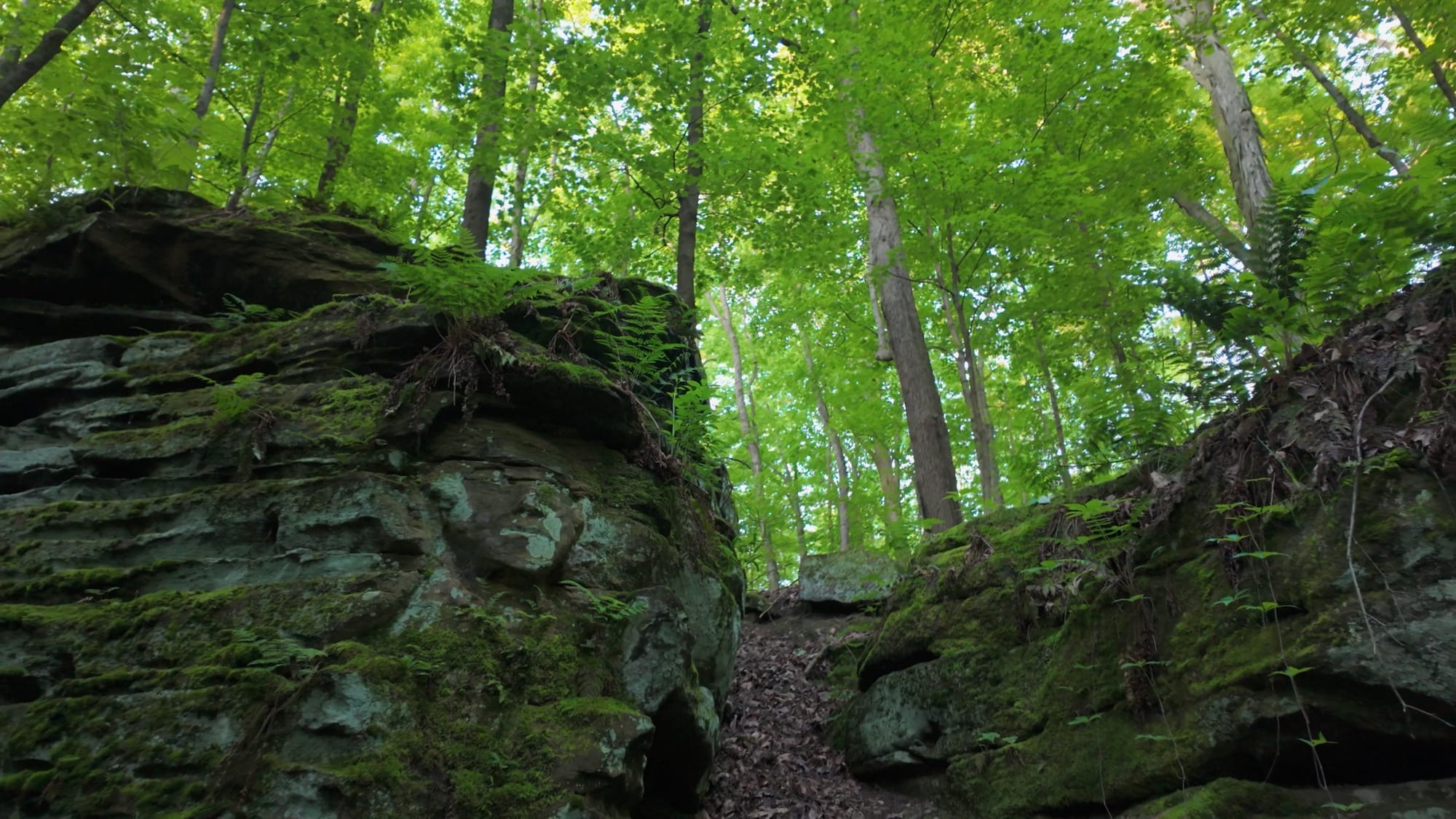
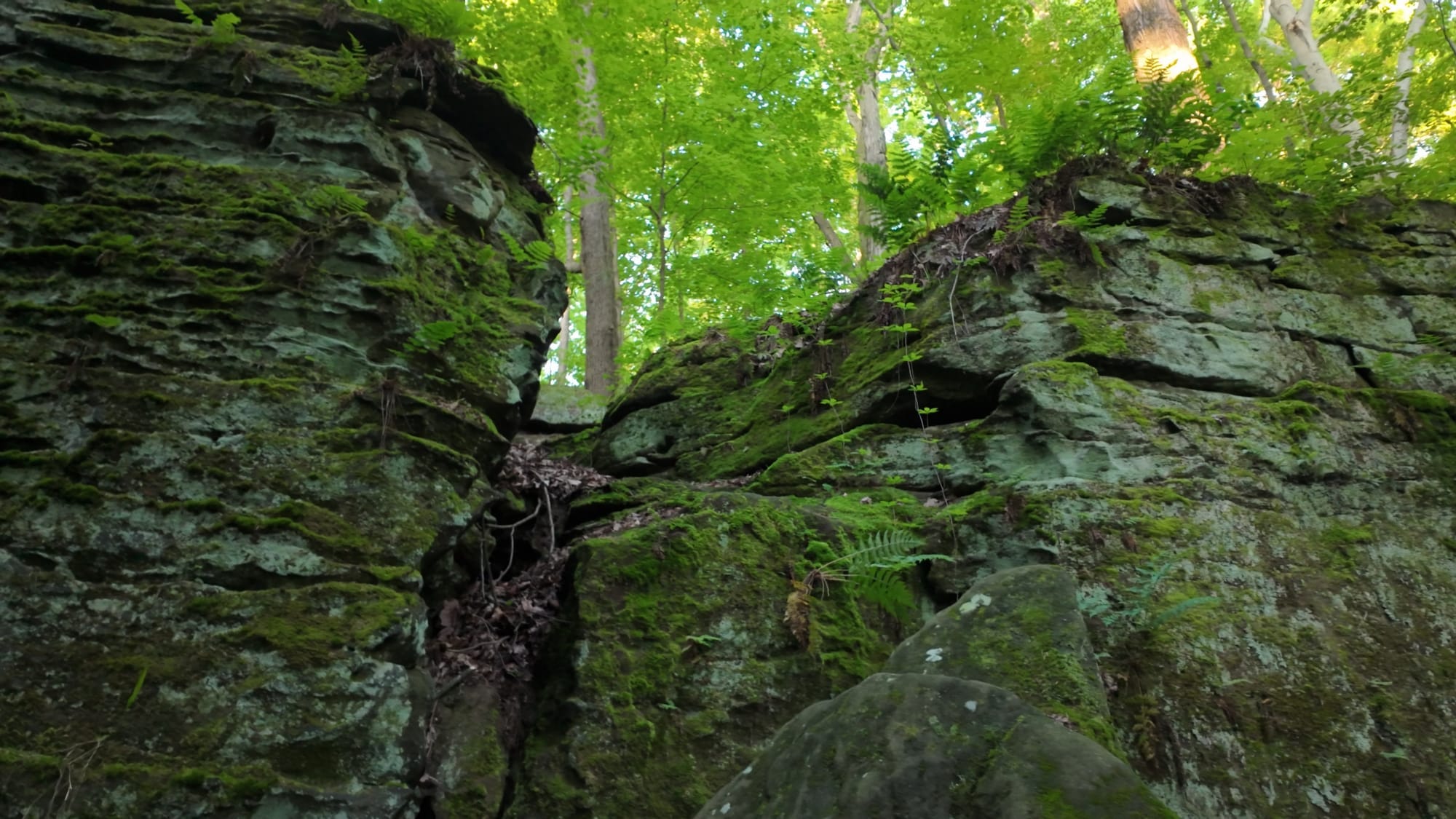
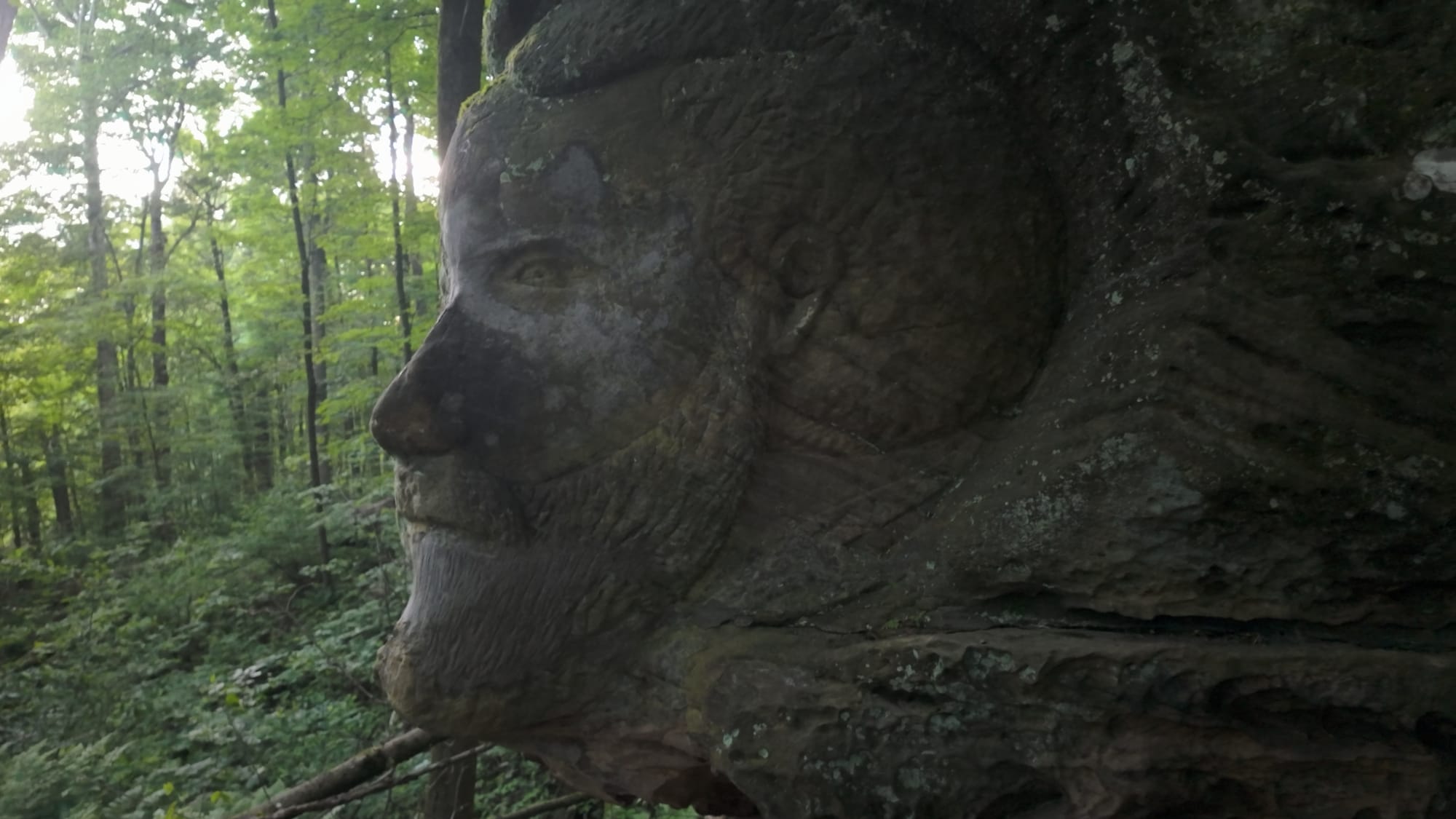
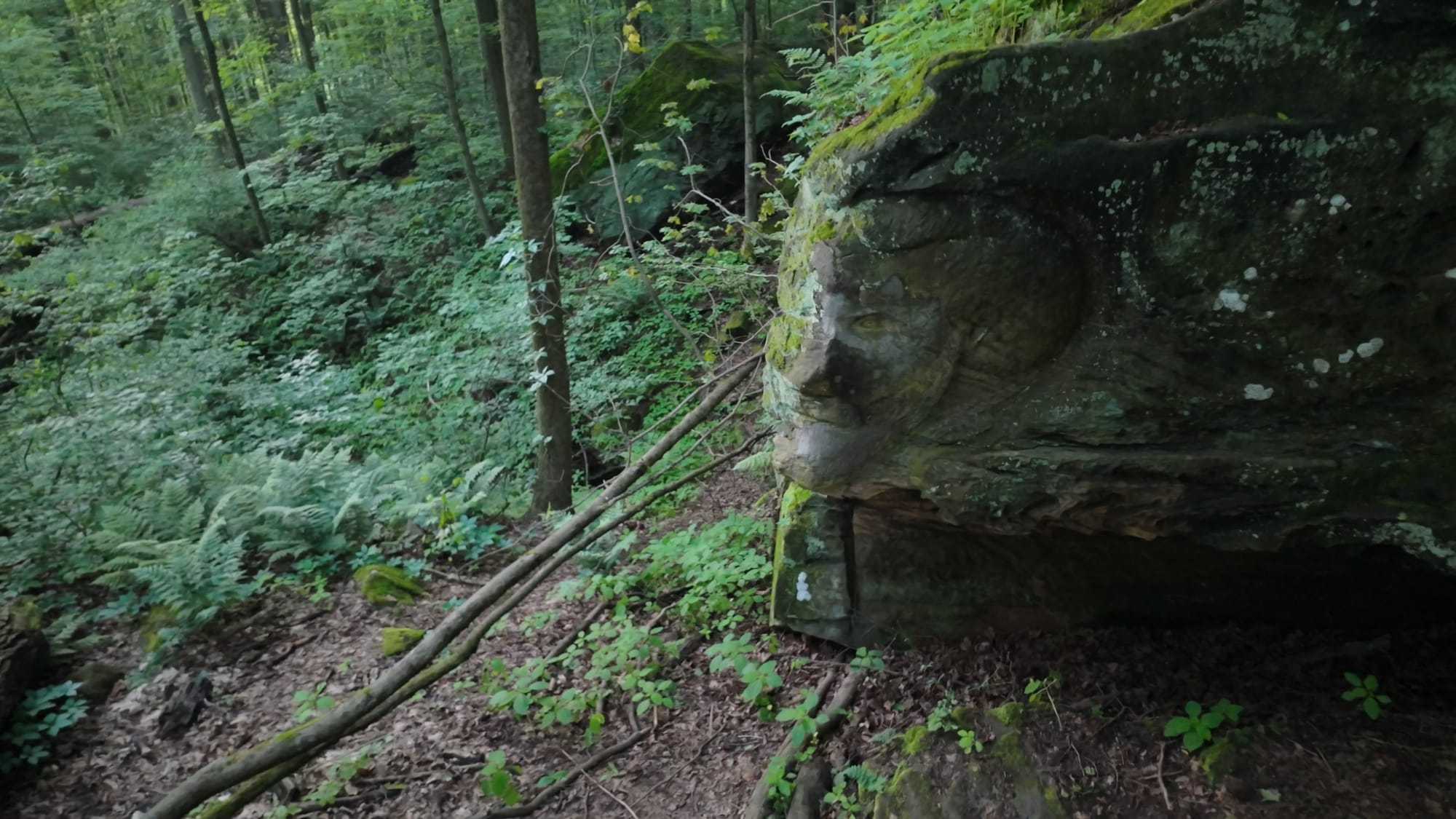
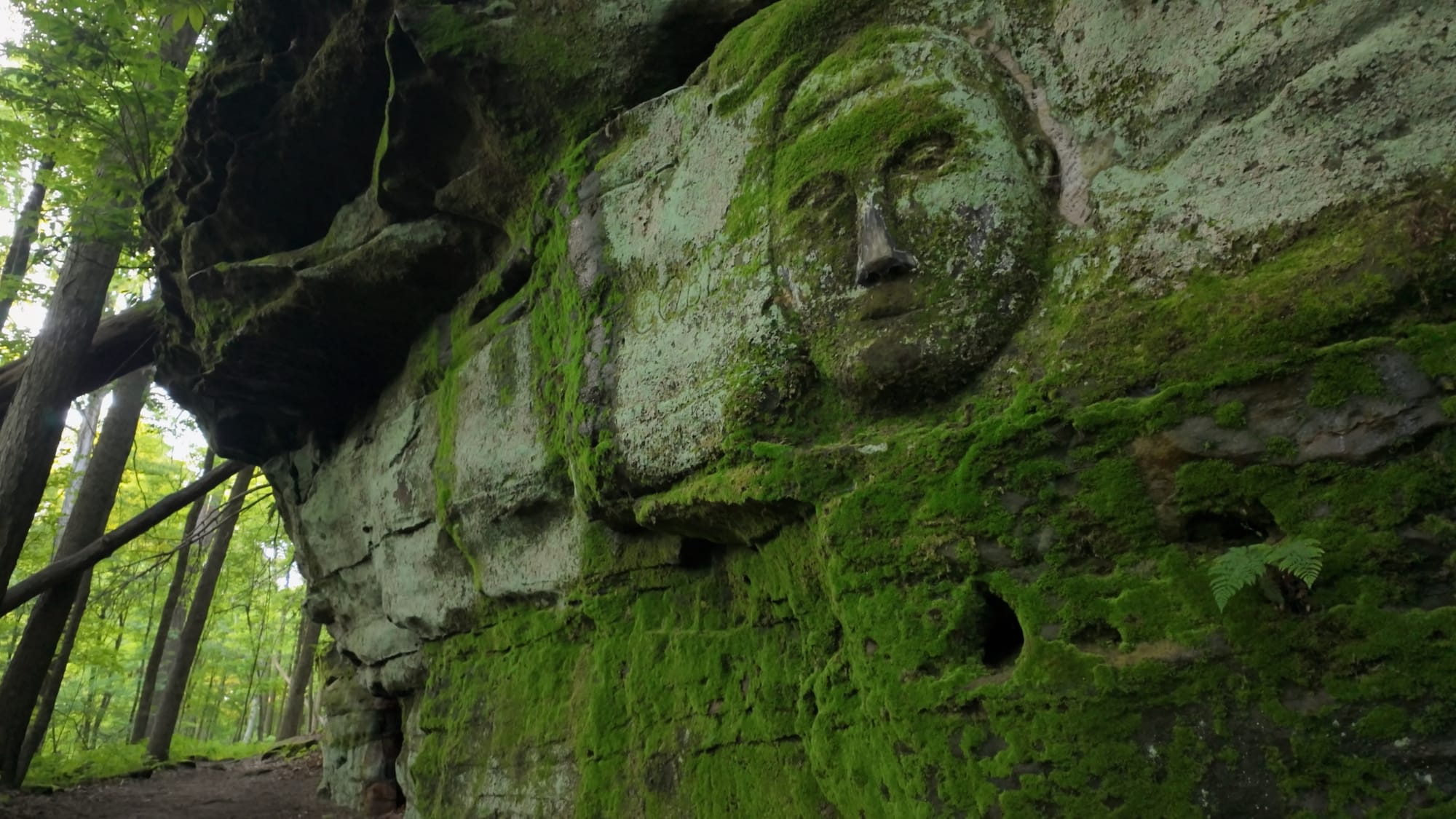
Somewhere in the middle of the Worden's Ledges Loop Trail in Hinckley Reservation, you walk around a corner and there is a sphinx. Fourteen feet of carved sandstone, mossy and weathered, sitting in an Ohio forest like it has always been there and you are the one who arrived late.There's no sign explaining it and no plaque with the artist's name. The trail markers in this part of the Hinckley Reservation have raccoon faces on them, which about covers the level of formal orientation on offer. The loop is 0.7 miles, part of the Cleveland Metroparks, about thirty miles south of Cleveland, and most people who hike it on a weekend afternoon walk past the sphinx the same way they walk past everything else on the trail — without knowing what they're looking at or why it's there. That's a shame, because the story behind these ledges is considerably stranger than anything a trail sign would tell you anyway.
Three Hundred Million Years of Setup
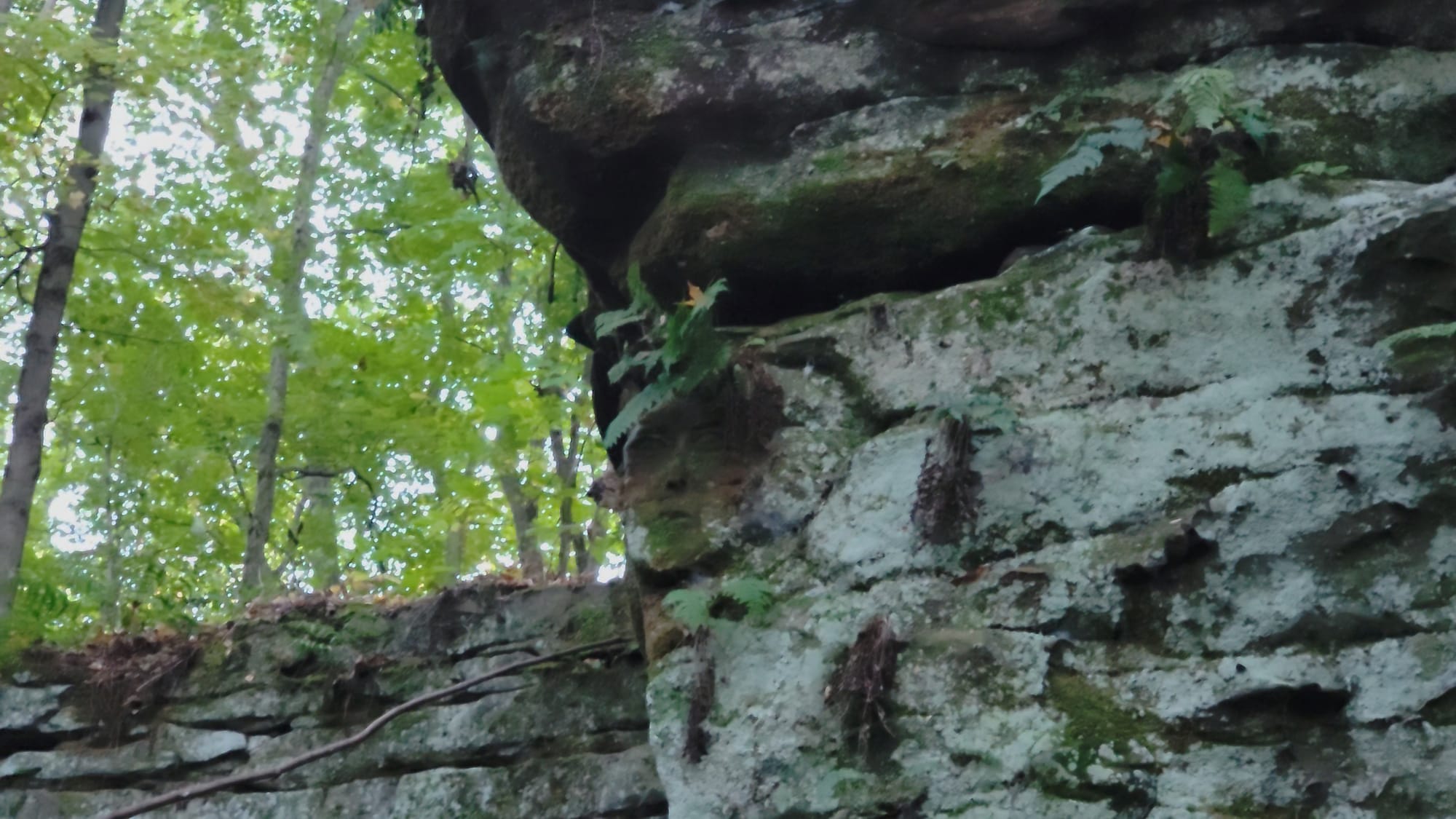
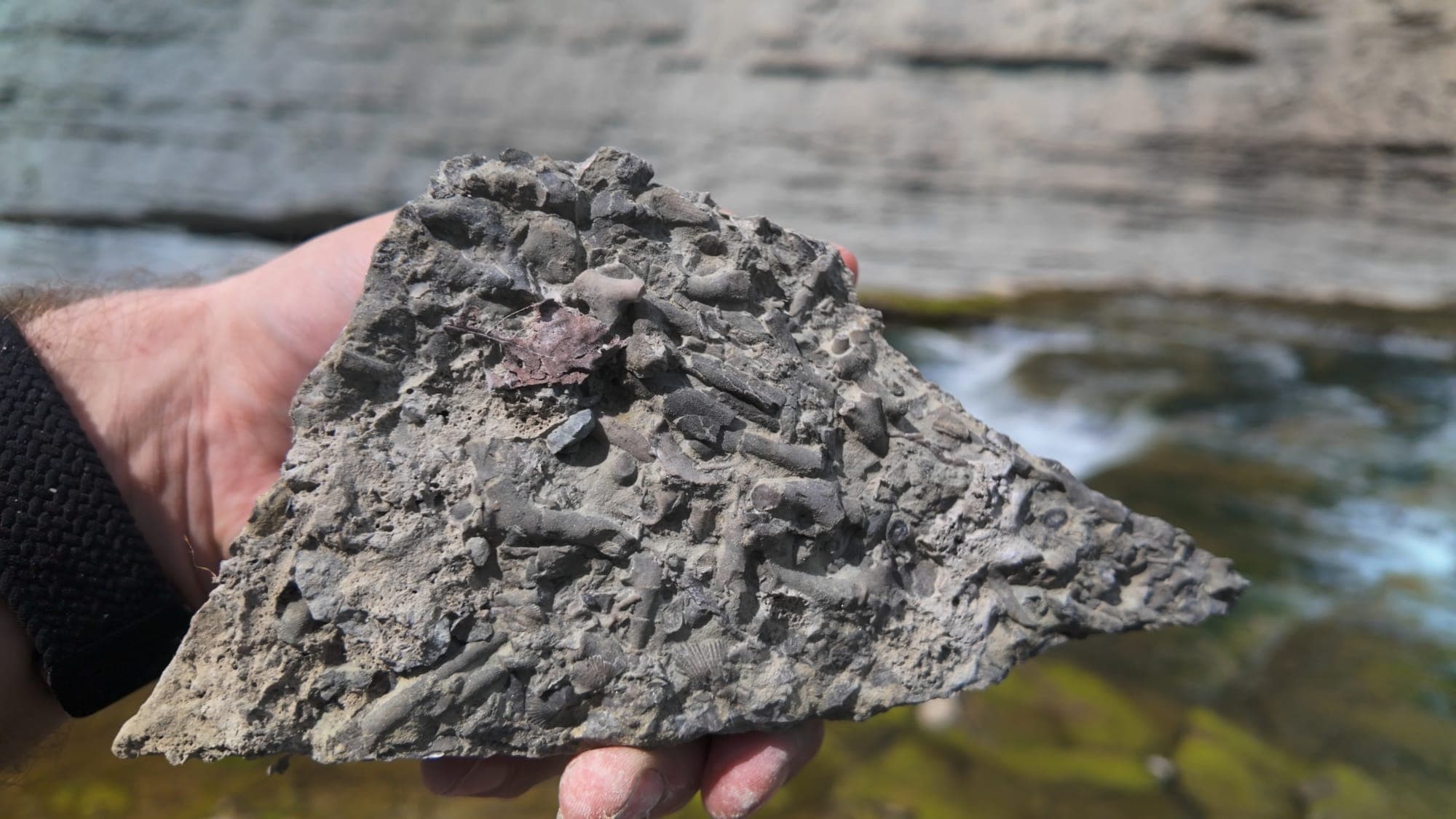
The ledge walls that Noble Stuart spent two and a half years carving into are made of Sharon conglomerate, a sandstone formation that dates to the Pennsylvanian period, roughly 310 million years ago. At that time, shallow braided rivers were depositing sand and gravel across a landscape that sat near the equator — draining toward an inland sea that covered what is now central Ohio. As those rivers slowed approaching the sea, they dropped their sediment loads in bars and channels, and over hundreds of millions of years those deposits compressed and lithified into the resistant, cliff-forming rock that now defines the landscape of northeast Ohio's reservations and national park.Because the Sharon conglomerate is relatively resistant to weathering, it has formed steep ledges in many locations across the region. It's also — and this is the part that matters for this story — workable with hand tools. Not easy. But possible. Soft enough to carve, hard enough that what you put into it stays.The Hinckley Reservation sits within what Cleveland Metroparks calls the Emerald Necklace, a chain of connected green spaces encircling greater Cleveland. In the context of the park system, Worden's Ledges is a footnote — a short loop off Bellus Road, easy terrain, suitable for families. The kind of trail you'd do in an afternoon and then get lunch. The kind of trail where you might not look closely at the rock walls you're walking past.That would be a mistake.
The Worden Family
The story begins with Hiram Mace Worden, a skilled tombstone and statue artisan who migrated from New York to Hinckley in the early 1840s. In 1851, he married Melissa Bissell, and together they had four children — with their youngest daughter, Nettie, completing the family. Hiram built the family homestead on the property in 1860 and ran the Medina Monumental Company, a monument and tombstone business over in Medina, out of which the family made a comfortable living.The fact that a tombstone carver's land would eventually become the site of one of the more unusual works of folk art in northeast Ohio is the kind of irony that doesn't need pointing out. It's just there.Following Hiram's death in 1896, Nettie assumed sole ownership of the Worden homestead — an enduring legacy that had spanned four generations of the same family on the same land. By the accounts that survive her, Nettie was not a woman with wide ambitions for travel or change. She lived on the property her entire life, in the house her father had built, and her departures from it were apparently rare enough to be notable. When she did leave, it was to go to church. That was basically it.She also, at the age of 80, married a 63-year-old bricklayer from Cleveland named Noble Stuart — which, by all accounts, did not go over smoothly with the people who knew her.
Noble Stuart
Noble Stuart married into the family in the 1940s, much to the purported chagrin of those around them. He had come to the Cleveland area for work — bricklaying — and purchased a small parcel of land near the Worden homestead. That's where he met Nettie. The courtship was short. Stuart was the third husband of Hiram Worden's daughter Nettie and the last family occupant of the property.He was also, for his entire adult life, an aspiring sculptor who had never had the material or the circumstances to become one.Nettie died in 1945, a year after the marriage. She left the homestead and its land to Noble.On the property, beyond the fields, were sandstone ledges the Worden family had used for generations as a place for picnics, recreation, and quiet reflection. Noble Stuart walked out to those ledges sometime in 1945, after his wife died, with a hammer and a set of chisels, and he started carving.He worked for approximately two and a half years. Between 1945 and 1948, he produced nine carvings into the ledge walls and three freestanding sculptures near the homestead. Then he stopped. He lived until 1976 — thirty years after Nettie died — and he never produced another carved work.
What He Made
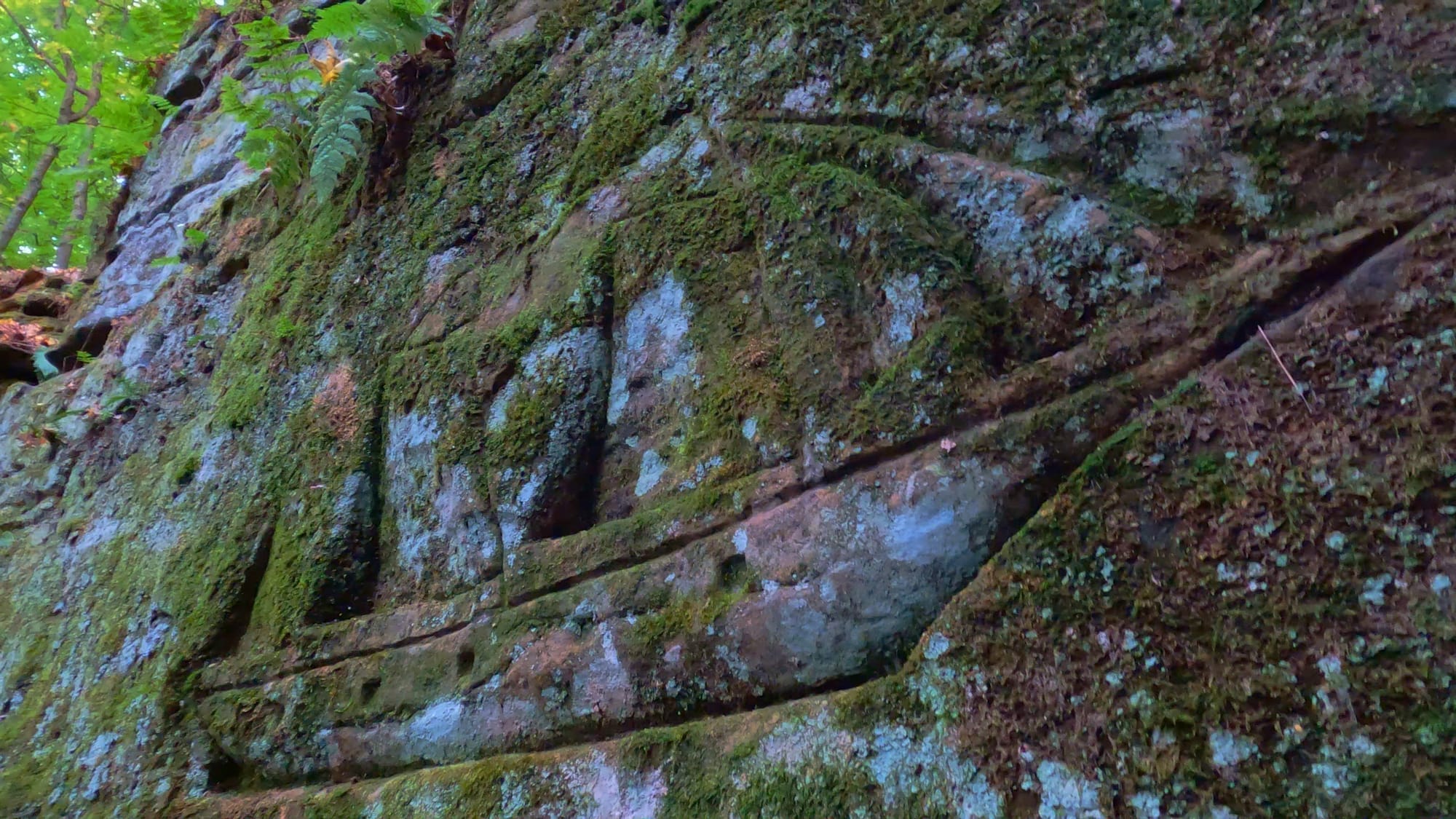
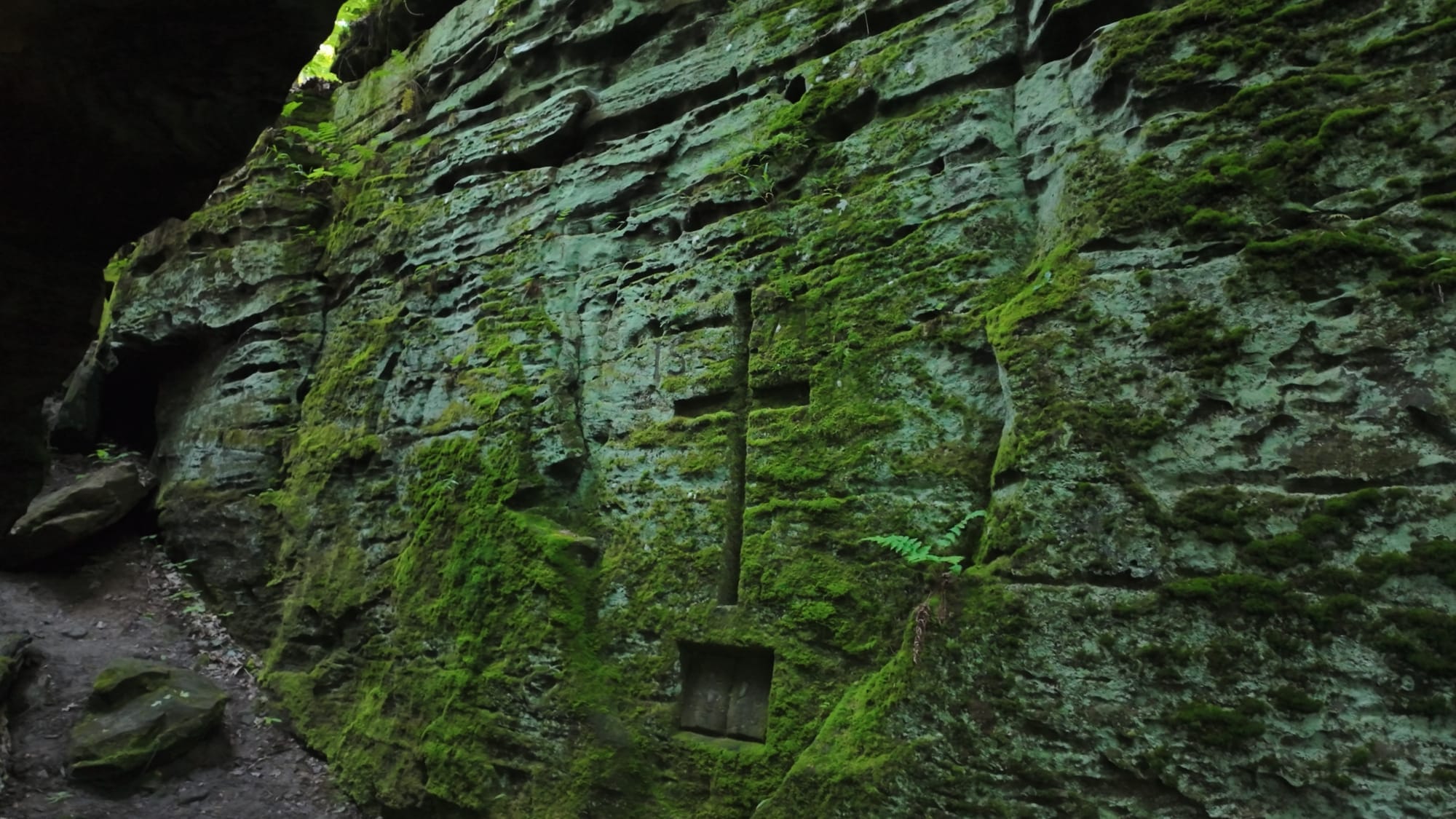
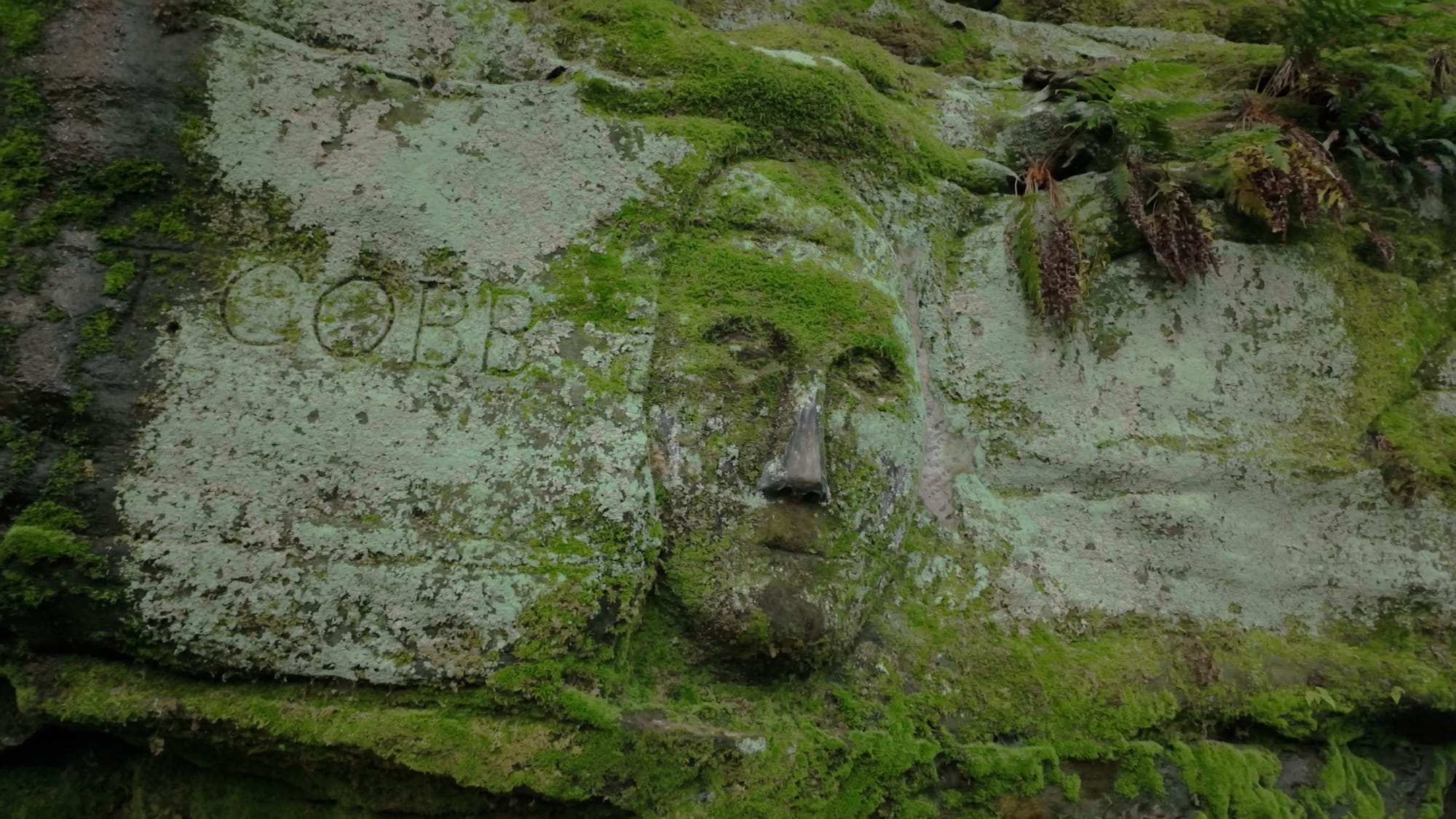
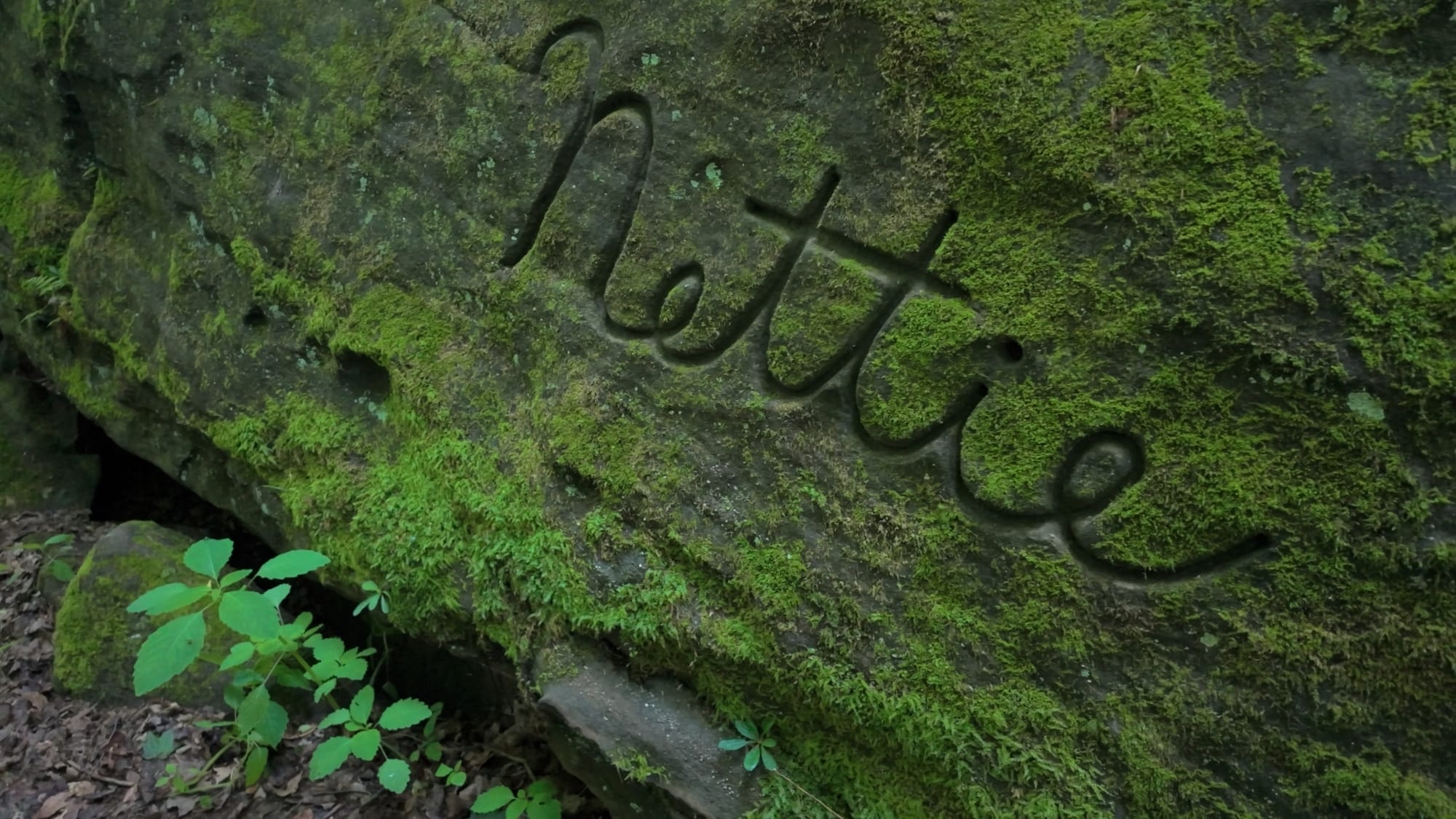
The carvings don't announce themselves. That's part of what makes the trail genuinely interesting rather than just historically notable — you're not walking up to a monument or an installation. You're walking through a forest, and things keep appearing. High on a wall. Low near the ground. Around a corner where you weren't expecting anything.The three-masted schooner is generally considered the most technically accomplished carving on the ledges, though time has been less kind to it than to some of the others. Its location and style have left it more weathered than most, thickly covered in moss and lichen that blur the detail at a glance. Look closely and it's still there: the rigging, the hull lines, the full profile of the ship rendered in bas-relief on a sandstone wall with a level of detail that's hard to account for given that Stuart was a bricklayer working with hand tools on the face of a rock. His father had a connection to the sea — the ship was his.The cross and the open Bible are near each other on the ledge wall. Nettie had spent her life going to church and almost nowhere else. Those were hers.George Washington and Thomas Jefferson appear as faces in the cliff. One of them is carved high enough on the wall — easily twenty feet up — that it's entirely possible to walk this trail multiple times and never spot it. Worth scanning upward as you go.The face of Hiram Worden himself is carved into the ledge wall — the original owner of the land, rendered in the stone of the property he'd bought a century earlier. His daughter's husband put him there. It's not a gesture that requires much interpretation.The three freestanding sculptures near the homestead site include a Native American armed with a tomahawk, Christ on a crucifix, and a rendering of Romulus and Remus — the mythological founders of Rome. No particular theme connects those three except that they were, apparently, things Noble Stuart had in his head that needed to get out.And then there's Ty Cobb.The face of Ty Cobb — the Georgia Peach, the Detroit Tigers outfielder widely considered one of the greatest and most difficult baseball players in the history of the sport — is carved into the sandstone at Worden's Ledges, right alongside the founders of Rome and a sphinx. Cobb was still alive when Stuart was carving; he wouldn't die until 1961. Whether Stuart was simply a fan or had some other connection to Cobb, no surviving record says. The carving is there. There's no explanation for it.And near the ground, close enough that you might walk straight past it without stopping:Nettie.Just the name, carved into the rock of the land she never left.
The Long Misattribution
For decades after the carvings were discovered by visitors to the reservation, the working assumption was that they dated from the 19th century. They looked that old. The weathering, the style, the patina that had developed on the sandstone — all of it suggested something much earlier than the 1940s. It was originally believed that Frank Worden, Hiram's son, had created the stone figures. However, they were later revealed to be the work of Noble Stuart, Worden's son-in-law, confirmed by descendants of the family.That confirmation matters beyond simple attribution. The carvings are from 1945 to 1948 — a grief period, two and a half years of sustained, deliberate work by a man who had just buried his wife — and they read completely differently knowing that. A 19th-century carving in sandstone is one kind of thing: folk art, local history, something old and interesting. A bricklayer spending two and a half years carving his dead wife's name and the things she cared about into the rock she'd spent her life walking past is something else.Nature has not just coexisted with Stuart's carvings — it has actively embraced them, growing around and over the figures in ways that blur the line between sculpture and living landscape. Eighty years of moss and lichen and weather have softened everything. The carvings look older than they are, and given what Stuart was working through when he made them, that seems about right.
The Homestead
The original Worden homestead, constructed by Hiram Worden in 1860, was acquired by the Hinckley Historical Society around 1988 and was extensively restored and renovated to serve as an open-air museum illustrating mid- to late-19th century regional pioneer life. The Society developed programming including demonstrations of crafts and domestic activities like candle-making to develop visitor interest and support, and maintained the antique domestic and agricultural equipment furnishings of the house and outbuildings. The original rope bed belonging to Hiram Worden, dating to around 1842, was still there. The hardwood floors were original. The windows still had the wavy glass of period construction.When the Hinckley Historical Society could no longer support the upkeep of the property, it was acquired by Cleveland Metroparks, and the Historical Society began transitioning off the property in 2014. There was a community effort to preserve the homestead building. It didn't succeed. The house was demolished in 2017.The carvings in the rock are still there, which is more than can be said for almost everything else Noble Stuart touched during his time on that land.
Visiting
Worden's Ledges is in the Hinckley Reservation, part of the Cleveland Metroparks system, accessible from the trailhead on Bellus Road in Hinckley Township — about thirty miles south of Cleveland and roughly a half-hour from Akron. Admission is free, and the reservation is open year-round.The Worden's Ledges Loop Trail is 0.7 miles of relatively easy terrain. At the start of the loop, bear left — the sphinx tends to be the first carving most people encounter coming from that direction, and arriving at it cold, without having seen it in a photo, is worth preserving if you can.A few things to know before you go:Look up. Some of the carved faces are significantly higher on the ledge walls than eye level, and the Washington carving especially is easy to miss unless you're actively scanning. The carvings have also had eight decades of weathering, so the contrast between the carved surface and the surrounding rock can be subtle in certain light — overcast days tend to show the detail more clearly than direct sun.Look down, too. The Nettie carving is near the ground. It's the one most people walk past.The three freestanding sculptures near the former homestead site are separate from the ledge trail loop, so check the Metroparks trail map before you go to make sure you see all of them rather than just the wall carvings.The rest of the Hinckley Reservation is worth your time. Hinckley Lake is the centerpiece of the reservation, and the area has a separate, entirely unrelated piece of folklore: every year on March 15th, buzzards return to roost at the Hinckley ledges — a migration that's been observed and documented since the mid-19th century, and that has given rise to an annual Buzzard Sunday celebration the town takes genuinely seriously. It's a different kind of strange from the sphinx in the woods, but it fits the general character of Hinckley.
🥾
Gear for the Trail
The boots, layers, and daypack worth having before you hit the trail
Affiliate links • Helps fund my adventures at no extra cost to you
What Remains
Noble Stuart was a bricklayer who spent thirty years outliving the one sustained creative act of his life. He didn't sign the carvings. There is no plaque with his name at the trailhead. For decades, most people who found the carvings assumed someone else had made them, a century earlier, and they were not entirely wrong about the way they felt — because Stuart had used the oldest material available to him and put into it the things a man puts into things when he's working out of grief and has nothing to lose by being sincere.The sphinx is still the thing that stops people on the trail. But the name near the ground is the one that stays with you.Ohio Hidden Corners is an ongoing series covering the overlooked, the odd, and the genuinely worth finding in northeast Ohio. Episode 2 covers Worden's Ledges in full — watch it below.
Next up: Leetonia, Ohio. Two hundred industrial coke ovens built in 1866, ran day and night for decades, went cold during the Depression, and then sat there — untouched — for fifty years.