Most people who hike to Henry Church Jr. Rock in the South Chagrin Reservation take a photo, maybe read the interpretive sign, and head back the way they came. That's a reasonable response to a boulder with a substantial bas-relief carved into it. What's less reasonable is that most of those same people walk around to the river-facing side of the rock, glance at the rougher carvings there, and leave without knowing that those two sides of the same boulder tell entirely different stories — about entirely different things — by the same obsessive, self-taught, spiritualist blacksmith who spent years out here after dark, working by lantern, and preaching sermons to the dead.That's the story. Here's the longer version.
A Blacksmith in Chagrin Falls
Henry Church Jr. was born in Chagrin Falls in 1836, the son of one of the settlement's founders — one of the first non-Native children born there, in a place that at the time was barely a cleared patch of wilderness on the Western Reserve. His father was a blacksmith. His uncles were blacksmiths. He was apprenticed in the shop at thirteen and spent the next several decades doing the work, eventually opening his own shop in the village.He was also, by every account that survives, one of the stranger people Chagrin Falls ever produced.As a child, Church was considered too sickly for school, which left him largely unsupervised in the forests around the settlement. He developed, in those years, an unusual familiarity with the natural world and a deep interest in the Native American history of the land he was wandering through — land that had been Iroquois territory within living memory of the adults around him. That early solitude seems to have set a template. Church was a man who went off on his own and made things, and who did not particularly require anyone else's understanding or approval to keep doing it.By the time he was an adult, the output was difficult to keep up with. He painted portraits on commission and carved sculpture from stone, iron, and metal. He played in the village band, maintained the town's Triangle Park, and made the weather vane that still sits atop Chagrin Falls town hall today. He painted portraits of Shakespeare and Lincoln in charcoal, oil, and crayon, and was commissioned for murals. John D. Rockefeller, who wintered near Cleveland, owned some of his paintings. An 1896 profile in the Cleveland Plain Dealer described him as the most interesting man in Chagrin Falls — which, given everything else in the article, was probably accurate.None of it made him much money. He converted the second floor of the smithy into a studio and spent every available hour up there. Eventually he leased the shop out entirely so he could paint and sculpt full time. That didn't make him money either. In 1888 he opened a small personal museum at Geauga Lake, charging ten cents admission. That also did not make him money.What he was not, crucially, was trained. Church didn't encounter another working artist until he was in his thirties, when he made a trip to Cleveland specifically to watch Archibald Willard work. Willard was the man behind The Spirit of '76 — the fifer, the drummer, the flag, one of the most widely reproduced American paintings of the 19th century. That was the only professional artist Henry Church Jr. ever directly observed before going back to Chagrin Falls and continuing to teach himself.He was also a practicing spiritualist, in the fullest sense of the word. Spiritualism in the Victorian era was a formal movement — organized around the belief that the spirits of the dead could be contacted through mediums, séances, and other means — and Church was a genuine participant, not a casual observer. An 1889 article in the Plain Dealer places him at a séance conducted by a traveling clairvoyant named Josiah Francis Baxter, during which the spirit of Church's own father, Henry Sr., was reportedly summoned and communicated with the group. He kept attending séances after that, and his spiritualism eventually became less a personal belief than a working framework — the lens through which he understood what his art was actually for.Which brings us to the river.
The Work
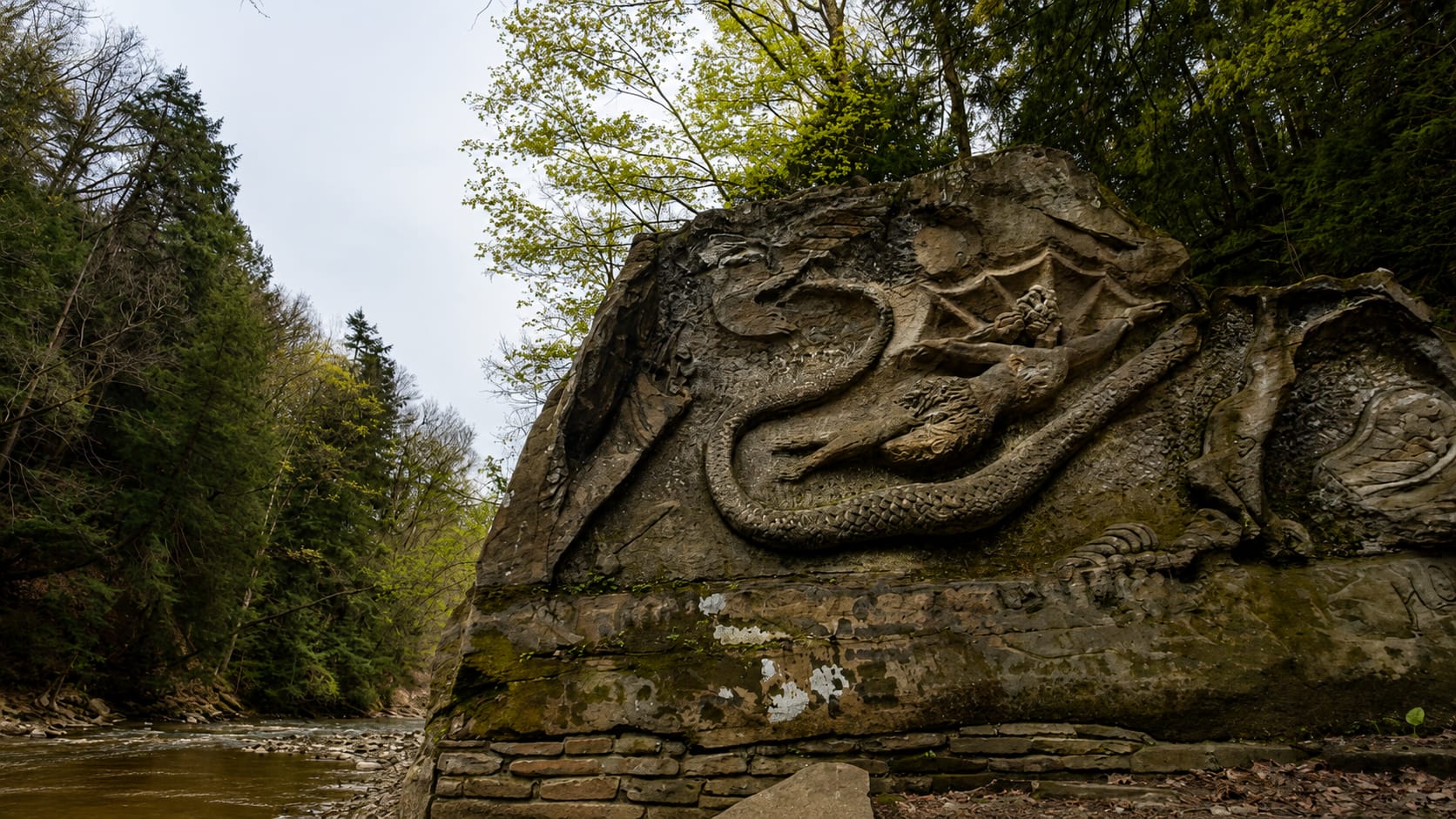
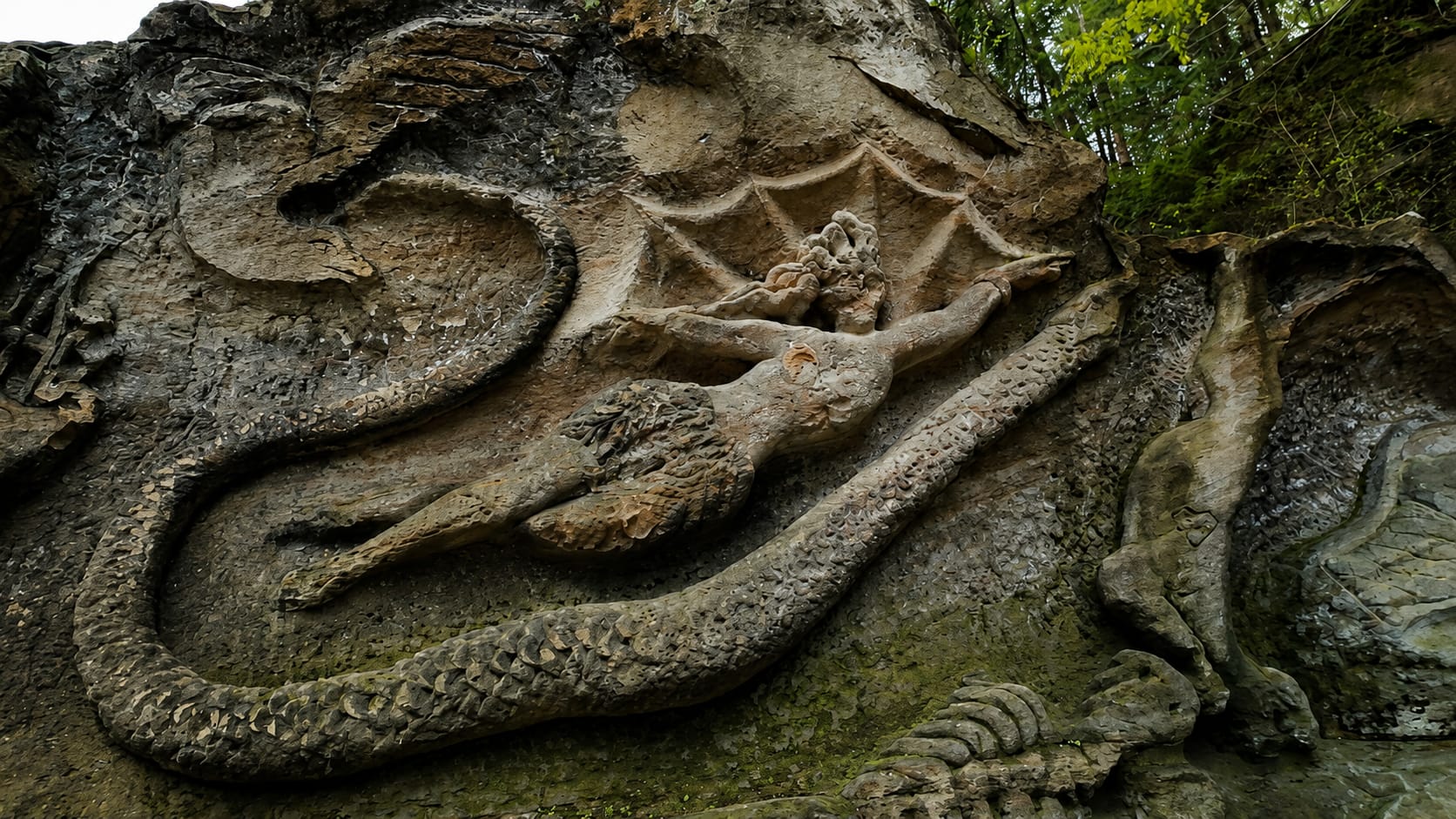
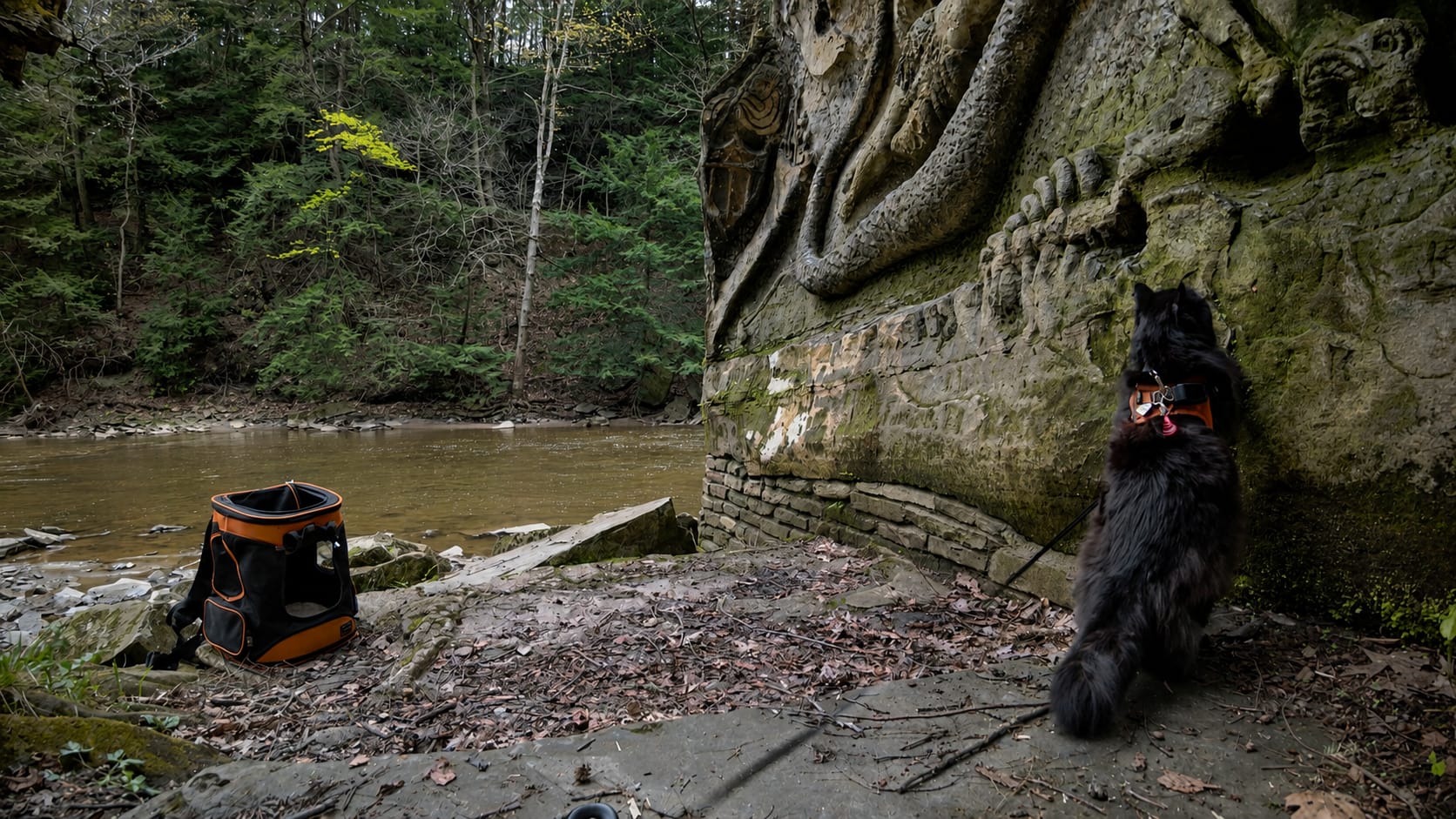
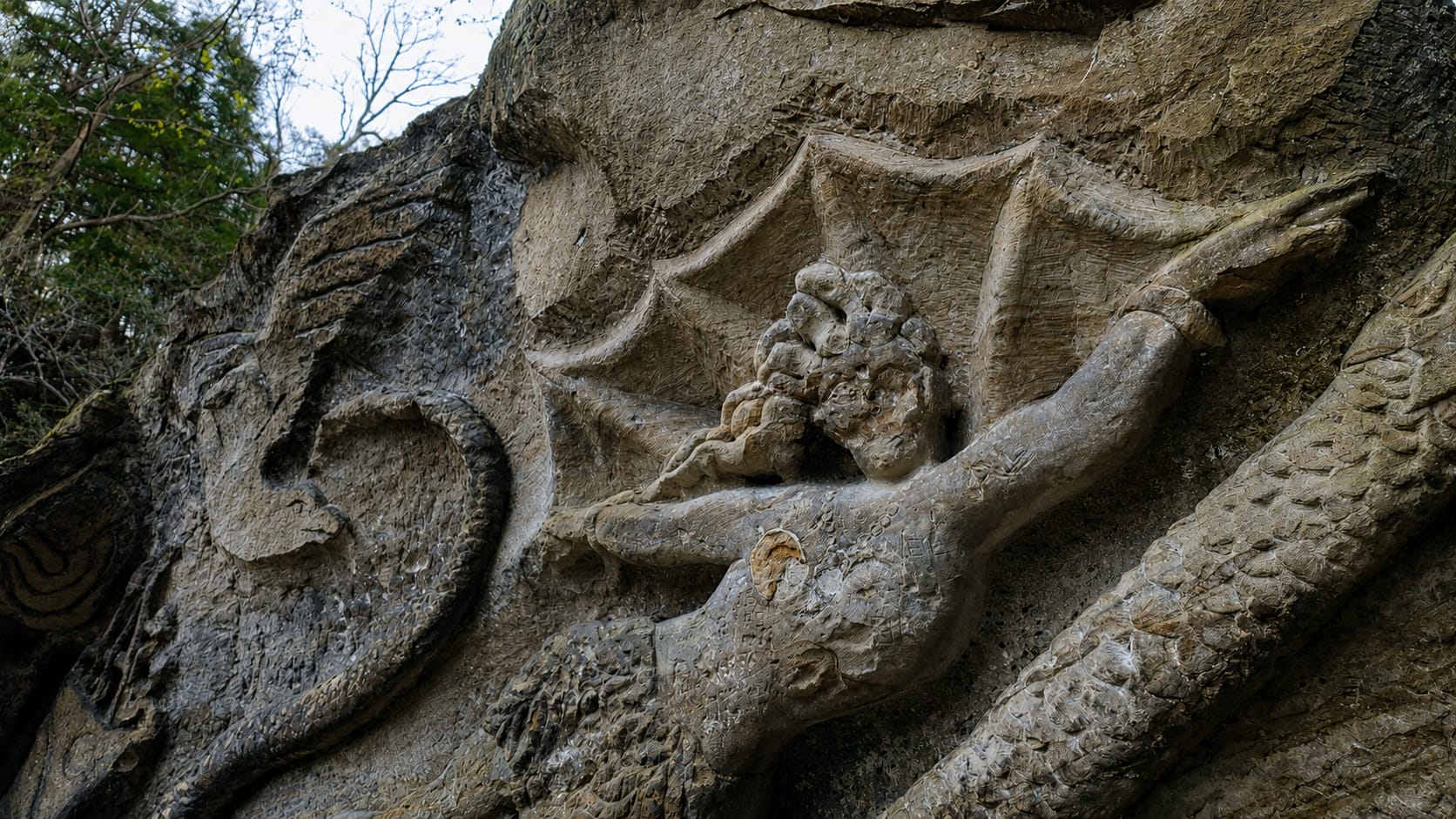
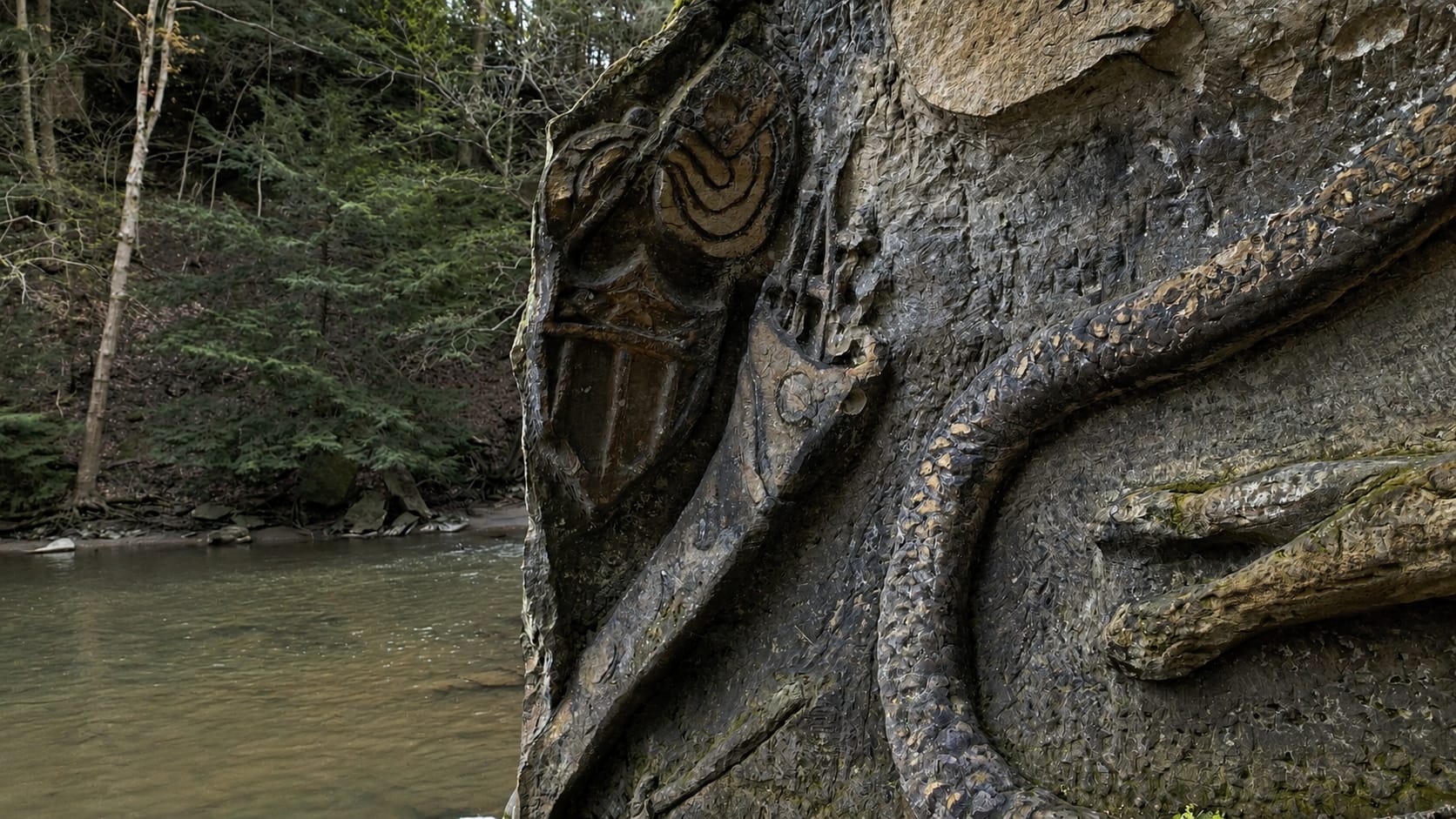
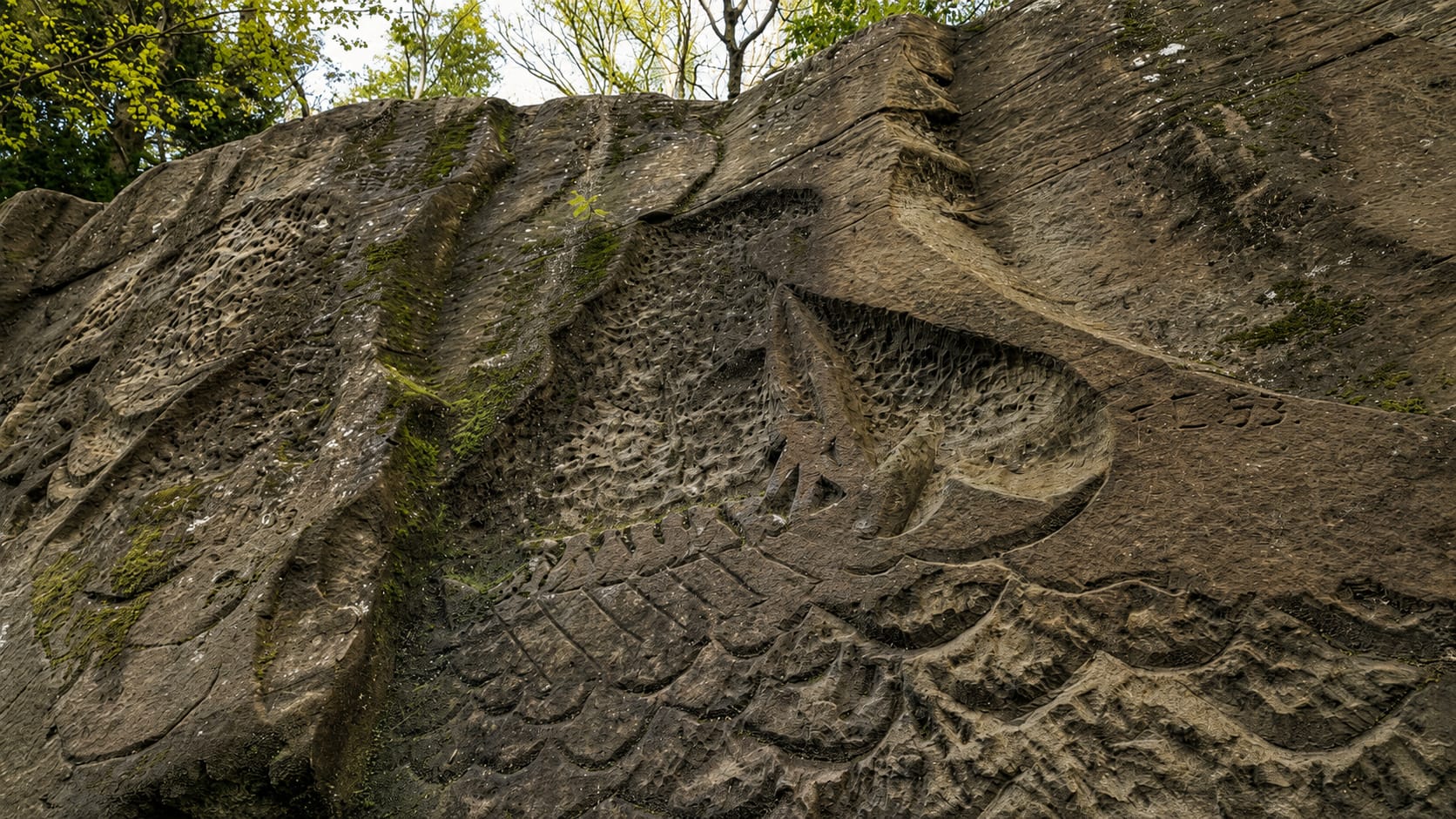
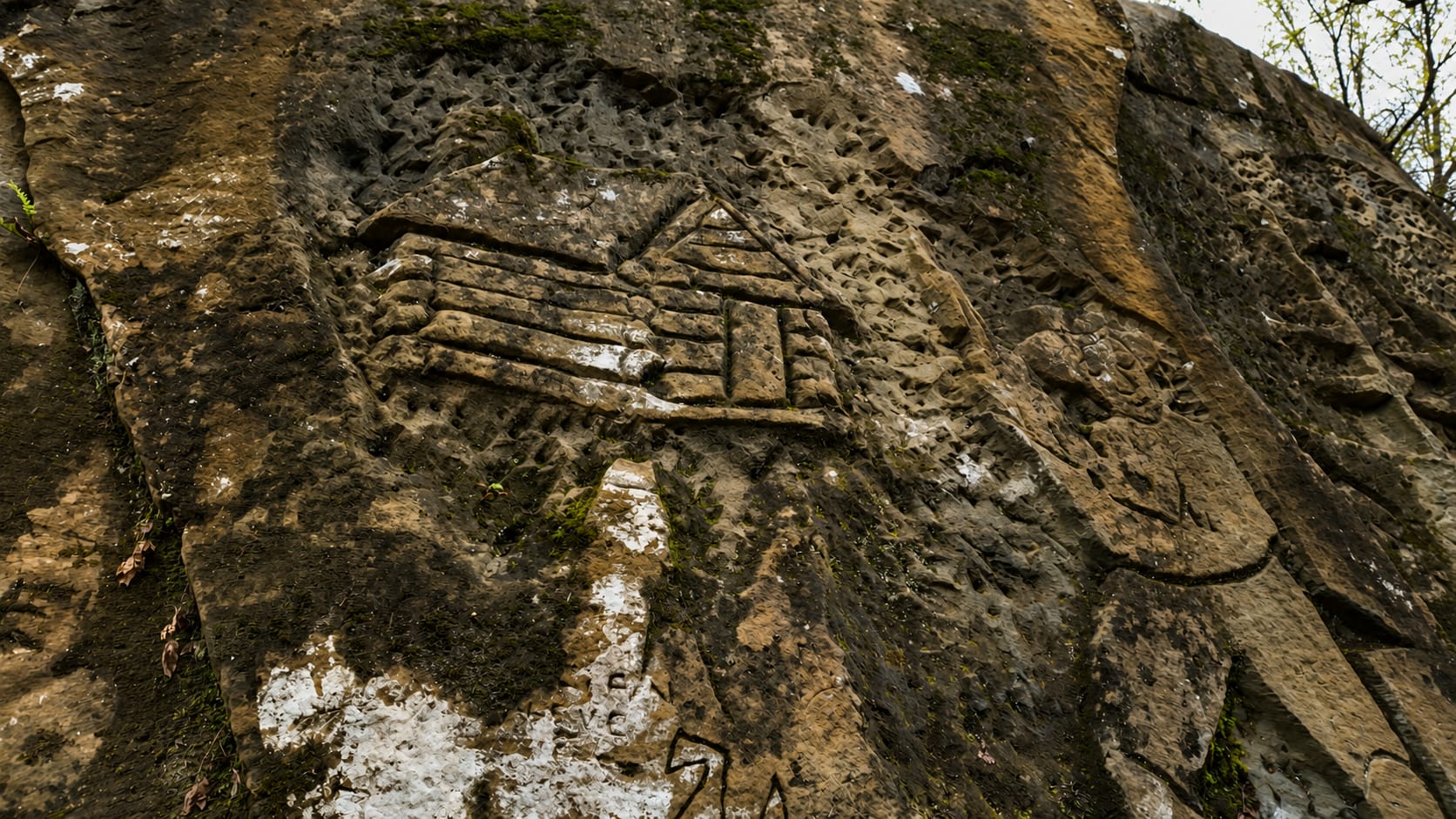
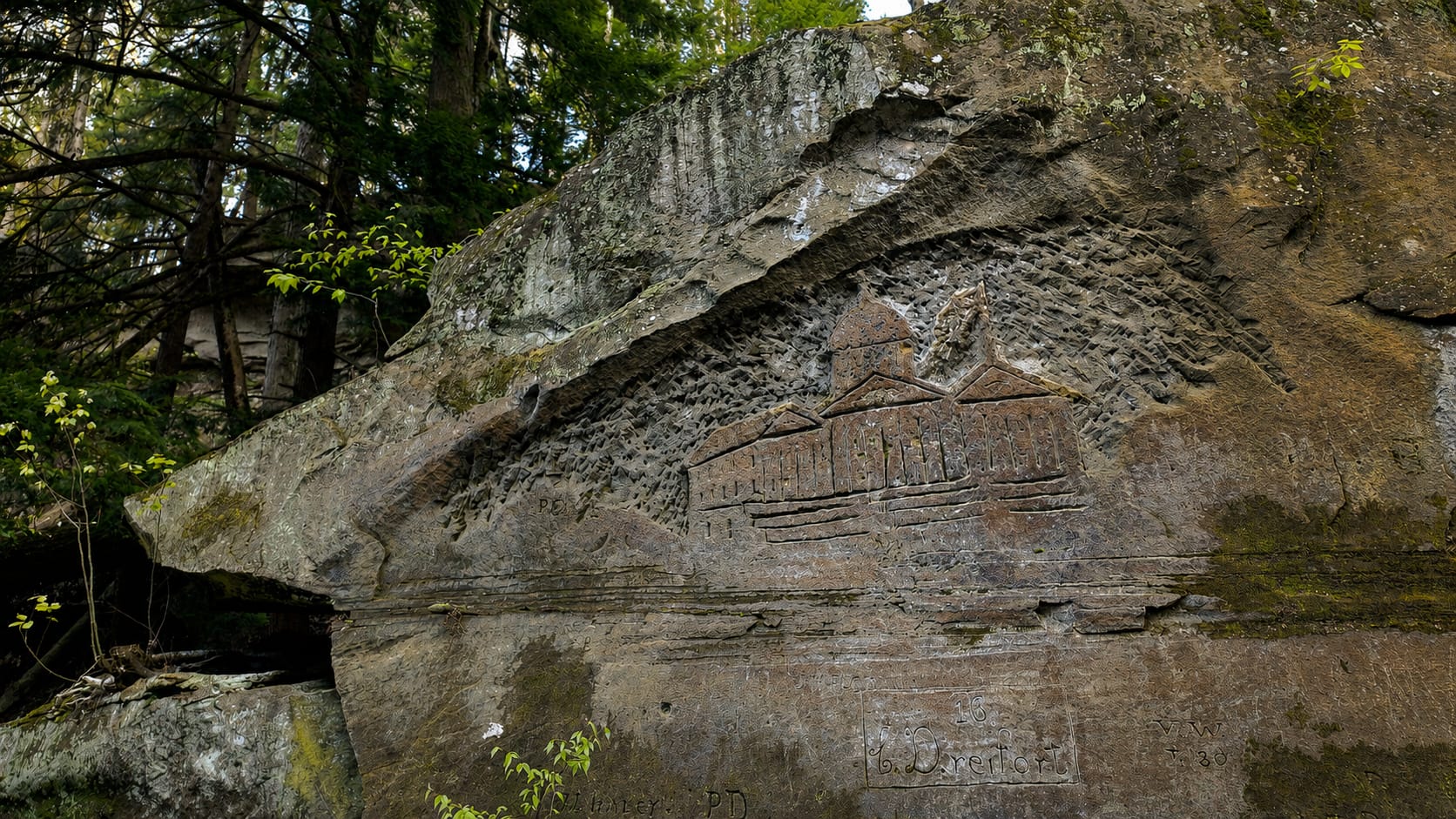
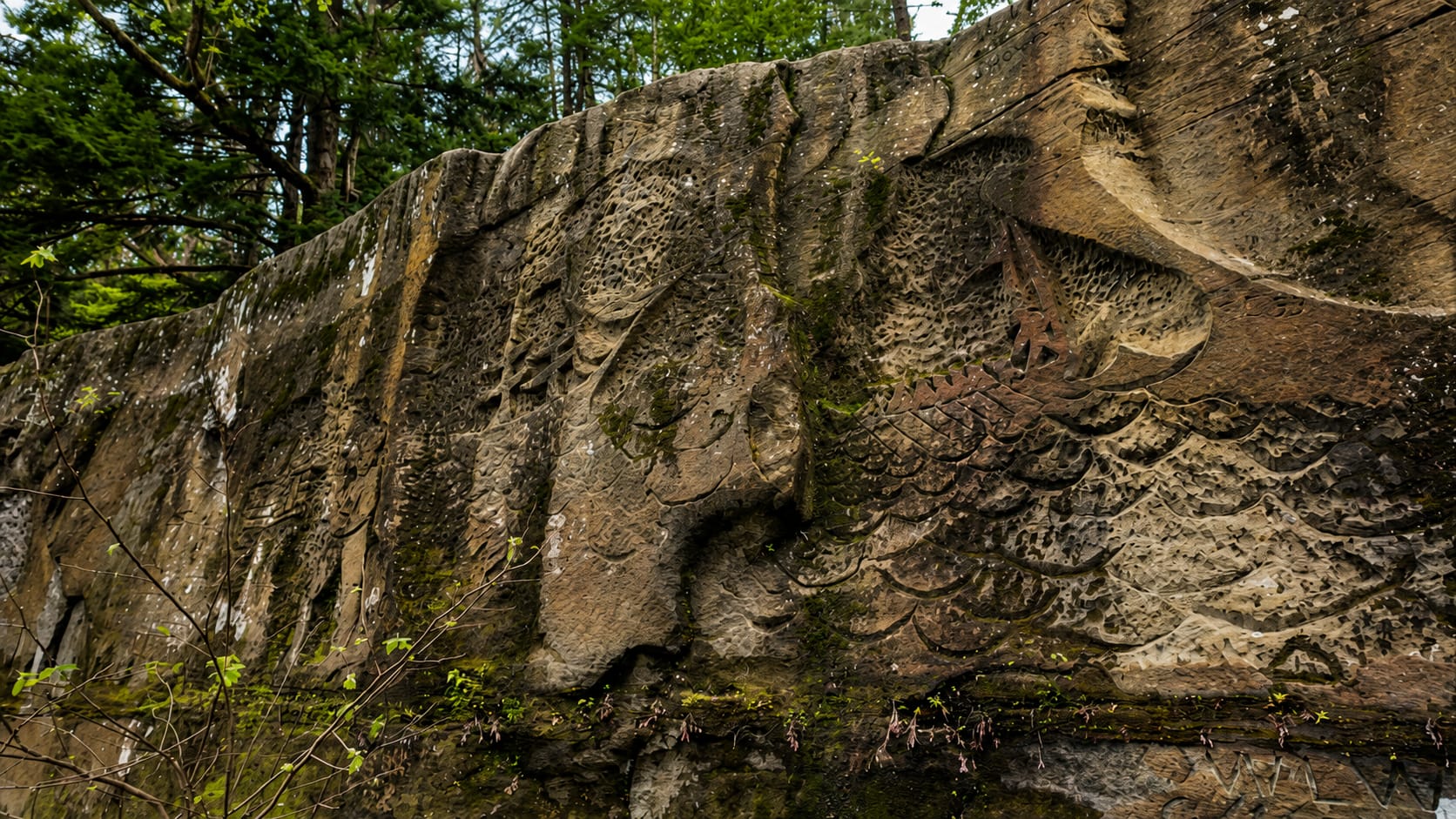
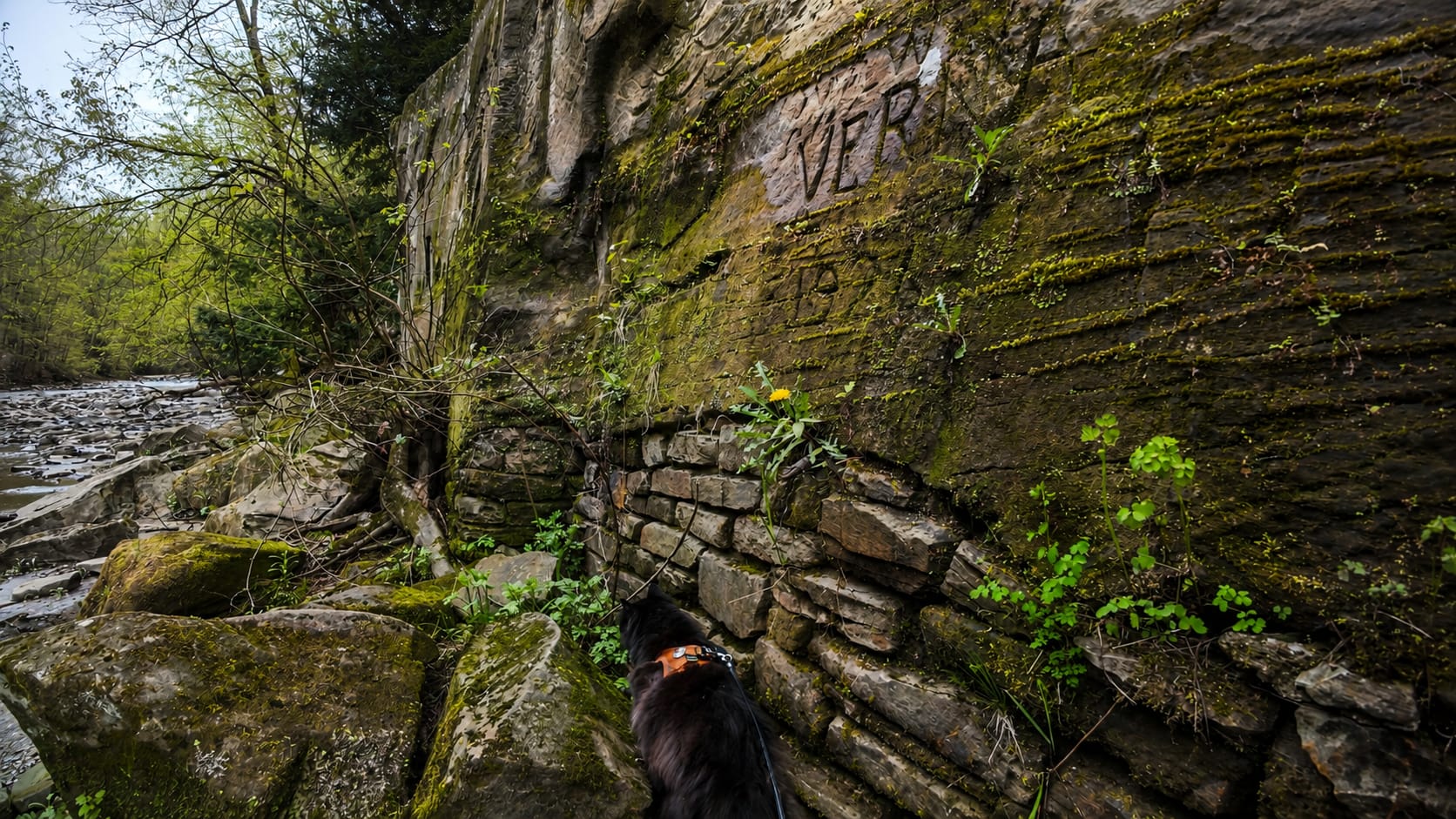
Sometime in the early 1880s, Church identified a massive sandstone boulder on the western bank of the Chagrin River, about two miles from his home and shop, and began making the walk out there after his work day was done — hammer, chisels, and a lantern. He carved in the dark and walked back. He did this for years.The finished carving, completed in 1885, is substantial — a boulder large enough that the full composition doesn't register until you're standing back from it. Church gave it a title that left nothing to interpretation: "The Rape of the Indians by the White Man."The main face of the rock is crowded with figures. At the center is a life-sized Native American woman, nude, coiled around by a ten-foot snake. Church's intent for the central image was explicit — the woman represented the Indigenous tribes, the snake represented the United States government. Surrounding them: a child in a cradle, a human skeleton, an eagle with spread wings, a mountain lion, a tomahawk, a shield, and a quiver of arrows into which Church carved the four phases of the moon. The overall composition was interpreted by some contemporaries as a condemnation of federal Indian policy and by others as a broader allegory of American civilization. Church seems to have been fine with the ambiguity. What he was not ambiguous about was the title.The quality of the work is genuinely surprising. Sandstone is workable but unforgiving — it won't allow corrections the way softer materials might. The snake's scales, the feather detail on the eagle, the facial features of the central figure — these are the product of someone who had mastered working in the medium through sheer accumulated hours. Church had no formal training, no mentor, and was doing this by lantern light in the small hours. The result is classified today as American folk art, which is an accurate description but undersells the technical ambition.And then there's the other side of the rock.On the river-facing face, the subject changes completely. A woodsman felling a tree. A log cabin. And farther along, a rendering of the United States Capitol Building in Washington. The imagery is widely interpreted as tracing the life of Abraham Lincoln — born in a Kentucky log cabin, raised in frontier poverty, ultimately ascending to the presidency.Church left this side unfinished. The carving quality is rougher, more tentative; you can see where the work stopped. Whether that incompleteness was deliberate — a comment on Lincoln's own unfinished story, cut short by assassination — or simply the result of Church running out of time, no one knows. Church never explained it.There's also a smaller Native American figure carved on the south face of the rock that most visitors never notice at all.One other detail that rarely makes the official write-ups: Church built a small pulpit on the riverbank near the rock and preached sermons there — addressed, in keeping with his spiritualist beliefs, to the spirits of the displaced Indigenous people the carving was about. He was out here in the dark, by himself, carving political art nobody asked for, and preaching to the dead. That is the full picture of what was happening on this riverbank in the 1880s.
What Happened After
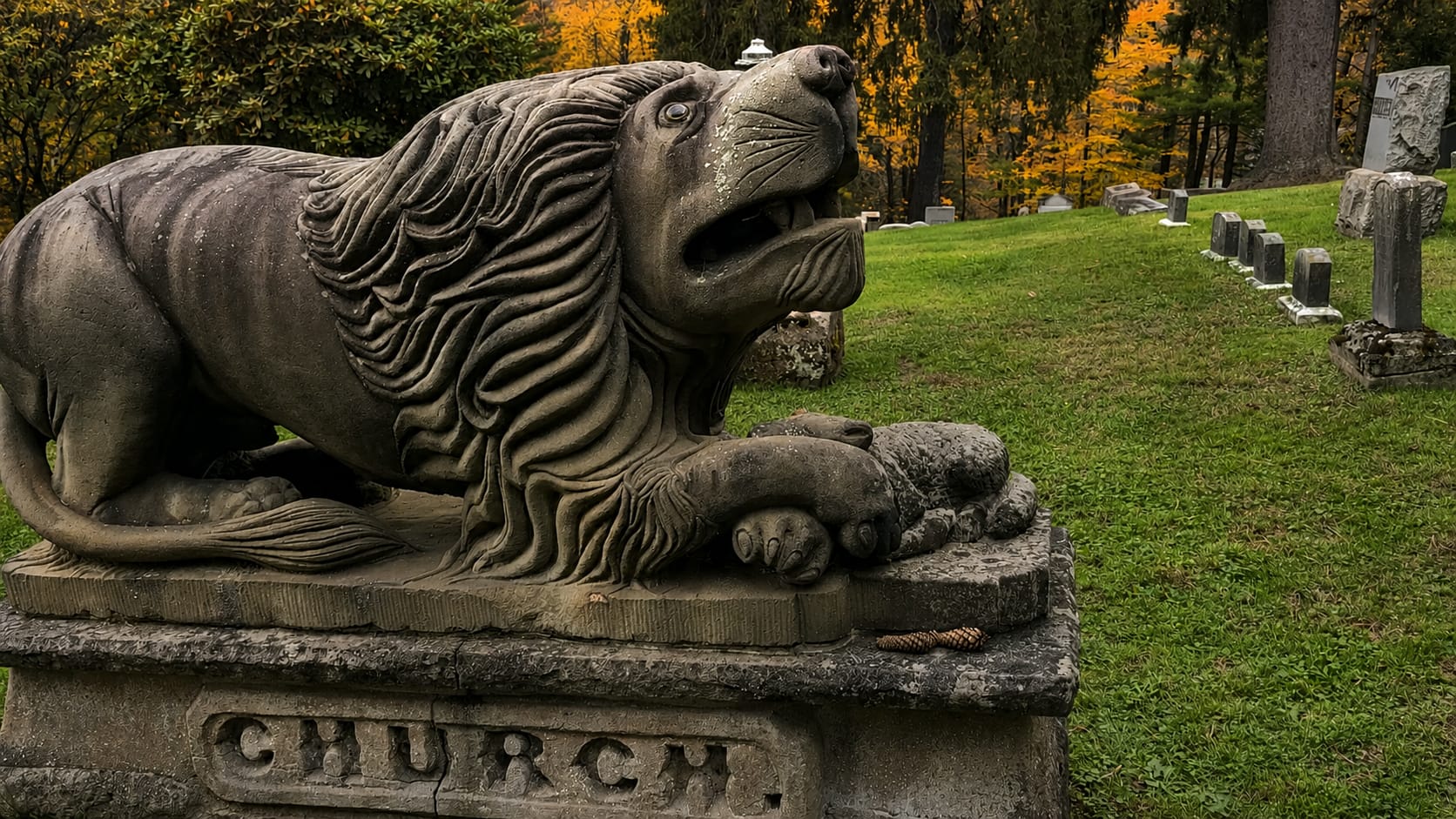
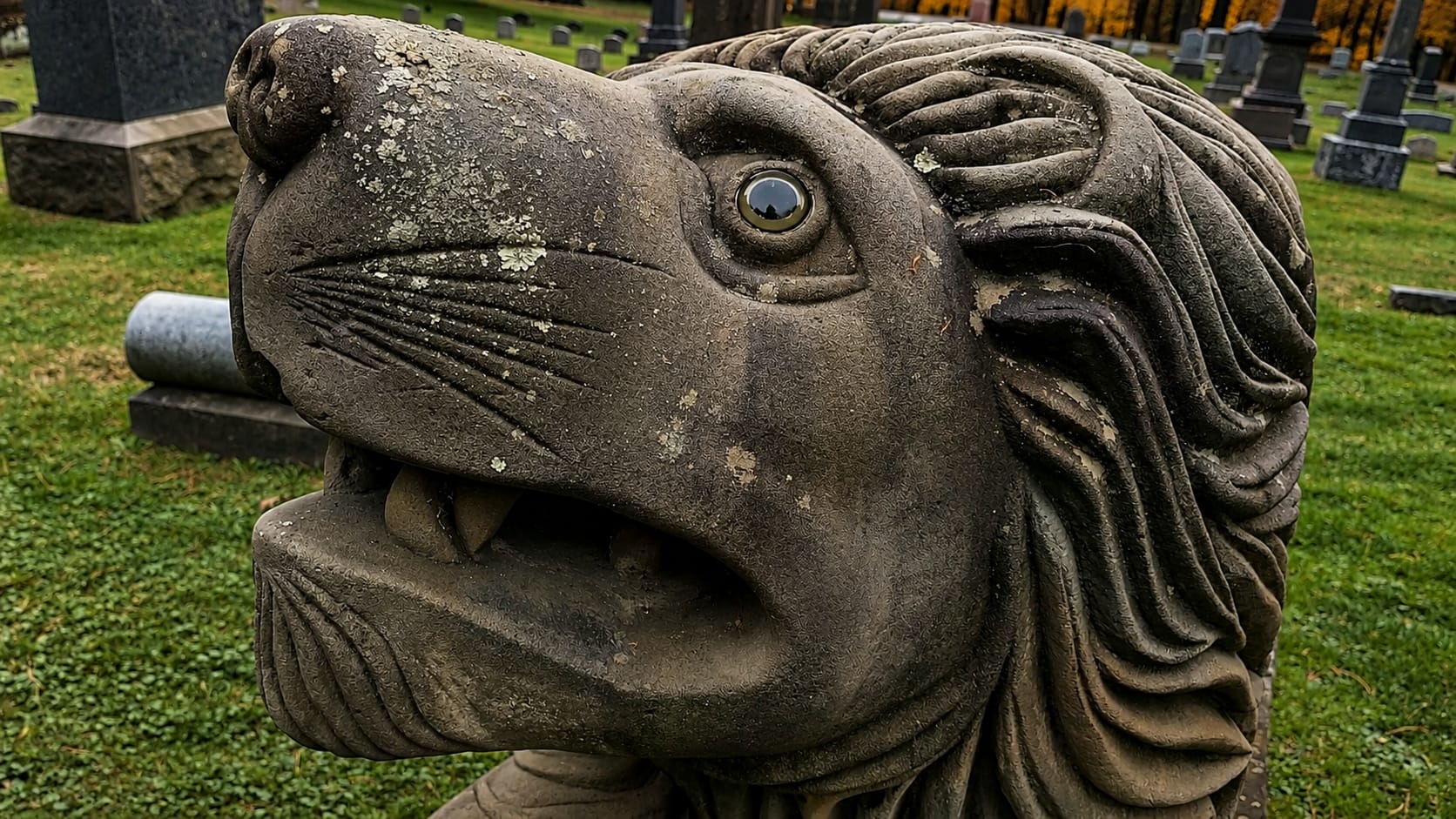
Church finished the rock in 1885 and kept making art for the remaining twenty-three years of his life. He never became well known. Most of his paintings were destroyed by his daughter after his death in 1908 — a loss that's difficult to fully assess, since what survives suggests he was operating at a level well beyond what "folk artist" typically implies.The Monkey Picture, an oil-on-paper work from around 1895 to 1900, was sold by his daughter for twelve dollars in the 1930s. It is now in the permanent collection of the Abby Aldrich Rockefeller Folk Art Museum in Williamsburg, Virginia.Before he died, Church carved his own tombstone — a stone lion, taken from Isaiah 11:6, the lion lying down with the lamb — and it is currently on long-term loan at the Cleveland Museum of Art, displayed in their courtyard. He spent his life unable to support himself through his art, and his tombstone ended up in one of the finest art museums in the country. Make of that what you will.The wax cylinder is the detail that tends to stop people. In the years before his death, Church — a man whose entire belief system was organized around the idea that death was not a final boundary — pre-recorded his own funeral sermon on a gramophone cylinder. When he died on April 17, 1908, at the age of 72, his recorded voice was played at the service, addressing the mourners directly and thanking them for their kindness toward him during his life.The Plain Dealer obituary eulogized him as an artist by impulse and a blacksmith by necessity. It's a good line. It's also slightly wrong, or at least incomplete — Church was a man who believed with genuine conviction that the dead were still listening, and who arranged his affairs accordingly. The wax cylinder was less a novelty than a logical extension of everything else he'd done. He'd spent years talking to spirits on a riverbank. He wasn't going to let a thing like dying stop the conversation.
The Name
For over a century, this site was known as Squaw Rock. The word "squaw" derives from an Algonquian term that was corrupted into a slur through generations of colonial misuse; as of the most recent federal count, it still appears in more than 750 place names across the United States, though approximately 167 have been officially renamed in recent decades. Cleveland Metroparks renamed the site Henry Church Jr. Rock and updated the signage. The renaming matters both in the obvious sense and in the specific one — the artist's name is now attached to his work, which seems like the minimum owed to a man who spent years making something in the dark.
Visiting
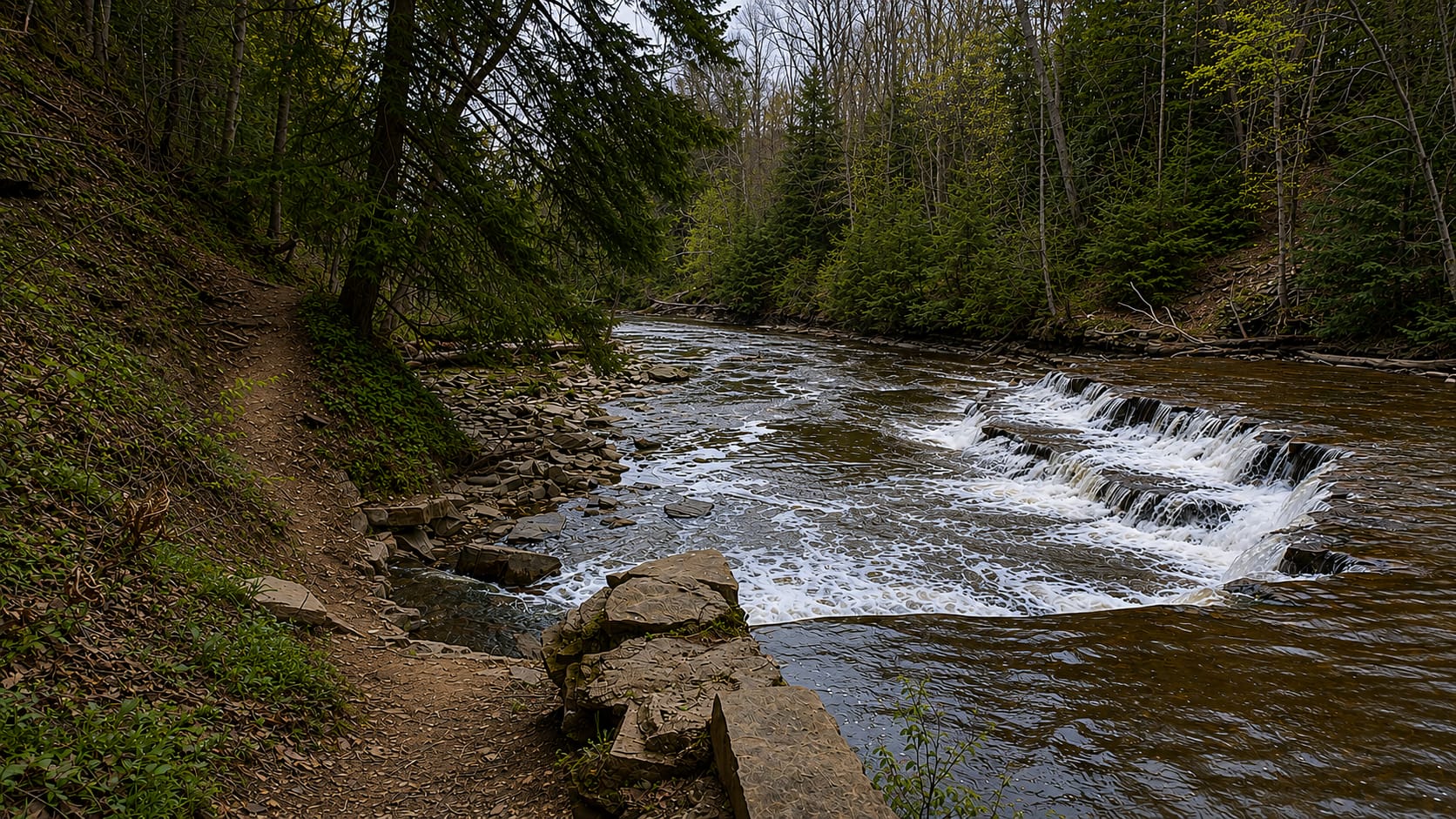
Henry Church Jr. Rock is in the South Chagrin Reservation, part of the Cleveland Metroparks system, in Bentleyville — roughly half an hour southeast of Cleveland. The trailhead is at the Henry Church Jr. Picnic Area parking lot, and the walk to the rock is just under a mile out and back with minimal elevation change.The Chagrin River runs alongside most of the trail, and the Metroparks system has designated it an Ohio Scenic River, which it earns. The path is heavily shaded by Eastern hemlock and crosses a pair of stone arch bridges that are worth a stop before you get to the main attraction.Before you reach the rock, a short spur branches off to Double Decker Falls — a two-tier waterfall that spans the full width of the river. It's a brief detour and worth taking, particularly after any rain.A few practical notes:The carvings have been weathering since 1885 and have sustained some vandalism damage over the years. A preservation committee has worked with the Intermuseum Conservation Association to assess the sculpture's condition, and state funding has been allocated toward restoration work. The sandstone looks solid but is more fragile than it appears. Don't touch the carvings.Afternoon light is significantly better than midday for seeing the detail work. The bas-relief depends on shadow to read clearly, and flat midday light flattens it considerably.The river-facing side of the rock requires walking around the full perimeter — it's not visible from the front approach, and it's not signed in a way that makes it obvious there's anything back there. Go around.The rest of the South Chagrin Reservation is worth your time while you're out there. Look About Lodge, built in 1938 from more than 300 chestnut logs, now operates as an outdoor education center. Quarry Rock offers good views of the river from above. The reservation is open daily from 6 AM to 11 PM.
🥾
Gear for the Trail
The boots, layers, and daypack worth having before you hit the trail
Affiliate links • Helps fund my adventures at no extra cost to you
The Longer View
Henry Church Jr. carved a politically charged monument into a sandstone boulder in a northeast Ohio forest in 1885, signed it with a title that was genuinely confrontational by the standards of the era, preached sermons at it in the dark, and then died in relative obscurity with most of his other work destroyed. The rock has been out here for 140 years. Most people who walk past it don't know his name.The Cleveland Metroparks fixed the naming problem. The Abby Aldrich Rockefeller Folk Art Museum, the Chagrin Falls Historical Society, and the Cleveland Museum of Art between them hold what little is left of the physical work. The rest is this — a boulder on a riverbank in Bentleyville that took years to make, still saying the same thing it said in 1885.He was, by the Plain Dealer's assessment, an artist by impulse and a blacksmith by necessity. What the obituary didn't say was that he was also a man who chose a medium that outlasts everything else, placed it somewhere people would have to walk to find it, and made absolutely certain it was impossible to misread. For someone who never achieved recognition in his lifetime, he seems to have thought carefully about what would last.Ohio Hidden Corners is an ongoing series covering the overlooked, the odd, and the genuinely worth finding in northeast Ohio. Episode 1 covers Henry Church Jr. Rock in full — watch it below.
Episode 2: The Hinckley Reservation, where a bricklayer spent two and a half years carving his dead wife's memory into a 300-million-year-old rock face. There's also a sphinx.